How a platform of Kathakali enthusiasts in Kerala is helping artistes battle mental health issues
Following the death of renowned Kathakali artiste Hari R Nair, who had reportedly been battling stress, a group of artistes and enthusiasts is working hard to strengthen a platform they had already floated in December 2025 —Swaira Vachanam, or 'words of solace' — to help those in distress. But will the taboo associated with mental health issues allow artistes to seek help?

On May 23, renowned Kathakali artiste Hari R Nair was found dead at his house in Panjal, a heritage village near Kerala Kalamandalam in Cheruthuruthy town, in Kerala’s Thrissur district. Known for his depictions of epic figures such as Baali, Dussasana, Parasurama and Jarasandha, the 48-year-old teacher at Kerala Kalamandalam was reportedly experiencing some family-related stress. A...
On May 23, renowned Kathakali artiste Hari R Nair was found dead at his house in Panjal, a heritage village near Kerala Kalamandalam in Cheruthuruthy town, in Kerala’s Thrissur district. Known for his depictions of epic figures such as Baali, Dussasana, Parasurama and Jarasandha, the 48-year-old teacher at Kerala Kalamandalam was reportedly experiencing some family-related stress. A purported suicide note was recovered. A week after Nair’s passing, however, his relatives reportedly submitted a petition to the state home minister, requesting an inquiry into the circumstances of the artiste’s death. A police probe is on in the case.
Meanwhile, moved by Nair’s death, a group of Kathakali enthusiasts is working to strengthen a platform they had first launched in December last year, to offer assistance to Kathakali artistes experiencing stress, depression and other mental and physical health issues. Named Swaira Vachanam, or ‘words of solace’, the platform also aims to provide support to families of artistes.
The promoters of Swaira Vachanam claim it to be the first attempt of its kind in the performing arts sector in India.
“I interact with many Kathakali artistes as I have been coordinating shows in different districts across the state. Many experience feelings of insecurity and isolation, without having a platform to voice or share their feelings. They often internalise their problems, which can lead to various mental and physical health issues. Some even resort to alcohol,” says Nisha Menon Chembakassery, the brain behind Swaira Vachanam.
Chembakassery, who has been organising Kathakali performances for over a decade, adds: “We initiated Swaira Vachanam to address these problems. I am happy to say that many artistes have started reaching out to us to discuss their concerns.”
Swaira Vachanam borrows its name from a scene of Nalacharitham, a classic Kathakali play written by Unnayi Warrier. The five-member platform, in addition to Chembakassery, includes Akavoor Santhosh, an Ayurvedic physician at the Arya Vaidya Sala Kottakkal, Kathakali artiste and teacher Kalamandalam (Vaikkom) Prashanth, Aarcha Gowri Varma, a psychiatrist, social sector worker and Kathakali artiste and Sanju Palassery, a medical doctor.
“We do not even turn off our mobile phones at any time and any artiste or any member of their families can reach us at any time. Once we are informed of an issue, a member of the platform, who is closest to the artiste at the time, is designated to communicate with the person in need of assistance. We discuss the matter within the group, ensuring that the person’s name remains undisclosed. We maintain strict confidentiality regarding the identity of the person,” adds Chembakassery.
The assurance of confidentiality is important, since those associated with Swaira Vachanam say fear of stigma often stops artistes from seeking help.
Also read: Why new BJP government in Bengal has brought both hope, apprehension to Bengali film industry
A traditional form of Indian classical dance, which is also believed to be one of the most complex forms of Indian theatre, Kathakali is native to Kerala. Identified by its intricate make-up and large costumes, the expressions and gestures take years of practice to perfect.
Kshama Raja, a Kathakali musician-actor who has been associated with the art form for more than 25 years, recalls her initial struggle to find a master. “I was raised in Chennai [Tamil Nadu], where finding a master to train me in Kathakali proved to be quite a challenge. In 2000, I relocated to Thrippunithura (Ernakulam, Kerala), yet many still consider me an outsider,” says Raja.
Even after years of dedication, success is uncertain.
Raja alleges that in Kathakali, as often in other performing arts, those who once secure opportunities continue to receive more, while others tend to get left behind.
The imbalance is something others also talk about.
RLV Aryadevi Thiyyadi, an artiste specialising in Kathakali and Ayyappan Thiyyattu (another traditional form), is more open when she talks of the influence of groupism and favouritism in Kathakali. “For many artists, Kathakali serves as their sole source of income. A junior artiste earns Rs 1500 for a performance, whereas a senior artist receives Rs 4000 to 5000. The most senior will make Rs 25000 to 30000 for a performance. The payment is contingent upon the artist's fame and influence. Certain clubs favour artistes affiliated with Kerala Kalamandalam. Groupism and favouritism are pervasive. Some artists struggle to navigate these dynamics, leading to stress and depression,” she says.
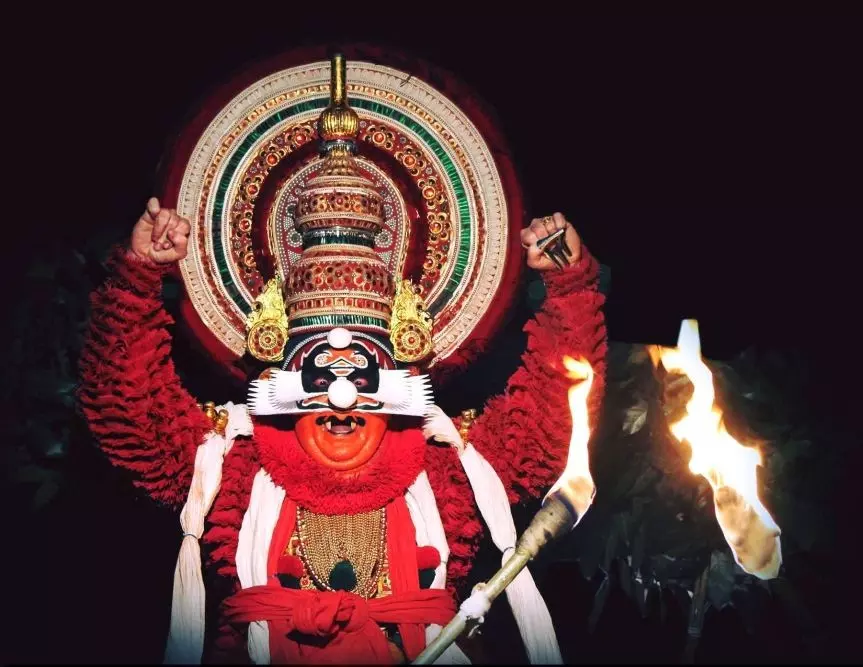
Hari Nair essays the character of Baali on stage. Photo: By special arrangement
While there has been no formal census, those associated with Kathakali claim there are approximately about 850 Kathakali artistes in Kerala, including those who are not currently active, with many relying solely on income made from performances during the festival season, when the demand for artistes is traditionally more. Barring a group of senior and well-established artistes, the majority do not have a stable source of income, they say. While over the years, the dance form has transformed from a rural, temple-focused ritual into a well-defined classical art form that brings in income through international tourism, government funding and events organised by local clubs, not everyone benefits equally from these.
It is something those associated with Swaira Vachanam, too, talk of.
“It is a very unorganised sector. While some manage to cope with these issues, others struggle,” says Akavoor Santhosh, an Ayurvedic physician and member of Swaira Vachanam. It is to these that the platform hopes to provide support”.
But the platform has to battle lack of awareness, deep-seated social mindset and fear of stigma where mental health is concerned, before it can help those in need. Seeking psychiatric help remains a taboo for many artists, including Kathakali performers. Which is why any breakthrough feels special for the Swaira Vachanam members.
“A Kathakali artiste reached out to me shortly after we started strengthening Swaira Vachanam following Hari's tragic passing. He said he was not able to sleep. I spoke to him for nearly an hour. When he mentioned he would call me again, I encouraged him to do so. I assured him that if I were in class, I would return his call. He was happy and said he would never take any extreme step,” recalls Prashanth, a Kathakali artiste, teacher at Chennai’s Kalakshetra Foundation and a Swaira Vachanam member.
Also read: Why in Kerala, World Cup flex wars are reflective of football being a lived experience in the state
Success or finances are not the only source of worry for the artistes. As most live a nomadic existence, moving from performance to performance, distance and friction within the family often act as an added source of tension.
“Most artistes lead an itinerant life, resulting in spending insufficient time with their families. With Kathakali practitioners, the shows often happen after sunset and sometimes are night-long. They stay in various places, often revisit them, at least annually, in the case of temple festivals. Their performances earn them fans. The relationship can lead to extramarital affairs, straining domestic life in the process. Dependency on alcohol is common,” says Sreevalsan Thiyyadi, art writer and a former manager of the Sadanam Kathakali Academy in Pathirapala, near Ottapalam in the Palakkad district of Kerala. Sibi Chakravarthy, a Kathakali artist known for his expertise in both heroic (pacha) and anti-heroic (kathi) roles, agrees. “If your spouse comprehends your challenges, then there are no problems. However, if she does not, it can become difficult. I chose to marry someone who is deeply passionate about Kathakali. This may not be the case for everyone. Artists typically refrain from sharing their concerns,” he explains.
Often, the toll taken is not just on the artiste; families too suffer.
Aravind (name changed), a school dropout currently working as a bus driver, is the son of a former Kathakali dancer. “My father was quite popular, but after he began to drink alcohol regularly and lost everything. No club would hire him for any events due to his inconsistency. We experienced severe hardships, mental as well as physical. I had to leave school to secure a daily wage to support my mother and sister. If a platform like Swaira Vachanan had existed ten years ago, it might have assisted my father, who is now bedridden,” he says.
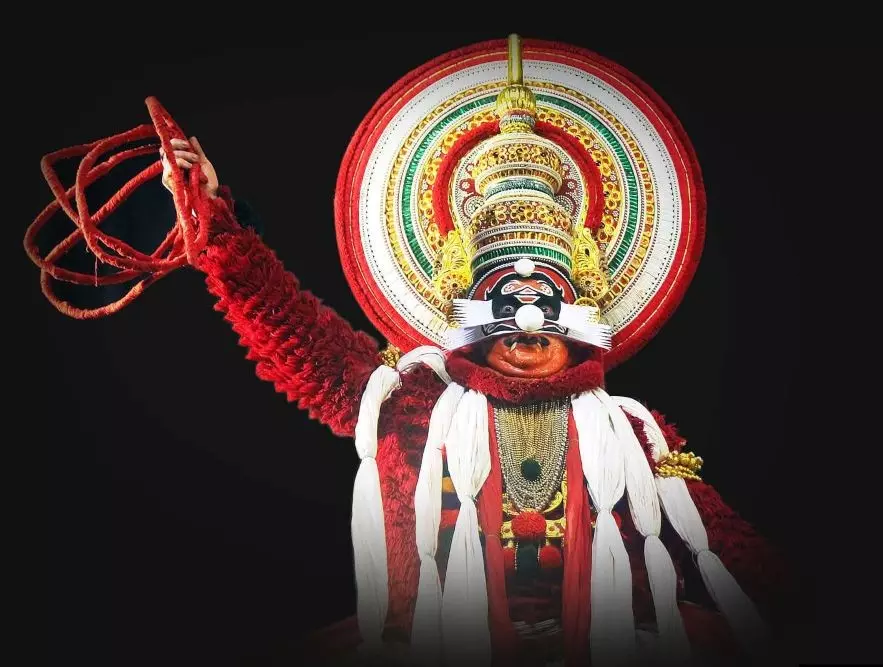
Dussasana by Hari Nair. Photo: By special arrangement
Since it was set up, Swaira Vachanam members say they have also received calls for assistance from family members of Kathakali artistes, even some relating to financial distress.
While most artistes The Federal spoke to expressed hope in the benefit of having a platform like Swaira Vachanam, there were concerns raised about whether communications would indeed remain confidential and whether artistes would have the confidence to approach the platform.
Damodaran Pazhoor, a senior Kathakali artist, who says he has been informally, in his individual capacity, been offering advice to artistes across age groups, believes that the key to resolving one's problems lies in understanding a fundamental truth. “The shadows cast by a small lamp differ from those of a larger one. Such variations exist everywhere. No art form is devoid of groupism and favouritism,” he says, adding, “initiatives like Swaira Vachanam will undoubtedly be beneficial”.
K Mukundan, a psychiatric counsellor based in Thrissur, on his part, stresses on the importance of caution while interacting with artistes. “Artistes possess a high degree of sensitivity. If they perceive that we do not regard them with the seriousness they deserve, it marks the end of our engagement. We cannot re-establish communication with them. I exercise caution when interacting with artists, as they require special care,” he explains.
Members of Swaira Vachanam admit facing challenges, especially when it comes to getting artistes to seek help.
“Every issue has a solution. By coming together, we can certainly find a resolution. But how many will take that step? That is a challenge in itself,” says Chembakassery. To address this, she says, they are now telling everyone that if they are aware of anyone needing help, to not overlook them. “Please inform us immediately. Let us take a proactive approach,” she adds.
Agrees Aarcha Gowri Varma, a psychiatrist, social worker, Kathakali artiste and Swaira Vachanam member, “Most issues we encounter could be addressed early if they sought our assistance from the outset. Their absence from welfare groups and associations contributes to a lack of group feeling and cohesion.” Varma says she often provides basic counselling to artistes before referring them to others for further treatment if needed.
Sanju Palasseri, a former Lieutenant Commander in the Indian Navy, serving as a surgeon, now a medical officer in the health and family welfare department of the Kerala government, believes “If your mind is not well, it will manifest in your body”.
A member of Swaira Vachanam, he adds, “Stress may be the underlying cause of fatigue. I have observed numerous artists experiencing psychosomatic disorders, where mental or emotional stress leads to, exacerbates, or induces physical symptoms”.
Meanwhile, remembering Nair, Prashanth wonders if the artiste would still have been alive if he had had someone to confide in. “To my knowledge, Hari lacked a close friend. I last met him when we did a show together a couple of months ago. Seeing his performance, one would not suspect that he was grappling with stress or depression. He exhibited great strength and delivered a compelling performance without revealing any signs of the internal struggles he faced,” he says.