Why in Kerala, World Cup flex wars are reflective of football being a lived experience in the state
From towering flex boards put up by Argentina, Brazil and Portugal fans in Kongad to houses being painted in team colours across Malabar, debates surrounding Lionel Messi and Cristiano Ronaldo and matches being watched on big screens, in Kerala the Football World Cup is not just another tournament. And newer generations have added fresh layers to the cultural landscape of the game.

In Kongad, a small town in Kerala’s Palakkad district, the 2026 FIFA World Cup has already begun! Not on television screens or in crowded viewing halls — the international football tournament kicks off on June 11 — but on the roadside; in the form of towering flex boards that stretch across the horizon and command attention.It started with Argentina.A group of local fans erected...
In Kongad, a small town in Kerala’s Palakkad district, the 2026 FIFA World Cup has already begun! Not on television screens or in crowded viewing halls — the international football tournament kicks off on June 11 — but on the roadside; in the form of towering flex boards that stretch across the horizon and command attention.
It started with Argentina.
A group of local fans erected a 160-foot-long flex inspired by the 2022 World Cup in Qatar. At its heart stands Lionel Messi, holding the trophy aloft, flanked by Ángel Di María and Julián Álvarez. Another image shows Emi Martinez making that epic clutch save in the finals. The images are instantly recognisable, but in Kongad they acquire a different scale and meaning. It is not merely celebratory. It is declarative. For a brief period, that stretch of road became an extension of Argentina itself.
The response was swift and inevitable.
Brazil fans followed with a flex that did not just match the Argentine display but exceeded it. At 180 feet, it stretched further, brighter and more assertively into public space. It was not simply an act of fandom. It was a counterstatement; an answer delivered in size and spectacle.
The central image featured Neymar Junior, accompanied by a wistful caption that read, “The prince who never became king”.
Portugal supporters, though fewer in number, soon joined in. Their entry into the visual contest came slightly later, but their message was unmistakable. Anchored in the figure of Cristiano Ronaldo, their flex carried the anticipation that this World Cup might finally resolve the long-running debate over football’s greatest player.
The 2026 Cup is being hosted across the US, Canada and Mexico, with the final scheduled for July 19.
What has unfolded in Kongad is part of a pattern that has become familiar across North Kerala during every World Cup cycle. Yet this time, the scale and visibility of these displays have drawn attention far beyond the state. International media, particularly in Brazil and Argentina, have taken note of the phenomenon. On social media, fans from those countries have responded with a mix of curiosity and astonishment, reacting to images of a fervour that mirrors their own but emerges from a place geographically and culturally distant. For observers outside Kerala, this enthusiasm can seem unexpected.
“It was Argentina fans who erected the jumbo flex in Kongad first, and then the Brazil and Portugal fans followed,” says Jasir S,24, a scooter showroom sales professional and an Argentina supporter. “We have this custom of fan flexes for some World Cups now. Last time we did a 140-feet flex and this time, decided to do it bigger. It is all initiated by expats in the Gulf countries who have a lot of excitement for things like this. Though we are divided in fanfare, we are not foes. We cooperate with each other.”
The reference to expatriates is significant. Kerala’s long-standing migration to Gulf countries has created a transnational flow of both capital and sentiment. Financial contributions from these communities often underwrite the cost of such displays, while their emotional investment sustains the enthusiasm.
Also read: Why in Haryana’s Balali, the Phogat family home is missing its mud pit action
Sreejith Gangadharan, a 23-year-old digital marketing executive and a Brazil supporter, provides a clearer picture of the economics involved.
“The flex costs us around two lakh rupees, mostly sponsored by our NRI friends in Gulf countries,” he says. “As Brazil fans, when we decided to put up a longer flex than Argentina, they stood with us. That’s the spirit here. In a way, this has put our small village on the map. Earlier, Kongad was known for the Naxalite killing of a feudal landlord [a reference to the assassination of MM Narayanankutty Nair in 1970]. Now, it is known for something entirely different.”
Sreejith’s words underline a distinctive feature of Kerala’s football culture. Rivalry exists, but it is rarely antagonistic. Instead, it is embedded within a framework of cooperation and shared celebration.
Sreejith also represents a younger generation of fans whose engagement with football has been shaped by digital media.
“I started following football in the post-insta [social media platform Instagram] age and Brazil became my passion from the early days. This time, we think Ancelotti will deliver it to us,” he adds, referring to the anticipated leadership of Carlo Ancelotti, the decorated Italian manager of the Brazilian team.
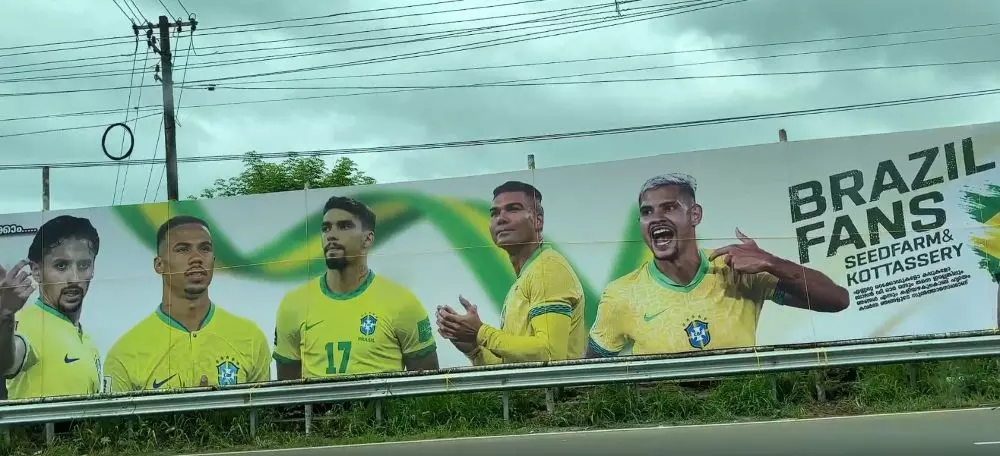
A flex of the Brazilian team in Kongad. Photo: Sunil Baby
Portugal fans, though comparatively smaller in number, express a similar optimism.
“We have a good team this year and we are the ones who are more inclined to lift the trophy. Even if it does not happen, as far as us here in Kongad are concerned, we will still be thick friends,” says Shafeek (identified by first name only), 30-year-old kitchen furnace worker.
The insistence on friendship, even in the midst of intense competition, is not incidental. It reflects a deeper social dynamic in which fandom is a shared experience rather than a divisive force.
This dynamic becomes clearer when one moves beyond Kongad and into the broader geography of football in Kerala.
The epicentre of this culture lies in the Malabar region, particularly in districts such as Malappuram, Palakkad, Kozhikode and Kannur. Here, football is not confined to global tournaments. It is a year-round presence, sustained by a parallel ecosystem that predates the arrival of televised international football.
At the heart of this ecosystem is Sevens football.
Played on smaller fields with seven players on each side, sevens’ matches are fast-paced, physically demanding and intensely competitive. They are typically held under floodlights, transforming ordinary grounds into vibrant arenas that draw large crowds. Spectators gather close to the action, reacting to every pass and tackle with an immediacy that is rarely seen in more formal settings.
Sevens football is not merely a sport. It is a social institution. Clubs represent local communities, with some of them even fielding foreign players, and their performances carry collective significance. Players achieve a form of local celebrity status, while matches become focal points for discussion and debate.
This culture has played a crucial role in shaping Kerala’s engagement with football. Long before European leagues and international tournaments became accessible through television, sevens football had already cultivated a deeply invested audience.
When the World Cup entered Kerala’s homes, it did not encounter a passive viewership. It found a population that was already fluent in the language of the game. For an older generation, this engagement is anchored in a specific historical moment. The 1986 World Cup, won by Argentina under the leadership of Diego Maradona, remains a defining reference point. Maradona’s performance in that tournament, marked by extraordinary skill and individual brilliance, left a lasting impression on fans in Kerala.
“I had been a player in my school days. Unfortunately, I could not continue my studies or football. I am a Messi fan. It started with Maradona and from that period onwards, I was with Argentina and still am. Their play, especially Maradona and Messi, is a treat to watch,” says Balakrishnan (identified by first name only), a 64-year-old granite quarry worker in Kongad.
For Balakrishnan and many others like him, Maradona represents more than footballing excellence. He embodies a narrative of resilience and defiance that resonates with broader social and political sensibilities in Kerala. This resonance is often reflected visually, with Maradona’s image appearing alongside figures such as Che Guevara in murals and posters.
“Maradona is not just a player. He represents the ordinary man and his fighting spirit. He stood against every form of oppression. Look at the respect he had for revolutionaries like Che Guevara and Fidel Castro. He spoke out against the Americans when they invaded other countries. He stood with people’s movements in Venezuela alongside Chávez [Venezuelan revolutionary and former president Hugo Chávez]. He even dared to question the Pope [a reference to his row with Pope John Paul II over the giving of a rosary, with Maradona challenging the Pope to sell the ornate Vatican ceiling to feed the poor]. Do we have even a single player capable of this today? Is anyone raising their voice against the wars that the US and Israel are forcing upon ordinary people in places like Iran and Lebanon? That is why, for us, Maradona remains the ultimate legend,” says MK Sankaranarayanan, a 56-year-old tea shop owner and CPI(M) worker from Pulappatta in Malappuram.
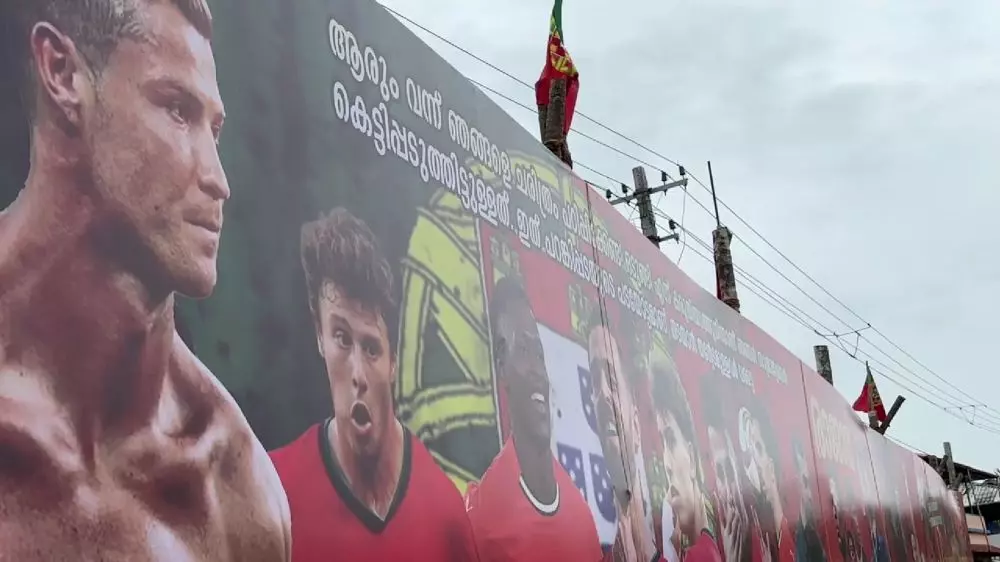
A flex put up by fans of the Portugal team. Photo: Sunil Baby
While Sankaranarayanan’s generation carried politics as an added layer to their football fandom, the younger generation has shaped its own version of engagement. Gen Z and Alpha fans are more drawn to the technical and tactical aspects of the game. Many of them follow formations, player movements and data with close attention, and a significant number are active players themselves, bringing a more hands-on, analytical understanding to their passion for football.
“Unlike our elder brothers in the locality, we student fans are more into league tournaments across the globe. The Premier League, La Liga, and even the Bundesliga. Ligue 1 and Serie A (European Leagues) are closely followed. So we know the players in and out when they come for the World Cup. Many other football fans here mostly follow only the national teams and that too mainly during the World Cup,” says Arjun Manohar, a 19-year-old engineering student from Thrissur.
The other thing that has changed is that football fandom in Kerala is no longer confined to young men and local clubs. Women, too, are becoming increasingly visible and active participants in the World Cup frenzy.
In Malappuram, groups of women, including members of Kudumbashree — the state’s grassroots women’s self-help network known for its role in poverty eradication and community development — have taken the celebrations to the streets. Kudumbashree even organised friendly matches, with participants turning up in Argentina and Brazil jerseys, adding a festive and inclusive dimension to the fanfare.
Among this new generation of fans are Khadeeja Safa, 19, and Salma Ummer, 23, sisters and ardent Argentina supporters who have turned their home in Wayanad into a tribute to their team.
“Our father was a big Argentina fan. He made us watch the matches, and that’s how we developed an interest in the team and in Messi,” says Khadeeja. “The World Cup is always exciting, and that’s why we decided to paint our house in Argentina’s colours.”
For them, fandom is not inherited passively. It is adapted, expressed, and lived in ways that are both personal and public, adding yet another layer to Kerala’s ever-evolving football culture.
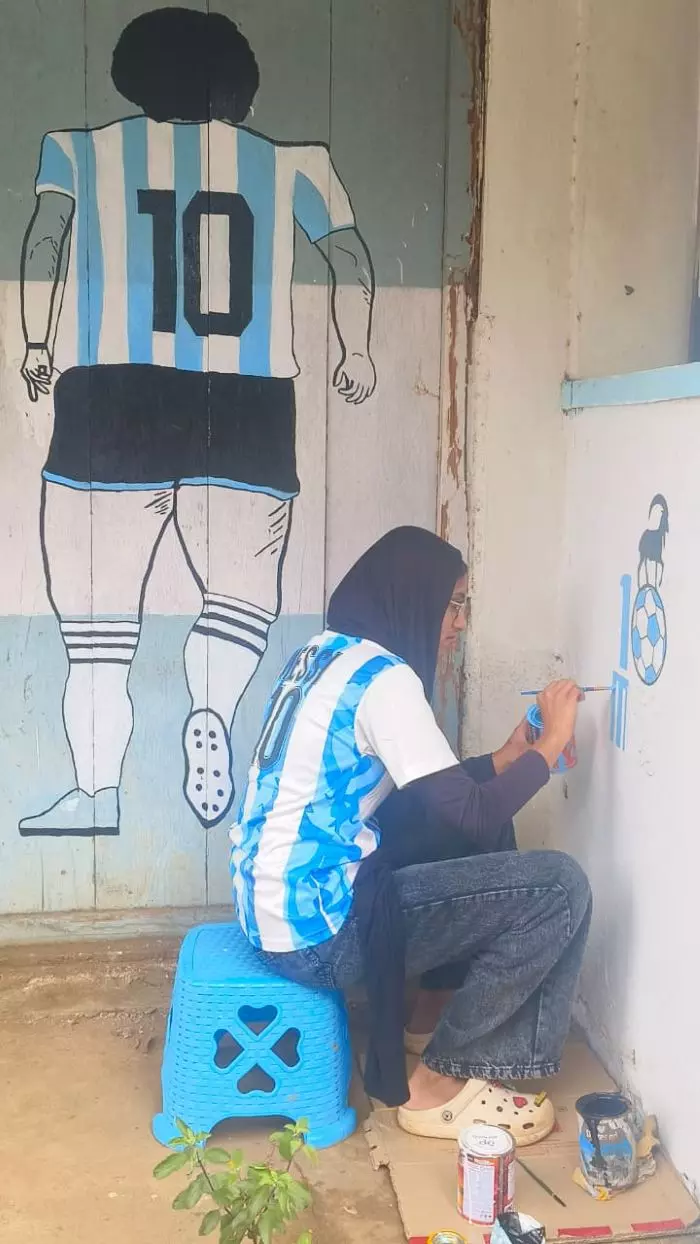
Khadeeja Safa, an Argentina supporter, paints the walls of her Wayanad house as a tribute to her team. Photo: Surjith A
And so, the modern era has added new layers to the cultural landscape of football in Kerala.
The prolonged rivalry between Lionel Messi and Cristiano Ronaldo has redefined football discourse globally and in Kerala, it has created new forms of identification and division. Fans align themselves not only with national teams but also with individual players, leading to complex and sometimes overlapping loyalties.
Brazil supporters, for instance, are often drawn to Neymar, whose popularity transcends traditional team boundaries. His association with Messi introduces an element of ambivalence, leading to what fans describe as “friendly fire” in debates and discussions.
At the same time, supporters of Cristiano Ronaldo frequently position themselves in opposition to Messi, a stance that often extends to their choice of national team allegiance during the World Cup.
“I’m a Brazil fan, so obviously we don’t like Argentina winning. But with Messi, it’s different. He’s the closest to the heart thing for me after the yellow jersey. There may be Brazil fans who dislike him, but when you see the bond he shares with Neymar, that’s something I really appreciate. I have no doubt Messi is the best player in the world right now, but the greatest of all time, for me, is Pelé,” says Hamd Ashraf, an MBBS student from Thrissur district.
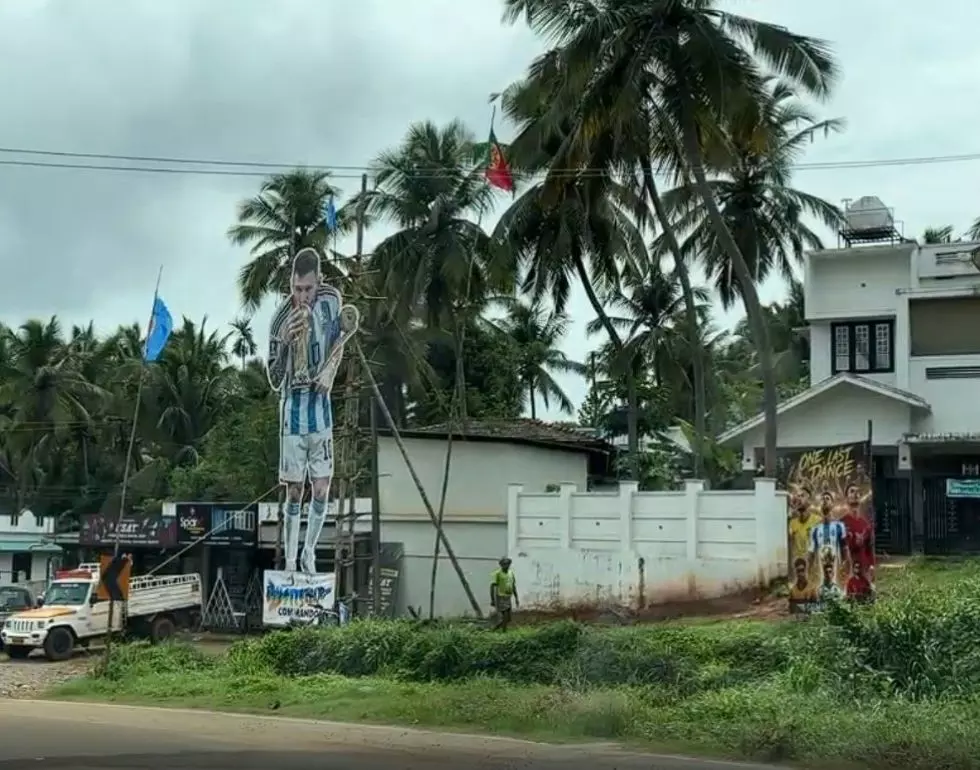
A Messi cutout outside a house in Pathirippala. Photo: Sunil Baby
These layered identities add depth to Kerala’s football culture, even as they complicate its internal dynamics. Yet, when the World Cup begins, this complexity tends to recede. The focus returns to a simpler, more enduring rivalry. Argentina versus Brazil. This binary, rooted in decades of fandom, continues to dominate the emotional landscape of the tournament.
Among those who sustain this landscape are individuals like Subair Vazhakkad, 45, a farmer from Vazhakkad in Malappuram.
Despite having dropped out from school at an early age, Subair possesses an extensive knowledge of both international and club football. He follows the sport closely, analysing team compositions, player form and tactical approaches. An ardent supporter of Argentina, he had predicted Messi’s triumph in Qatar.
“This time [Lionel] Scaloni has challenges. Many players have injuries. But he is a very pragmatic coach and he would come up with a plan. But this game is not that easy for Argentina this time as teams like Spain, Portugal, France, the Netherlands and even England are strong this time. We cannot write off Brazil, especially under Ancelotti,” he says.
His analysis reflects a level of engagement that goes beyond casual fandom. It illustrates the depth of understanding that characterises football culture in Malabar.
Even as Kongad captures attention with its flex boards, the scale of such displays is set to expand further.
In Munda, near Nilambur in Malappuram district, fan groups are preparing to erect a flex that is expected to exceed 350 feet in length and measure approximately 12 feet in width, which they claim would be the longest in the world. Scheduled to be installed over mid-week before the World Cup kick off, the structure represents a new level of ambition in what has become an evolving visual tradition.
The planning involves coordination, funding and logistical effort, underscoring the seriousness with which these displays are approached. Despite this escalation in scale, certain underlying values remain consistent.
“In many parts, the fan fight turned into enmity and clash. Here, our boys are not like that. They are all together. Now I have suggested to them to erect some hoardings for the African teams as well,” 64-year-old Balakrishnan of Kongad observes.
His suggestion points to an inclusive instinct that coexists with competitive enthusiasm. As the World Cup approaches, Kerala’s landscape will continue to transform. Streets will fill with colour, conversations will intensify, and nights will extend as matches are watched and debated. The passion also finds expression in more personal ways. Across Malabar, houses have been painted in team colours, with entire walls turning Albiceleste blue and white or Brazil’s yellow and green, reflecting a level of emotional investment that goes far beyond match days.
Faisal Mohammed, a 30-year-old travel agent working in Dubai, still remembers the night in Lusail when the World Cup found its perfect ending. He and five of his friends had travelled to Qatar in 2022 to watch the tournament live. Among them were Brazil and Cristiano Ronaldo supporters, who had already seen their teams exit, but that did little to diminish the moment.
“Three of us were Brazil and Cristiano fans and we were all disappointed when our teams lost (both Brazil and Portugal lost in the quarterfinals). But when we saw Messi lifting the trophy in Lusail, it was something else. Everyone felt it,” he says.
For that group, the trip had carried an added sense of finality.
“Last time, it felt easier. We all thought it was the last dance for Messi and Ronaldo. Two of us had that extra excitement as Argentina fans because we were there in the stadium and got to witness it,” Faisal recalls.
This time, the experience will be different.
“Some of our friends tried to arrange visas for us again, but it didn’t work out. The cost is also not affordable now and the war [US-Iran] is having its effect on our income as well. So we will watch it here, on big screens,” he says.
Plans are already taking shape.
“The only worry is the rain. Last time it was in December, now the season is different. We are trying to arrange cinema halls to screen the matches on a big screen,” he adds.
The memory of Lusail lingers, but like many fans in Kerala, Faisal is preparing to recreate the spectacle closer to home, in a setting that may be smaller, but no less intense.
Football in Kerala is not an occasional spectacle. It is a lived experience, shaped by history, sustained by community and expressed through both knowledge and creativity. From the sevens grounds of Malabar to the roadside flex boards of Kongad, from the legacy of Maradona to the contemporary appeal of Messi and Ronaldo, the sport occupies a central place in the cultural life of the state.
What begins as a flex on a roadside ultimately reveals itself as something more enduring. A shared language. A collective memory.