- Home
- India
- World
- Premium
- THE FEDERAL SPECIAL
- Analysis
- States
- Perspective
- Videos
- Sports
- Education
- Entertainment
- Elections
- Features
- Health
- Business
- Series
- In memoriam: Sheikh Mujibur Rahman
- Bishnoi's Men
- NEET TANGLE
- Economy Series
- Earth Day
- Kashmir’s Frozen Turbulence
- India@75
- The legend of Ramjanmabhoomi
- Liberalisation@30
- How to tame a dragon
- Celebrating biodiversity
- Farm Matters
- 50 days of solitude
- Bringing Migrants Home
- Budget 2020
- Jharkhand Votes
- The Federal Investigates
- The Federal Impact
- Vanishing Sand
- Gandhi @ 150
- Andhra Today
- Field report
- Operation Gulmarg
- Pandemic @1 Mn in India
- The Federal Year-End
- The Zero Year
- Science
- Brand studio
- Newsletter
- Events

Why Kashmiri Pandits’ hopes of being rehabilitated by the BJP seem to be on the wane
Most Kashmiri Pandits remember January 19, 1990, as a night of terror, triggering a mass exodus from their homeland. More than 35 years later, while many Pandit families are scattered across India and the world, thousands continue to live 'pitiful lives' in camps in Jammu.

Ashok Raina, 55, clearly remembers the day when his family left Kashmir. “My father and the entire family cried when we locked the main gate of our house in Mujmarg, Shopian,” he says. That was in 1990; he had been in his twenties then. More than three decades later, tears roll down his cheeks at the recollection.Since then, the family has been living in Jammu, in camps for displaced...
Ashok Raina, 55, clearly remembers the day when his family left Kashmir. “My father and the entire family cried when we locked the main gate of our house in Mujmarg, Shopian,” he says. That was in 1990; he had been in his twenties then. More than three decades later, tears roll down his cheeks at the recollection.
Since then, the family has been living in Jammu, in camps for displaced Kashmiri ‘Pandits’, a term used to refer to the Hindu population of the Kashmir valley.
His father had been a government employee in Kashmir, but after the move, lived out his life dependent on the cash assistance and free ration provided by the Jammu and Kashmir government (which is reimbursed by the Centre). After his father died in 2011, his mother received the benefit, but she too died in 2018.
Ashok worked at various private sector jobs, but since 2020, following two surgeries for heart-related issues, he hasn’t had an income and is also solely dependent on government relief.
The family — he, his wife and two children — live in the Pandit camp at Purkhoo on the outskirts of Jammu, along with 124 other families. The accommodations here are mere tin sheds, measuring 20 feet by 12 feet each, in which the families are cramped. Ashok Raina’s residence is crudely partitioned with tin sheets to create a small kitchen and sleeping area. Ventilation is poor. And privacy, with two young adults in the house — Ashok’s children, still students, are aged 18 and 20 — is almost non-existent.
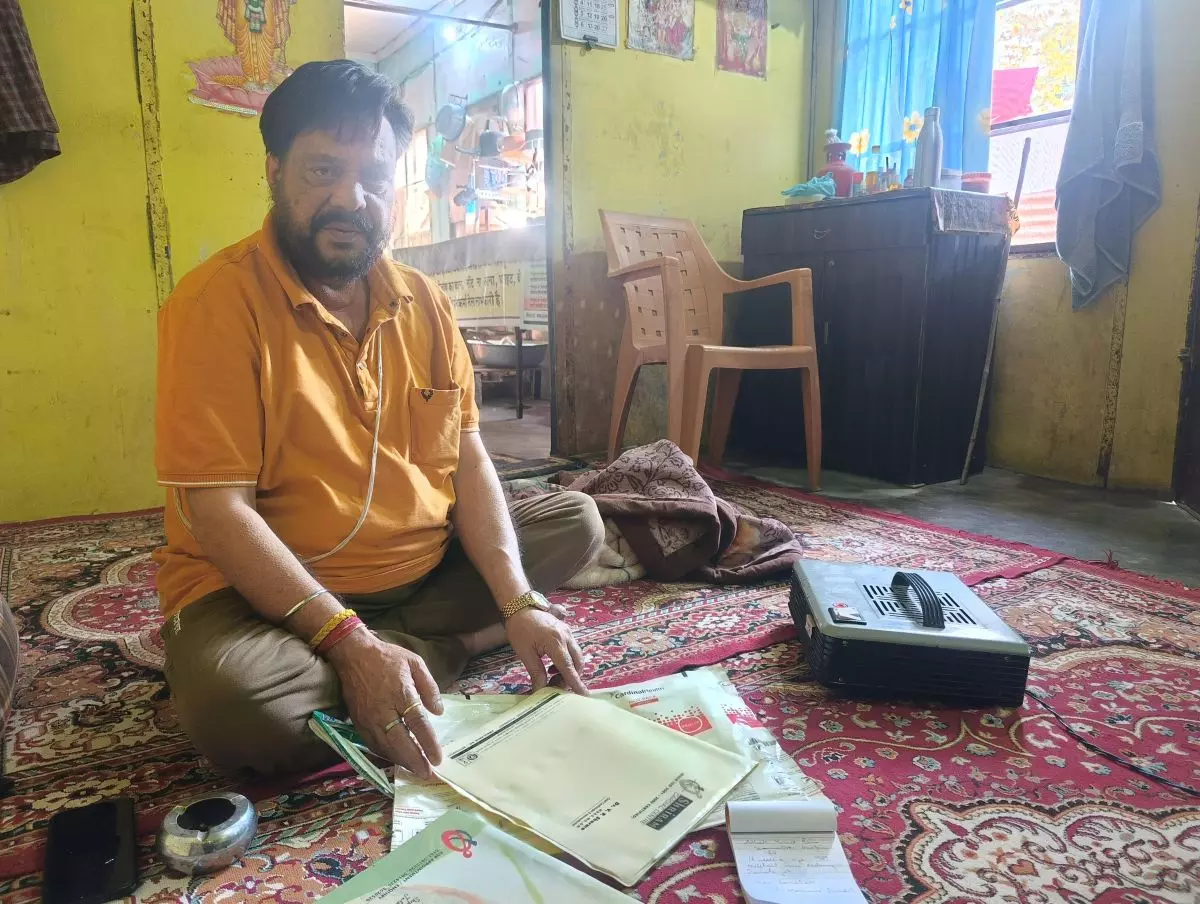
Ashok Raina at his residence at the Purkhoo camp. Photo: Basharat Amin
“We have a miserable life here,” says Ashok, fretfully. “During June and July [monsoon], surviving in these sheds becomes extremely difficult.” It also gets stifling in peak summer, when temperatures frequently touch 40 degrees Celsius.
Also read: Over 120 deaths in 2025, why stampedes remain a recurring tragedy in India
Most Kashmiri Pandits, at least those born in the valley before 1990, remember the night of January 19 that year as one that divided their lives forever into 'before' and 'after'. Terrorism had already been on the rise, as had been anti-Hindu sentiments. A minority in the erstwhile state, Pandits recall the growing sense of insecurity in their own homeland. Then, on the night of January 19,1990, cries of “raliv [convert (to Islam)], chaliv [flee], ya galiv [die]” were raised; stones were pelted at Pandit residences.
The next day began the mass exodus of Pandits from the Kashmir valley. More than 35 years later, while many are scattered across India and the world, some continue to live in camps in Jammu. The community had pinned hopes of rehabilitation on the Narendra Modi-led NDA government at the Centre. The Bharatiya Janata Party (BJP), the main constituent of the NDA, has built its identity on Hindutva politics and included the issue of Pandit rehabilitation in its poll manifesto as far back as the 2014 general elections.
But 11 years later, the displaced community’s optimism seems to be waning.
There are around 5,000 Pandit families living in Jammu’s Jagti Migrant Camp, in two-room flats with a washroom, constructed by the Manmohan Singh-led UPA government and inaugurated in March 2011. Other camps, such as those at Jammu’s Purkhoo, Bhutanagar, and Muthi areas, also continue to shelter displaced Kashmiri Pandits.
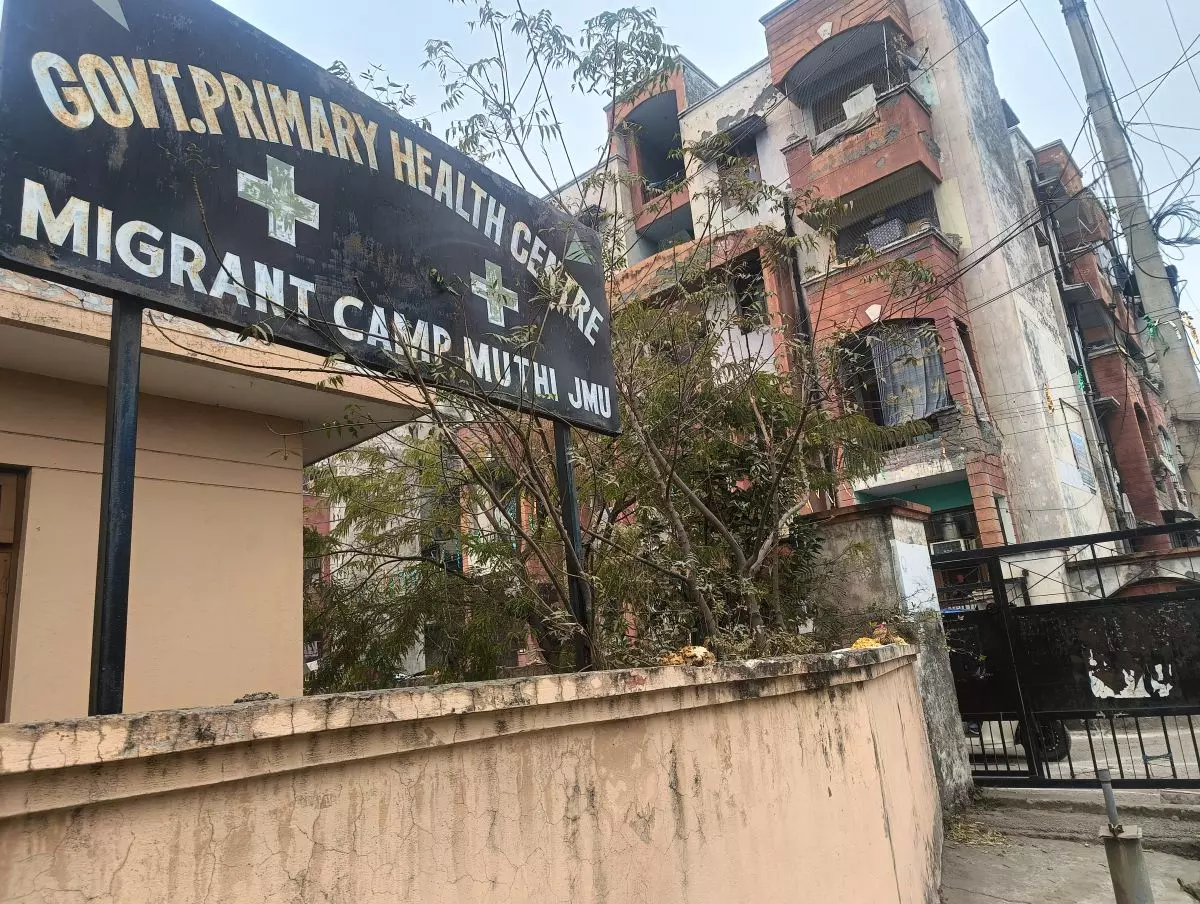
Entrance to the Pandit camp at Muthi. Photo: Basharat Amin
Ashok says he and other families from the Purkhoo camp have repeatedly visited the office of the Rehabilitation Commissioner seeking proper housing in place of tin sheds. Instead, they claim they are often scolded and labelled as “illegal residents”. “If we are illegal, why are we given relief and ration cards?” Ashok asks.“We are not here by choice. Circumstances forced us to leave our homeland.”
The 55-year-old has long nurtured the home of finding separate accommodations for his family, but money, he says, was never enough.
A resident at the Jagti camp, 73-year-old Om Prakash Mahajan, is living with a disability; he doesn't have an arm. Originally a resident of Amira Kadal, in the Kashmir capital of Srinagar, Mahajan too had left the valley in 1990. Since then, he has lived at camps in Purkhoo and other places, before moving to the one in Jagti. Living alone, he claims he survives on a meagre Rs 3,250 monthly relief provided by the government. “This amount is not enough to survive. I am 73 and need medicines daily. How can I manage?” he asks.“I had a three-storey house at Zaina Kadal that was destroyed and a shop at Maharaja Bazaar [both in Kashmir]. Today, we live like beggars,” he rues.
Another displaced Pandit, 62-year-old Ashwani Kumar, looks back at the years of living on government assistance. “Initially, we received Rs 500, which later became ₹1,000. Increases came gradually — about 30 per cent each time —but for the past five years, nothing has been enhanced,” he alleges. Kumar claims, “The relief ceiling remains Rs 13,000, regardless of family size. Even if a family has more than ten members, they receive only Rs 13,000.”
According to reports, in 2022, there were still over 5,000 Pandit families living in rehabilitation camps in Jammu. Over the years, successive governments at the Centre and Jammu and Kashmir, have variously promised relief and rehabilitation to the community.
From broad relief measures in the ‘90s, to a rehabilitation plan submitted by the J&K government in 2000 and a comprehensive plan for the “return and rehabilitation” of Pandits announced by the then UPA government at the Centre in 2008, the issue of Pandit rehabilitation has never faded from news, but never been accomplished either.
Then, in 2015, a year after Prime Minister Narendra Modi took oath as PM for the first time, the Centre approved the creation of an additional 3,000 state government jobs for Kashmiri migrants and the construction of transit accommodations in Kashmir. This was in addition to 3000 state government jobs that had been approved earlier. In total, 6,000 state government jobs were approved for the migrants. In a piece for Rising Kashmir last year, columnist Sanjay Pandita wrote, “... on the ground, these promises have translated into very little. Transit accommodations in Kupwara, Budgam, and Baramulla remain half-built, ill-equipped, or poorly maintained. Many of the young Pandits who accepted government jobs under these schemes now live in high-security zones, behind barbed wires, guarded by guns, unable to integrate into society.”
Also read: How life has altered for residents of Kashmir villages living with the threat of wildlife attack
Dr Agnishekhar, noted Kashmiri poet, writer, and founder-convenor of the Panun Kashmir organisation, which has consistently pushed for a homeland for Kashmiri Hindus, categorically rejects what he terms as the “cosmetic” return and rehabilitation of Kashmiri Pandits.
“Unless faith is restored in the Muslim-majority society, return is not possible. They failed as the elder brother who could not protect this minuscule minority,” he alleges.
According to Agnishekhar, meaningful rehabilitation requires sustained confidence-building at the community level. “Unless there is a clear assurance of non-repetition of the 1990s, institutional safeguards put in place and the exodus acknowledged as genocide, the return of Kashmiri Pandits will remain mere rhetoric.”
The poet adds: “We had high hopes when the new government [led by Narendra Modi] came to power [at the Centre], but that too disappointed us.”
On January 16, Panun Kashmir organised a yagya at the Jagti township and reiterated its demand for a separate homeland for Kashmir Pandits.
“Given our bitter experience, it is only natural to seek security within one’s own social and cultural environment. There is a perception that we have forgotten the past, but that is not true. Our younger generation, even in the diaspora, knows the history and wants to return to its homeland,” explains Agnishekhar.
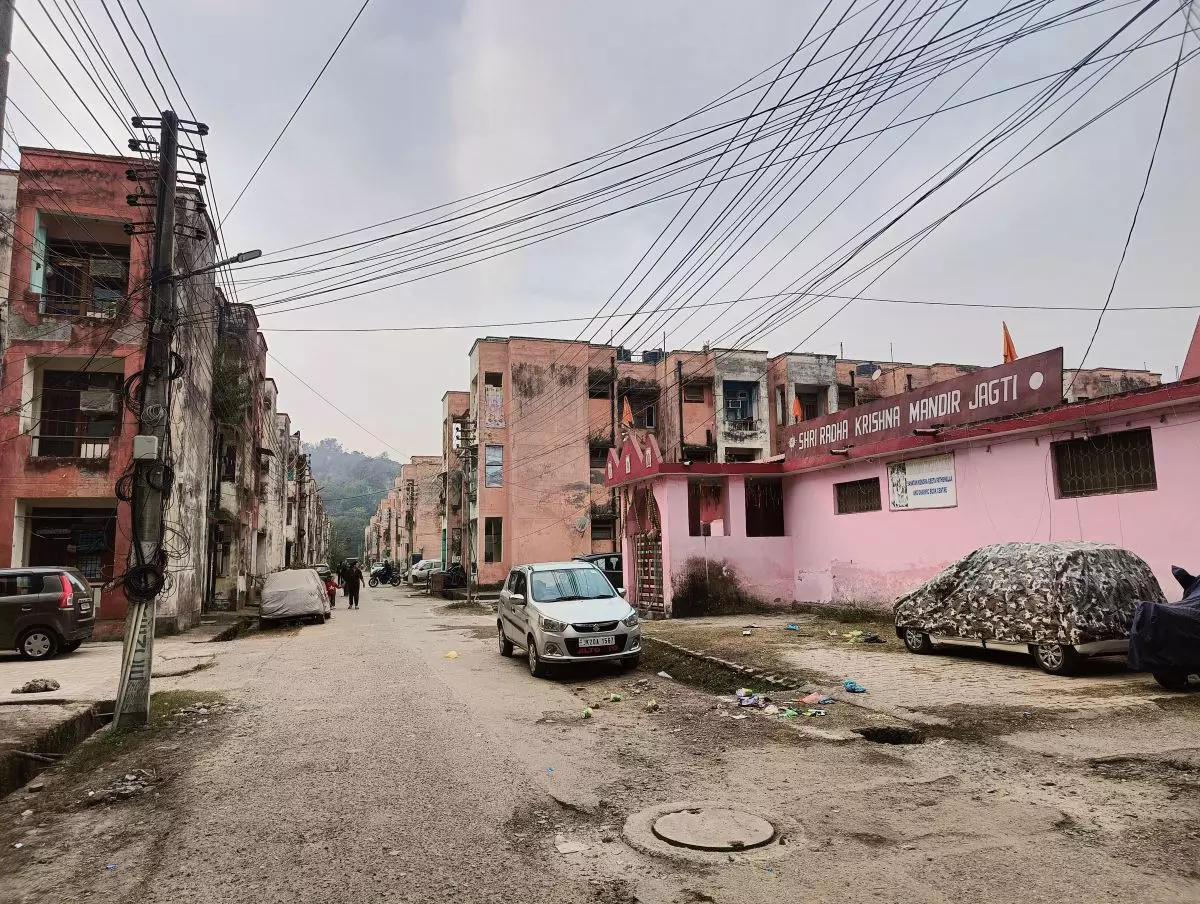
Flats at the Jagti township for Pandits in Jammu. Photo: Basharat Amin
However, for many displaced Pandits, the dream of a return to Kashmir is accompanied by a renewed assimilation into a shared social fabric.
Seventy-year-old Jawaharlal (identified by first name only), a resident of the Muthi migrant camp, insists that Pandits wanted to live with their “neighbours”. “We have deep-rooted connections with them. Our social milieu is the same — our language, traditions, and social fabric are woven together through shared commonalities,” he says.
Vijay Raina, 55 and a private sector employee, has been in Hyderabad after migrating from Kashmir. The issue of ‘homeland’, however, remains an emotional one for him. Raina says he is still deeply connected to his roots, speaking Kashmiri at home and staying in touch with friends in the Valley. “My children, now aged 20 and 23, ask tough questions — why, being Kashmiri, are we living in Hyderabad? Why were we displaced? Why can’t we return to our ancestral home?”
According to Vijay, nearly 60 per cent of the Pandit community wants to return, but only if a composite culture is restored in the Valley; otherwise, he said, it would remain mere rhetoric.
Ironically, Sanjay Tickoo, president of the Kashmiri Pandit Sangarsh Samiti, whose family never left Kashmir, the gap between the valley’s Hindu and Muslim communities has widened since the abrogation of Article 370 in 2019, which granted special status to Jammu and Kashmir and the bifurcation of the erstwhile state into the two union territories of Jammu and Kashmir and Ladakh. “Before 2019, there was a 60-70 per cent chance of the return of Kashmiri Pandits to the Valley. After 2019, that has fallen to just 10-15 per cent,” he claims.
Questioning the intent of Pandits demanding rehabilitation, he adds, “We in Kashmir cannot travel freely at night or move without fear, while those outside enjoy these freedoms. That is why talk of return remains rhetoric. If one truly wants to return, why don’t they?”
Also read: Why in Tamil Nadu, Pongal celebrations unite Hindus and Muslims in common 'thanksgiving’
Local political leaders, meanwhile, have repeatedly raised the issue of Pandit rehabilitation, stressing their intent to facilitate the same.
Talking to The Federal, Imran Nabi Dar, spokesperson of the Jammu and Kashmir National Conference — the party's vice president, Omar Abdullah, is the current CM of Jammu and Kashmir — says, “We are committed to their safe return. It was the National Conference that took steps for their relief and rehabilitation in the past and under the current government, it is clearly stated in our manifesto that their return to their places of birth should be ensured with dignity.”
On his part, PDP spokesperson Mohit Bhan claims his party has submitted an evolving document to Lieutenant Governor Manoj Sinha and the Government of India and that the issue will be raised in the upcoming Assembly session.
Rejecting the demand for a separate homeland, Bhan adds, “We have to reclaim our rich cultural heritage.” According to Bhan, PDP has a clear stand: Kashmiri Pandits should be allowed to return initially to transit camps, where faith and trust can gradually be rebuilt. “Thereafter, five marlas [a unit of measurement] of land should be given to every Pandit household.”
While Bhan admits that mainstream regional parties have a role to play in creating a conducive atmosphere for rehabilitation, he insists that the primary onus lies with the central government, particularly with regard to providing security, finance, and land.
Meanwhile, talking about the present condition of displaced Pandits living in camps in Jammu, the Union Territory’s relief and rehabilitation commissioner Arvind Karwani told The Federal that while a hike in cash assistance was a policy decision of the government, no one was currently living in “abandoned or unsafe temporary sheds”. “We have received around 1,100 applications [for shelter]. Our priority is widows and persons with disabilities. On December 13, the chief secretary of the Government of Jammu and Kashmir, Atal Dulloo, visited the Jagti camp and issued directions in this regard. If there is availability in Jagti, or if any quarters are vacated, we will fill the gap strictly as per the prescribed criteria,” he said.
The Federal also reached Dulloo over email for comment on the status of Kashmiri Pandits living in camps in Jammu and the issue of rehabilitation; the article will be updated when a response is received.
For those like Ashok Raina, however, the past few years have been the slow burnout of another hope. Talking about the community’s relationship with the ruling BJP at the centre, he says, “The BJP has no real vote bank in Kashmir. Their vote bank in Kashmir is none other than the Kashmiri Pandits. That is why rehabilitation was included in their election manifestos in 2014 and 2019. But on the ground, nothing has changed,”
Till 2020, Ashok says he worked as the BJP’s booth-level president in his area. But quit owing to “unfulfilled promises”. “We had hoped that the current government would mitigate our suffering, but they have failed to relocate us properly or rehabilitate us here in Jammu. Returning to Kashmir Valley — our homeland — seems an even more distant dream,” he sighs.