- Home
- India
- World
- Premium
- THE FEDERAL SPECIAL
- States
- Perspective
- Videos
- Sports
- Education
- Entertainment
- Elections
- Features
- Health
- Business
- Series
- In memoriam: Sheikh Mujibur Rahman
- Bishnoi's Men
- NEET TANGLE
- Economy Series
- Earth Day
- Kashmir’s Frozen Turbulence
- India@75
- The legend of Ramjanmabhoomi
- Liberalisation@30
- How to tame a dragon
- Celebrating biodiversity
- Farm Matters
- 50 days of solitude
- Bringing Migrants Home
- Budget 2020
- Jharkhand Votes
- The Federal Investigates
- The Federal Impact
- Vanishing Sand
- Gandhi @ 150
- Andhra Today
- Field report
- Operation Gulmarg
- Pandemic @1 Mn in India
- The Federal Year-End
- The Zero Year
- Science
- Brand studio
- Newsletter

Why in Karnataka, 'Devadasis' and their families continue to suffer the damages of a banned practice
The Karnataka legislature passed the Karnataka Devadasi (Prevention, Prohibition, Relief and Rehabilitation) Bill, 2025, last year. However, a survey of former Devadasis has shown a sharp decline in their numbers, triggering concerns that the enumeration process covered only living Devadasis and not data across the three generations promised relief in the bill.

Before Padiyamma could understand what “serving God” meant, society had branded her a ‘Devadasi’. Her mother had left the family and her father died soon after.“One day, I returned from the fields, carrying fodder, and was taken to the Huligemma temple [in Koppal, north Karnataka] and dedicated to the deity. I was eight years old at the time,” recalls the now 66-year-old resident...
Before Padiyamma could understand what “serving God” meant, society had branded her a ‘Devadasi’. Her mother had left the family and her father died soon after.
“One day, I returned from the fields, carrying fodder, and was taken to the Huligemma temple [in Koppal, north Karnataka] and dedicated to the deity. I was eight years old at the time,” recalls the now 66-year-old resident of Karnataka’s Kyadagumpi village.
The torture of the years that followed is etched in her memory in painful vividness.
“When I was 12, there was an attempt to push me into the dark underworld of Mumbai [then Bombay]. Somehow, I escaped. But as I grew into adolescence, I became the target of lustful eyes in the village,” she claims.
She had four children, but the father was an alcoholic and, even before his death, provided her little support, she claims. With no means to support her or the kids, life was a daily struggle. “I couldn’t even provide milk for the children. For days, I survived on greens and salt.”
Believed to have originated sometime between the ninth and twelfth centuries, the Devadasi system saw young girls, or women, being dedicated to the service of God. According to historical accounts, the ‘Devadasis’, literally meaning ‘servants of God’, were required to spend their day in temple activities and in the practice of classical music and dance, which they performed at the temple and other religious and cultural gatherings. Since the women were considered “married to the temple deity”, they could never marry a mortal and were expected to maintain celibacy.
By all accounts, in the beginning, the Devadasis enjoyed considerable prestige and power — stemming from the patronage of the royals and other nobility. Being married to ‘God’, they were never widowed and were therefore considered auspicious and invited to weddings and other ceremonies to seek their blessings.
But over time, as the fortunes of the Indian royalty and nobles declined, so did the prestige of the Devadasis. Though barred from marrying, men — often married — were allegedly permitted to pursue relationships with the Devadasis, without having any responsibility to the woman or the children born of the relationships.
The cycle of abuse reduced the Devadasis to a life little better than that of sex workers.
Also read: Why Karnataka's new ‘Eva Nammava’ law alone may not be enough to curb 'honour killings' in the state
Over the years, multiple state laws have banned the practice. In Karnataka, the prohibition of the Devadasi system came in the early 1980s
However, activists claim in many areas the practice continues, albeit furtively. While earlier, dedication rituals were conducted openly in temples, now, owing to legal fear, they take place secretly in homes or small shrines during festivals, they claim.
“Although the Devadasi system is not as visible as before, it continues in hidden forms. There has been little progress in effectively implementing the 1982 law banning the system. A lack of social awareness also contributes to its persistence,” claims YJ Rajendra, national vice president, People’s Union for Civil Liberties (PUCL).
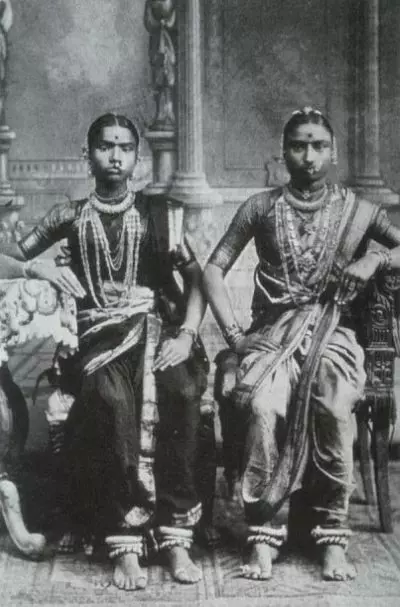
Two Devadasis of the past. Photo: Wikimedia Commons
In Karnataka, activists claim, the practice continues to be reported from districts like Belagavi, Ballari, Koppal, Vijayanagara, Raichur, and Bagalkot. Most victims are poor girls from Dalit and backward communities and their children and grandchildren continue to bear the stigma, they say.
Last year, the state legislature passed another bill to address the issue, the Karnataka Devadasi (Prevention, Prohibition, Relief and Rehabilitation) Bill, 2025. The law is currently awaiting the President's assent. The proposed law not only aims to completely eradicate the practice, but also provides rehabilitation and support for three generations of Devadasis. It also includes provisions for inheritance rights and establishing the paternity of children of Devadasis through scientific evidence; without a father’s name, access to education and relief measures often becomes difficult, claim many children of former Devadasis.
However, a survey conducted between September and December 2025 to establish the number of Devadasis and their family members — the results of which were released this year — has come under criticism for allegedly failing to obtain accurate figures and for leaving out the families of former Devadasis.
The 2026 survey comes after a gap of nearly a decade. No comprehensive survey of Devadasis has been conducted in Karnataka since 2007–08. Back then, around 46,660 former Devadasis were identified across 15 districts of North Karnataka. However, the 2026 survey by the state government identified only 23,395. Bagalkot has the highest number (4,189), followed by Vijayanagara (3,876), Belagavi (2,649), Koppal (2,469), and Ballari (2,333). Other districts like Kalaburagi, Yadgir, Dharwad, and Shivamogga also reported cases.
Activists argue this nearly 50 per cent drop in Devadasi numbers is misleading and was a result of only living Devadasis being counted, while children of deceased Devadasis — who continue to face similar stigma, exploitation and economic hardship — were excluded.
“Even though the 2025 bill proposes considering three generations [of Devadasis, for rehabilitation], officials failed to include family members of former Devadasis in the survey,” says RV Chandrashekhar, assistant professor, National Law School of India University, Bengaluru.
Chandrashekhar, also the coordinator of the Bill’s drafting committee, adds: “There are also allegations that the government conducted a superficial survey to claim that the Devadasi system has been eradicated and to show progress on paper. If surveys fail to identify all affected women, the bill’s objectives — restoring dignity and ensuring rehabilitation — will be undermined. Although the system has been banned since 1982, the government itself admits that 33 cases have been reported so far — indicating that the practice still exists. In some places, due to apathy from police and administrative authorities, cases do not even come to light.”
Chandrashekhar’s concerns regarding the reach of welfare measures in the face of alleged inaccurate enumeration is echoed by Chandalinga Kalalabandi, advisor to the Karnataka-based Vimukta Devadasi Women and Children Forum. “The continued existence of the Devadasi system is largely owing to poor implementation of laws and inadequate rehabilitation. While activists and organisations raise awareness, deeply rooted feudal attitudes in rural areas continue to sustain the practice,” Kalalabandi alleged.
Government statistics bear out the grim picture painted by activists and community insiders. According to figures released as part of the latest survey, around 66 per cent of former Devadasis lack housing facilities. Since 1983, only about 10,000 former Devadasis have been provided housing. About 90 per cent belong to the Scheduled Castes and eight per cent to the Scheduled Tribes. The survey also stated that 92 per cent of children of former Devadasis are deprived of education, and only 0.47 per cent have passed the secondary school leaving certificate examination (SSLC).
To support marriages of Devadasi women’s children, the government introduced incentives under the Shaadi Bhagya scheme in 2017–18. Initially set at Rs 5 lakh, it was later extended to all minority communities. After protests, a separate incentive of Rs 3–5 lakh was reinstated for Devadasi families. However, according to reports, even this support has not been properly disbursed for over a year, despite more than 2,500 applications pending. The Federal has reached out to the director, department of women and child development for comment regarding the survey; the article will be updated if a response is received.
Also read: Why Karnataka announcing revival of student union elections has reopened talks on campus democracy
“Children of Devadasis continue to face severe disadvantages. Many drop out of education because they do not know their father’s identity. Even those who study face humiliation and are denied jobs in private institutions due to the absence of a father’s name. They also struggle to access government schemes,” claims Ratna Kattimani, daughter of a former Devadasi in Raichur.
She adds: “Devadasi women and their children also face verbal abuse and social exclusion. Other communities often avoid associating with them. Many survive on daily wage labour, and even those opportunities are limited. As a result, some young girls are pushed back into the Devadasi system out of economic compulsion.”
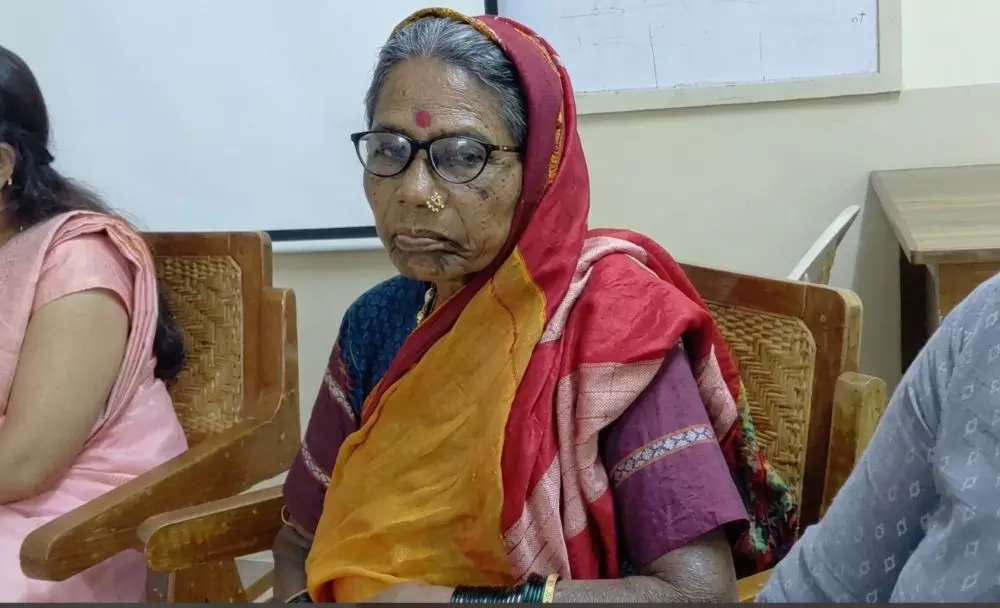
Former Devadasi Padiyamma at an event. Photo: Sharanu
The stories of abuse and struggle are many.
A Devadasi from Vijayanagara district recalls falling in love with and marrying a man from the Muslim community. Since the Devadasi system is not prevalent in Islam, she began a new life with him. However, after her husband passed away, she was forced to marry off her daughter while she was still a student in class IX. With two children of her own now, the former Devadasi’s daughter says she continues to face harassment and abuse because of her mother’s past.
“Eventually, I returned to my mother’s house. Despite arranging for an auto-rickshaw for my husband on EMIs, the suspicion and abuse did not stop. I am struggling to educate my two children in an English-medium school. I have applied to be included in the Devadasi survey,” she says.
Over the years, NGOs and individual activists have been stepping in to support former Devadasis and their families. An organisation in Kudligi, Ballari district, has been looking into the health needs of girls from Devadasi families since 2023. In Athani, a residential school helps children from these families access education.
With the result that some encouraging positive stories are now being reported.
Manjula Malgi, a resident of Mariammanahalli in Vijayanagara district, was born into a Devadasi family. For eight generations, the women in her family were part of the Devadasi tradition.
“We are an agricultural family, and Malgi is our family name. Since our great-grandmother’s time, ours has been a Devadasi family. Unmarried girls were taken to the Anjaneya temple, bathed after applying turmeric, dressed in green sarees and bangles, and dedicated to the deity. But after my siblings and I were born, my mother was determined to educate us well, even if it meant begging. She did not want us to go through the suffering and exploitation she endured,” says Manjula.
She adds: “After I completed my postgraduate degree, M Bhagyalakshmi, director of Sakhi Trust [an NGO], arranged my marriage in a simple ceremony at her office. I now have a daughter. My biggest dream is for people from my community to become educated, progress, and live with dignity.”
Another daughter, of a Devadasi, Kamakshi, managed to escape the system despite her “mother’s intention to dedicate her as a Devadasi”, she says. Kamakshi is now pursuing a PhD at the University of Sussex, UK.
She too says she received support from Bhagyalakshmi, crediting the Sakhi Trust for providing her with financial assistance for her education and standing by her at every stage.
“I have had to face the recurring question of who is my father. But I am determined to pursue higher education and rise above these challenges,” she says.
Also read: Why a Karnataka farmer’s campaign for road access to his land has made him a local ‘Gandhian’ hero
Padiyamma too managed to pull herself out of the Devadasi system in 1992, even going on to contest in the gram panchayat elections and be elected president of the panchayat. Neither of her sons survived the struggle years, but she has managed to get both her daughters married.
For years now, she has been taking a stand to eradicate the Devadasi system, fighting through the Vimukta Devadasi Mahila Vedike (Forum of Liberated Devadasi Women). "No one should ever become a Devadasi. There is no end to our suffering, mental and physical. There is no dignity to that life,” she says.