- Home
- India
- World
- Premium
- THE FEDERAL SPECIAL
- Analysis
- States
- Perspective
- Videos
- Sports
- Education
- Entertainment
- Elections
- Features
- Health
- Business
- Series
- In memoriam: Sheikh Mujibur Rahman
- Bishnoi's Men
- NEET TANGLE
- Economy Series
- Earth Day
- Kashmir’s Frozen Turbulence
- India@75
- The legend of Ramjanmabhoomi
- Liberalisation@30
- How to tame a dragon
- Celebrating biodiversity
- Farm Matters
- 50 days of solitude
- Bringing Migrants Home
- Budget 2020
- Jharkhand Votes
- The Federal Investigates
- The Federal Impact
- Vanishing Sand
- Gandhi @ 150
- Andhra Today
- Field report
- Operation Gulmarg
- Pandemic @1 Mn in India
- The Federal Year-End
- The Zero Year
- Science
- Brand studio
- Newsletter
- Events

Why Goans living along the Mandovi are against the entry of a new mega casino vessel into the river
The High Court of Bombay in Goa has passed an interim order barring the entry of the ship into the Panjim port without the prior permission of the court. A resident of the state capital, member of a citizens' group protesting against the new vessel, explains how such offshore casinos have ‘impacted their lives over the years’.

In February this year, residents of Panjim woke up to a flurry of activity in the Mandovi river. Mooring buoys were being installed upriver close to the new Patto bridge, leading to speculation of a new ship coming in. Enquiries made to the captain of ports revealed that one of the existing casino ships — the MV Horseshoe — was being moved from its position in the Verem bay to this...
In February this year, residents of Panjim woke up to a flurry of activity in the Mandovi river. Mooring buoys were being installed upriver close to the new Patto bridge, leading to speculation of a new ship coming in. Enquiries made to the captain of ports revealed that one of the existing casino ships — the MV Horseshoe — was being moved from its position in the Verem bay to this new location, to make way for a new 112-metre mega-casino to come into the river.
Earlier, residents of Reis Magos, a village on the opposite riverbank from Panjim, had pushed back against the proposed anchoring of the new casino vessel in the area.
“On October 2, 2025, we saw a barge doing dredging and mooring work with massive anchors near the Reis Magos riverbank and we were concerned about what was going on,” says activist and Reis Magos resident Harish Madkaikar. “We gathered a few villagers and stopped the work. We were angry as this was another attempt by the casino companies to take over our waters. The arrival of this mega-casino would destroy our livelihoods and ruin the river completely.”
The arrival of the new casino vessel would impact life on both sides of the Mandovi, say residents.
Madkaikar is now one of the petitioners — along with fellow activist Sudip Tamhankar and the association Enough Is Enough (spearheaded by retired Allahabad high court chief justice, former Janata Dal MLA and Goa resident Ferdino Rebello) — who have moved the High Court (HC) of Bombay in Goa against the proposed arrival of the new 112-meter-long casino ship in the Mandovi river.
While the HC has, in an interim order passed earlier this month, barred the entry of the ship, observing that the vessel shall not sail into the Panaji port without the prior permission of the court and without obtaining all the required certifications, the petitioners have also filed a caveat before the Supreme Court of India, apprehending that the casino company may challenge the interim order. The caveat ensures that no order can be passed by the Apex Court without first hearing the objections raised by the petitioners and citizens opposing the expansion of offshore casinos in Goa.
The ship – MV Deltin Royale – is reportedly currently at Mormugao Port.
Also read: Why a growing number of urban Indians are choosing treks to a relaxed resort holiday
Goa is home to six offshore casinos and over a dozen onshore casinos housed in five-star hotels. According to reports, in-principle approval for the controversial new vessel – MV Deltin Royale – was given to Delta Pleasure Cruises Limited in 2022-23. The casino company, in their application, had purportedly stated that the new ship would be a “replacement” for an existing casino ship – MV Royale Floatel - which would be moved out of the Mandovi.
Delta Corp currently holds three of the six offshore casino licences. The MV Royale Floatel (‘Kings Casino’) with a capacity of 70 passengers, MV Horseshoe (‘Deltin Royale’) with a capacity of 390 and MV Casino Royale (‘Deltin Jaqk’) with a capacity of 384.
The new ship MV Deltin Royale (not to be confused with the existing MV Horseshoe which is also branded and operating as Deltin Royale) has a reported capacity of 2,000 passengers. This is more than that of all the existing six casinos put together.
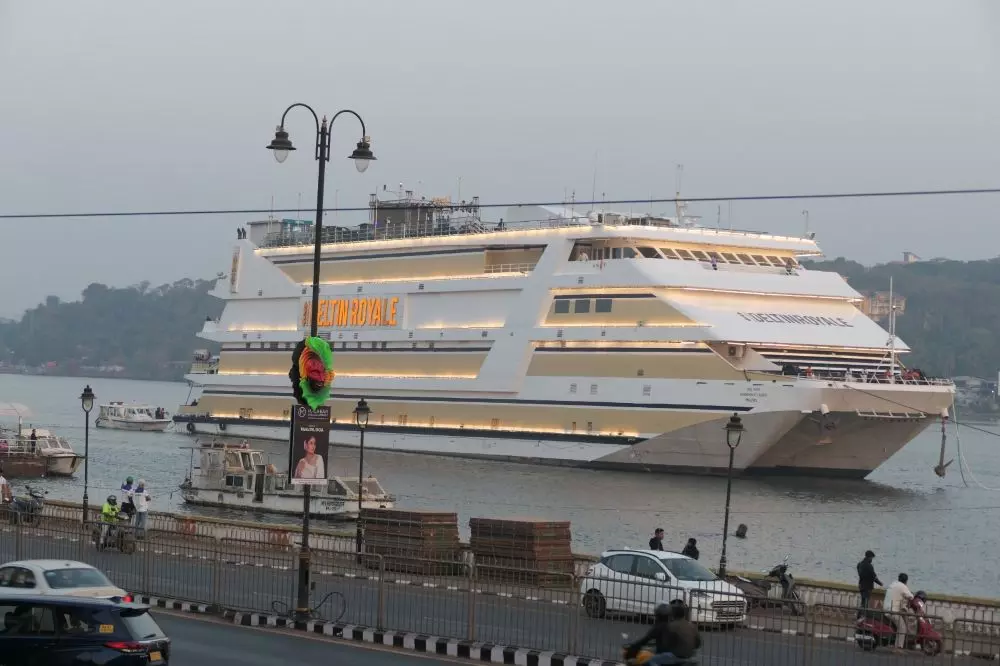
Deltin Royale (MV Horseshoe) temporarily relocated to near the Panjim river bank, opposite the Head Post Office. Photo: Chryselle D’Silva Dias
Activists and legal experts say The Goa Public Gambling Act, 1976, does not have any provisions for “replacement” of vessels. It allows for the transfer of licence, but that is for the same vessel. The casino licences are specific to the vessel. Delta Corp’s proposed replacement of a 70-passenger ship with one that can carry 2000 passengers would therefore be a violation of the Act.
While delivering the interim order earlier this month, barring the new vessel from entering the Mandovi, the HC reportedly observed that “Considering that as of today the vessel does not possess a certificate of survey, we deem it appropriate to direct that the vessel in question shall not sail into the Panjim port… without obtaining all the required certifications”. Even if it does acquire the documents, the court has stipulated that the vessel is forbidden from entering the river till it has received specific prior permission from the court.
The HC has also reportedly directed the Goa government that it would not amend the existing license for the MV Royale Floatel to accommodate the new vessel without first presenting its decision to the court.
Also read: How some of Delhi’s erstwhile ‘refugee colonies’ evolved into upscale neighbourhoods
The fight against casinos is not a new one in Goa. Since 2008, activists and residents have raised their voices and hit the streets against the proliferation of the gambling industry. Several activists like Tamhankar, Kashinath Shetye and Dr Aquaviva Fernandes have also sought legal intervention, some of which are still ongoing. Public sentiments against offshore casinos are more intense because of issues like parking in residential areas or public places, crowding, and disruption of normal life and the impact on the river water and livelihoods connected to it.
“When an amendment to the Goa Gambling Act was made [in 2012, to legalise and facilitate the operation of casino vessels in inland waters instead of the sea], we as Bailancho Saad protested and demanded its repeal,” recalls Sabina Martins, activist and founder of Bailancho Saad, a women’s rights group.
“The first casino boat in the river Sal [in south Goa] was objected to by the people of the area, supported by women's groups, civil society leaders, social justice church organisations and others and the boat was shifted to the Mandovi,” explains Martins.
Bailancho Saad has been protesting against the presence of casino vessels in the river since 2009, if not earlier.
The casinos operate 24X7, which means they have staff vehicles parked around residential areas at all times. The sheer volume of two and four wheelers is a strain on Panjim’s roads. Vehicles belonging to clients, loud music, disturbances in the middle of the night from drunk staff members and customers – all of this has added to a high-tension situation between residents and the casino operators. Complaining to the police or to the Corporation of the City of Panaji has yielded no permanent solution yet, say those in the know.
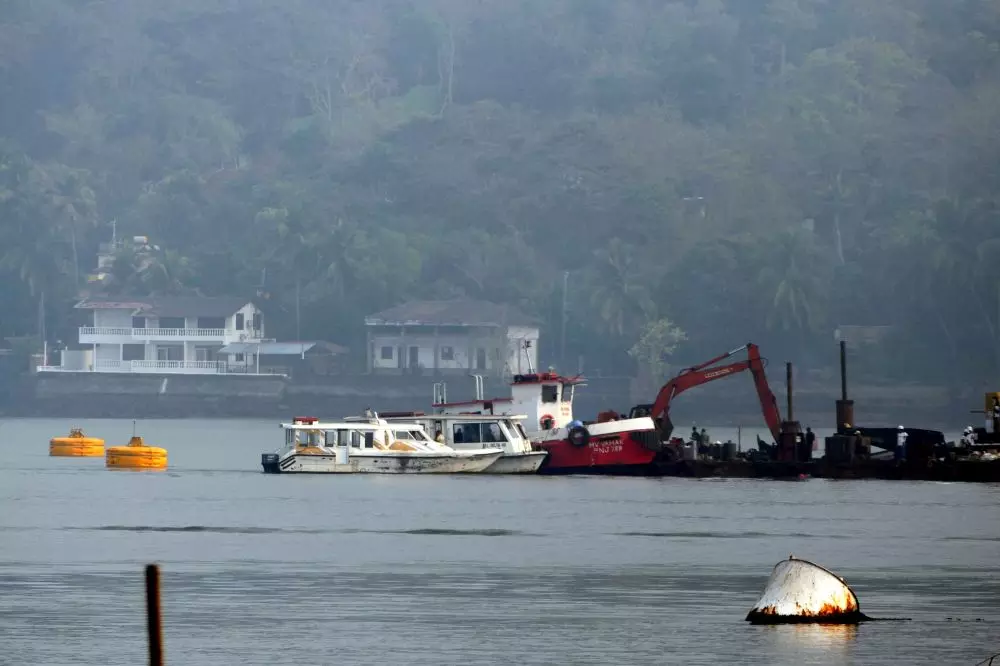
Mooring work for the new casino vessel at Verem Bay in April. Work has now stopped. Photo: Chryselle D’Silva Dias
The tiny state of Goa is home to a mere 169,000 people (as per projected figures from Census 2011 data). In contrast, the state reportedly received a staggering 1.08 crore visitors in 2025. A significant number of these would have visited the capital Panjim, for its historical importance, unique colonial Goan architecture and an exploding food scene. But the volume of visitors puts a strain on the city’s infrastructure. To this, add a constant flow of casino staff and visitors and the city is bursting at the seams.
“Casinos have encroached on public spaces, littered the entire state with illegal casino ads, caused addiction and created untold miseries in families”, says Martins. “We have seen increased violence and health issues, suicides, unnatural deaths, theft, dacoity, growing debt, distress sales and assault of women on streets. There is also enough evidence of noise pollution and traffic congestion owing to casinos in Panjim.”
Last year, a guest was held for allegedly murdering a casino security guard and injuring another, following an argument. In another incident, a visitor was booked for allegedly molesting a woman at an offshore casino.
Tests conducted by the Goa State Pollution Control Board on water samples collected over the years from five locations around the casino vessels anchored in the Mandovi also reportedly showed upto 200 per cent higher levels of faecal coliform bacteria in the river. The findings were tabled in the Goa assembly earlier this year. The High Court of Bombay in Goa has taken suo motu cognisance of the pollution and asked for a report from the Goa State Pollution Control Board by June 1.
In addition to these issues, RTI documents filed by activists like Sudip Tamhankar between 2019 and 2025 revealed several irregularities in the approvals for the new casino vessel. According to the documents, copies of which are available with The Federal, secretary (Ports) and other officials had warned the government in a file noting in 2021 that a new vessel of this size may create further navigational hazards, which would create a bottleneck at the mooring positions. Despite such cautionary recommendations, the government gave its nod for in-principle approval to bring in the new vessel.
Goa’s casinos are a rich revenue source for the state. The Goa government has reportedly earned Rs 1749.32 crore in revenue from casino operations in the past five years.
Also read: How ‘baithakis’ — intimate gatherings over conversation, culture and cuisine — are making a comeback
When the residents of Panjim first got to know about the impending arrival of the new casino vessel earlier this year, they formed a citizens group called “Ponnjekars Against Casinos” (PAC), to raise awareness about its potential impact on the river and the city. The group began with mostly residents from Panjim [including the writer of this article]. Prominent members included activists Patricia Pinto and Sabina Martins and Valmiki Naik, president of the Aam Aadmi Party Goa, in his capacity as a Panjim resident.
Over time, PAC delegations met various government department heads including captain of ports, minister of ports, the mayor of Panjim and Chief Minister Pramod Sawant, who “assured them in March that the boat is not coming”.
“Ponnjekars Against Casinos was formed as an emergency response to the new vessel coming into the Mandovi. The city is already reeling under the strain of so many casinos on land and in the water. There is also a significant threat to the fragile ecosystem of the Mandovi river with such a big vessel planned to moor here permanently,” says Amita Kanekar, architect, writer and member of PAC. “The recent reports on high levels of faecal coliform around the offshore casinos only prove what we have been saying for years – that the casinos are polluting the water with sewage. Our water stinks and our fish catch has reduced, which impacts everyone.”
In an earlier interaction with the media and public, available on social media, S. Muralidhar, retired chief justice of the Odisha high court and senior counsel of the petitioners in the case against MV Deltin Royale, had cited how any approval to the vessel to operate in Mandovi would be “ completely at odds with the statutory provisions which contemplate phasing out the existing casinos and taking them back to territorial waters if they still want to operate. Because the statute only contemplates vessels in territorial waters, not inland waters”.
The captain of ports Octavio Rodrigues, responding to The Federal's queries, said that documents relating to the final survey of the MV Deltin Royale by Indian Register of Shipping (IRS) are yet to be received by them. "The process is ongoing and is expected to be completed soon," he said. The Federal has also reached the Deltin for comment. The article will be updated if a response is received.
The next court hearing on the matter is on 6 July at the High Court of Bombay in Goa.
“The difference between the protests then and now is that twenty years ago, we predicted what would happen. Today, people experience firsthand the negative fallout of the casino industry,” says Martins. “Pollution of the river, traffic congestion, alienation of locals with hordes of people coming in, crimes increasing, families – women, children, elderly – suffering owing to addiction violence – all this has affected the quality of life. No amount of money can compensate for these losses to Goa.”