Why a growing number of urban Indians are choosing treks to a relaxed resort holiday
While visits to families, pilgrimages, or traditional sightseeing holidays would still account for a majority of travels by Indians, a growing segment, largely urban and upwardly mobile, is choosing experience-led journeys. Trekking now sits at the forefront of this shift, signalling a move to self-driven exploration.

Not every walk is a walk in the park. Cue in India’s growing interest in trekking — a journey, often long and arduous, amidst nature, made on foot.The urge to be in communion with nature is increasingly drawing urban travellers to find ways to get away from routine and trekking seems to be rising exponentially as a sector of its own.For Pune-based Mahesh Kailash Mhetre, a...
Not every walk is a walk in the park. Cue in India’s growing interest in trekking — a journey, often long and arduous, amidst nature, made on foot.
The urge to be in communion with nature is increasingly drawing urban travellers to find ways to get away from routine and trekking seems to be rising exponentially as a sector of its own.
For Pune-based Mahesh Kailash Mhetre, a 42-year-old technical specialist, the initiation came whe he was just nine years old. The first experience was a short one, a trek to the Singhabad fort near Pune; but it left him yearning for more.
“Trekking gave me an opportunity for self-reflection, appreciating the beauty of nature, testing my resilience, the patience to take each step slowly and appreciate the pace. It turned me into a bibliophile. Now, I admire boredom and the calmness it brings with it,” says Mhetre.
While trekking has changed his mind set in a holistic manner, his last year’s trek to Kailash Manasarovar, he says, has made him learn “poetically from nature that everyone is different in their own way and to accept them accordingly will only bring peace and harmony.”
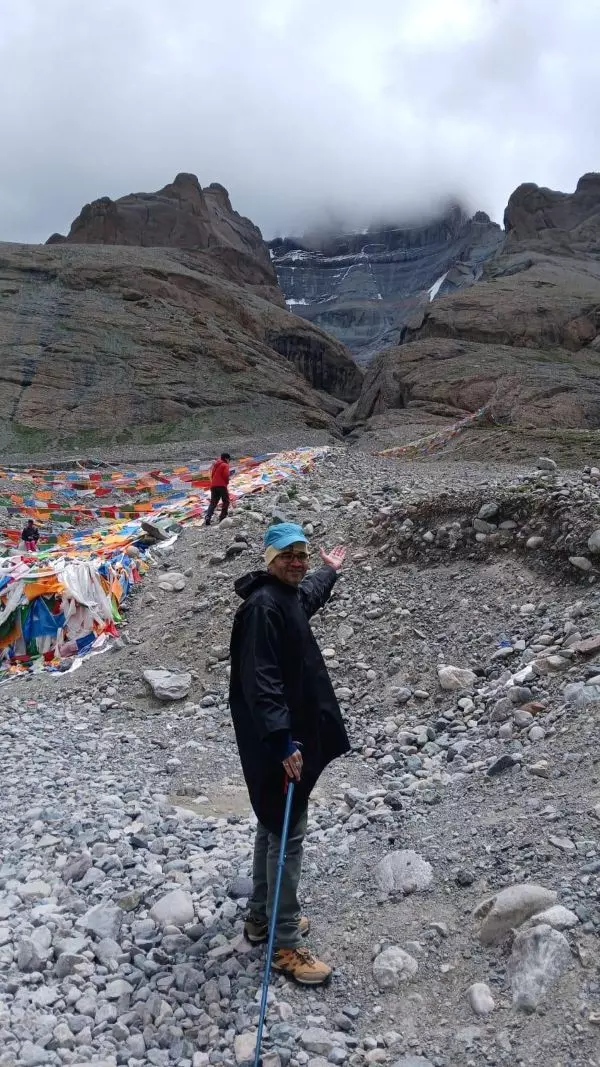
Pune-based Mahesh Kailash Mhetre on the trek to Kailash Mansarovar last year. Photo: By special arrangement
Trek organisers speak of a spurt in interest in the past decade. Arjun Majumdar, co-founder of Indiahikes, a trekking organisation with offices in Bengaluru and Dehradun that he started with fellow-trekker Sandhya UC in 2008, pegs the growth at over 300 per cent in the past 10 years.
“The scene has changed considerably over the past 15 years,” he says. “Trekking is now considered a sport rather than a niche activity that few would do.”
It is an observation shared by Nanditha Iyer, co-founder of the all-women travel community Dream Destinations, which organises getaways for women travellers. She acknowledges the interest in trekking and its rise amongst her “tribe,” as she likes to call her travellers. “We are seeing many more people in their 50s and 60s, especially women, being inspired to face more exciting challenges and explore the world of trekking. The number is much more than maybe a decade ago. I can say this about women specifically because we are a women-centric travel company with the aim of encouraging women to push the boundaries of age and fitness,” she says.
Also read: How some of Delhi’s erstwhile ‘refugee colonies’ evolved into upscale neighbourhoods
The trekkers are mostly city-based — for Manjumdar, the numbers come from Bengaluru, Mumbai-Pune, New Delhi, Kolkata and then other cities like Ahmedabad and Surat, in that order, he says.
He attributes the trend to a combination of factors.
“I would say trekking has emerged as the sought-after getaway after the rise of new-age industries like IT, pharma, banking and so on,” he says, adding that the global exposure of these corporate workers and ‘word-of-mouth’ publicity help boost interest. “When you are in the office and hear ‘Mahesh’ [or some such] talking about his trekking experience, then the thought that comes to mind is ‘If Mahesh can do it, so can I.”
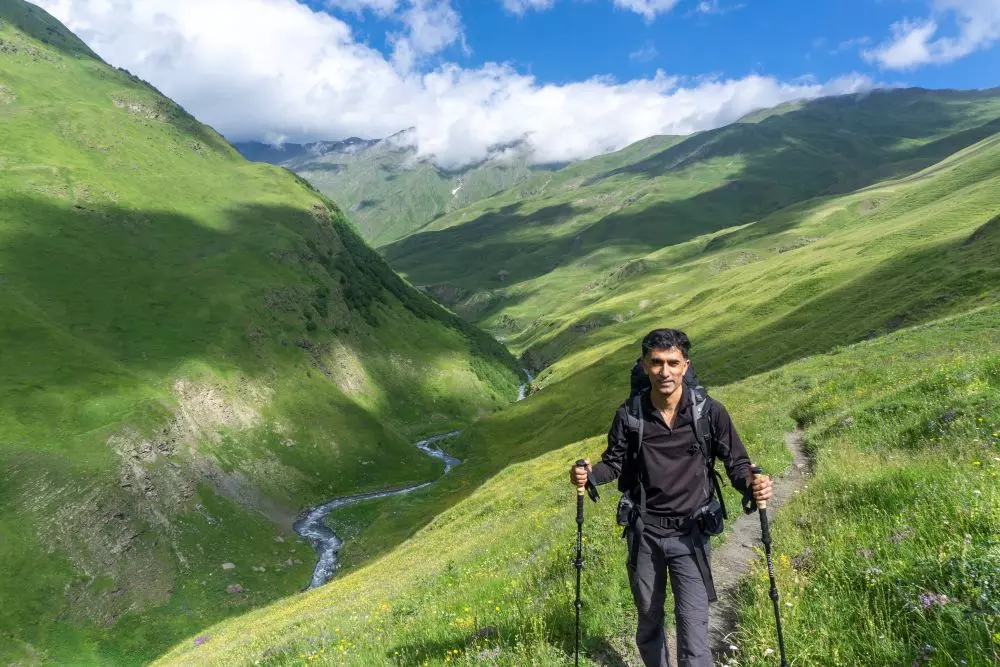
. Arjun Majumdar, co-founder Indiahikes, on a trek. Photo: By special arrangement
Iyer also acknowledges the influence of social media. “Social media has been a big influencer in this phenomenon,” she admits. The travel entrepreneur also believes that the availability of premium trekking equipment, trek wear and trek poles has also added to the confidence of trekkers.
Easy access is another factor that has helped boost interest. A decade ago, trekking required local knowledge and careful planning. Today, a growing ecosystem of organised operators, curated itineraries and online communities has lowered the barrier to entry. From arranging permits and transport to providing trained guides and safety support, much of the uncertainty has been removed, allowing even first-time trekkers to attempt high-altitude trails with a degree of confidence. “We believe that the onus is on us as a travel provider to ensure that our attention to safety standards and protocols truly reflects our belief that our travel tribe is our family,” Iyer says.
The wide array of experiences to choose from also plays a role in popularising treks. While the rise of customised packages has made the exercise attractive for first-time trekkers, those with restricted time at their disposal may opt for a quick weekend getaway.
Sowmya R, a 34-year-old marketing professional working in Bengaluru, talks of her experience trekking in the remote area of Sikkim in 2020. “My friend is from Sikkim and she had arranged with a local guide to take us, my husband and me, through Northern Sikkim. We even spent one night at a tribal village because the guide belongs to that tribe. It was memorable and totally worth the money,” she says.
Meanwhile, short itineraries around cities have turned trekking into a regular escape rather than an annual expedition for weekend trekkers, says Majumdar.
Bengaluru-based 40-year-old lawyer Vishwas Kumar talks of going to the Western Ghats whenever there is a long weekend. “I don’t plan too much in advance because of the nature of my job,” he says. “Instead, I do short treks whenever possible, sometimes even a day-long trek.”
When it comes to spending power, too, there are choices available. Depending on locations, treks can cost as little as Rs 16,000 to as much Rs 3 lakh or more. Flight tickets, in case flying is required to the trek starting point, can be inclusive or separate, depending on the package.
Also read: Why Bengal's iconic jhalmuri and telebhaja may be seeing a change in fortunes in Kolkata
And so, the idea of a walking holiday has caught the fancy of professionals who could otherwise easily afford a relaxing holiday at an upscale resort.
Sridevi Jade, a 60-year-old Bengaluru-based scientist and veteran trekker, started trekking because of her work. Her research work in the late 1980s required long, demanding trekking expeditions to install seismic observatories across remote stretches of the Himalayas, in Ladakh, Garhwal and Kumaon. “It was there,” she says, that “trekking became something more than a professional obligation. The mountains offered me a rare kind of ‘high’ along with peace which I find it difficult to put into words”.
Iyer agrees. “I see my girls, especially those over 50, approach trekking almost as a spiritual experience. There is something incredibly satisfying in the quiet trek where it is just you and the landscape. The absence of the phone (connectivity is often poor) is also very therapeutic, and there is a new appreciation for this. It’s wonderful to see,” she says.
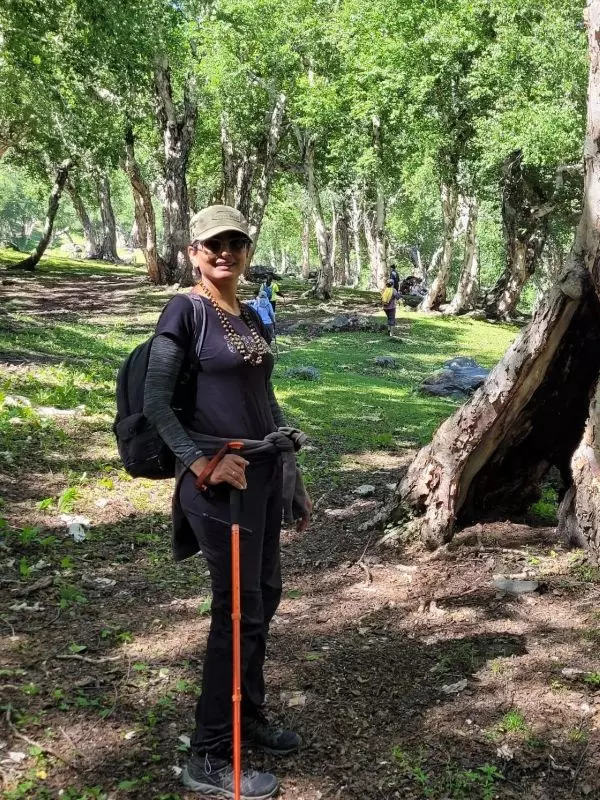
Nanditha Iyer, co-founder of the all-women travel community Dream Destinations, on a trek. Photo: By special arrangement.
For Mhetre, the real power of travelling on foot is that it encourages interaction.
“Many of us will go to great lengths to avoid speaking with strangers and this behaviour has spilled over from our daily lives to the way we travel,” Mhetre notes. “Now, wherever I go, I acknowledge the local culture and dishes, appreciate their way of life and respect them for their choices. Before (trekking), I used to go as a tourist, but now I go as a traveller. When I look back and connect the dots, trekking has introduced me to other things as well, like photography, especially micro photography. So yes, my life has changed for the better.”
There are the benefits of physical and mental fitness and wellbeing.
Both Jade and Mhetre believe it is one of the reasons why trekking has become an informed choice of holiday amongst corporate professionals who battle with stress and limited physical activity. “I think trekking gives us a sense of achievement and has great health benefits compared to other hobbies,” Jade notes.
Therapist A Gulati points out the mental health benefits that drive people to trekking. “In cities, we are constantly processing information. In the mountains or through forests, that noise drops away. Trekking becomes a way of regulating the nervous system without us even realising it.”
For Majumdar and his team, the natural beauty of the trail is an important factor while choosing trekking routes. “Difficulty level is not the decider,” he says. “It is always about the scenic landscape,” he notes. “Trekkers like to see a variety on the trail, from rivers, lakes, alpine forests, grasslands and so on. That’s what makes trekking special.”
While the Himalayas remain a constant, other trails too have been gaining popularity. On its website, Indiahikes mentions that ‘our trekkers are so used to Himalayan treks that they don’t know how different and wonderful our central Indian treks are…’. “One of my personal favourites includes the Chhattisgarh Jungle Trek, which we organise through the dense jungles of Chota Nagpur plateau,” says Majumdar.
Also read: How ‘Khela Hobe’ went from an election slogan to one of India's most defining political battle cries
But as humans penetrate deeper into nature, the environmental costs are something to worry about. With easy accessibility, popular trails are beginning to show signs of strain with overcrowding, littering and trail erosion emerging as growing concerns, prompting tighter regulations and permit systems in several regions.
“What I observe is that there are many who disregard the environment by throwing trash carelessly around and not observing proper protocol when in close contact with nature,” Mhetre says. There is also the newfound compulsion to record everything for social media. “People are more inclined to take selfies and post pictures on social media platforms to show the world that they are having a gala time. There is no dearth of social media influencers who go through desperate and careless measures to create followers. Further, it has become a habit among a select few to yell or talk loudly while trekking. This ruins the peace and serene atmosphere. We, as Indians, need to rectify our behaviour in public.”
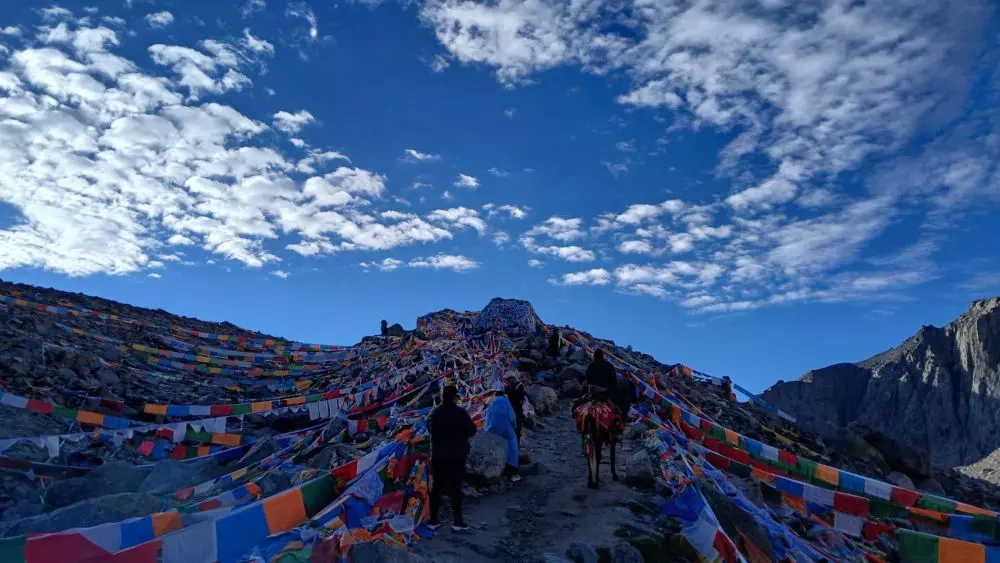
Another moment from Mahesh Kailash Mhetre's trek to Kailash Mansarovar. Photo: By special arrangement
Safety, too, has come into sharper focus, as an influx of first-time trekkers takes on increasingly demanding routes. Recently, GS Sharanya, a 36-year-old IT professional from Kerala, was rescued safely after disappearing for four days in Karnataka's dense Tadiandamol hills in Kodagu. She got separated from a 10-member group on April 2 and survived with little water, no food and a dead phone, drinking water from a stream and staying calm.
Not all, however, are lucky enough. State governments are now stepping up in creating stringent rules and regulations. The Karnataka government, as a reaction to Sharanya’s incident, has implemented strict new trekking rules (SOPs) requiring mandatory certified nature guides, pre-registered bookings, and GPS tracking for all forest trails. Key rules include a 1:10 guide-to-trekker ratio, a 150-person daily limit per trail, a ‘no-guide-no-trek’ policy, and a ban on night trekking and single-use plastics.
“We believe that the onus is on travel providers to ensure safety standards and protocols,” Iyer notes. “A government mandate absolutely banning trekkers from heading out on their own may be a very good idea just to prevent over-zealous newbies who put their lives in danger.”
Individual preparation is important too.
Majumdar notes the difficulty level of a trail is for many not deterrent. “Those who are determined to do a particular trail will find a way to prepare for it,” he says. In most cases, travel operators list out the difficulty level of the treks they plan. They issue detailed guidelines tailored to the route. Nanditha Iyer further corroborates, "We are always very very careful with the arrangements. We have a good expert local guide team wherever we go trekking. We assess and ensure that the trek is reasonable for the group’s fitness level. They are also given a real time picture of what they can expect and asked to train accordingly ahead of the trip. All our clients in general are pretty good about preparing for the journey. We always maintain that balance between being challenged and feeling overwhelmed on a trek."
Most of the usual treks in mountains and other terrains require some amount of training. Sowmya remembers training before trekking the Rupin Pass (15,279 ft) last year. "I was doing 5km runs every Sunday for one month apart from climbing 10 flights of stairs on alternate days. I would carry a backpack that was stuffed with about four pairs of jeans and a one-litre water bottle."
For high-altitude expeditions, a medical fitness certificate is typically mandatory, including a cardiovascular evaluation and lung function tests. Before his Kailash trek, Mhetre underwent three days of fitness checks. “Having good fitness is mandatory but there is no real training for altitude,” he says. “What we were advised was to keep active during our acclimatisation pitstops and to walk around as much as possible. That, along with proper rest, becomes critical.” A full night’s sleep, he adds, is not just restorative but essential for maintaining stable oxygen levels at higher elevations.
Despite growth, the Indian market remains small as compared to international demands.
According to market intelligence platform Grand View Horizon Databooks, the global adventure tourism market, which includes trekking as a core activity, was valued at around $1.16 trillion in 2024, reflecting a deeply mature and mainstream sector across regions like Europe, North America and parts of Asia. In contrast, India’s entire adventure tourism market is estimated at roughly $19–20 billion in 2025, though it is growing rapidly at over 20 per cent annually, one of the fastest rates in the world.
“Trekking in India, as compared to global standards, is still a small market,” concurs Majumdar. “But the interest in trekking is rising exponentially. State governments are now seeing the benefits in promoting trekking and many have invited us to suggest new trails and promote those trails,” he says
However, as Jade puts it, the future of trekking will likely hinge on how well the sector manages sustainability, builds awareness among trekkers and preserves the fragile ecosystems that make these journeys possible in the first place. “Sustainability and respecting the laws of nature are the only ways forward if we wish our future generations to enjoy trekking as much as we do.”