- Home
- India
- World
- Premium
- THE FEDERAL SPECIAL
- Analysis
- States
- Perspective
- Videos
- Sports
- Education
- Entertainment
- Elections
- Features
- Health
- Business
- Series
- In memoriam: Sheikh Mujibur Rahman
- Bishnoi's Men
- NEET TANGLE
- Economy Series
- Earth Day
- Kashmir’s Frozen Turbulence
- India@75
- The legend of Ramjanmabhoomi
- Liberalisation@30
- How to tame a dragon
- Celebrating biodiversity
- Farm Matters
- 50 days of solitude
- Bringing Migrants Home
- Budget 2020
- Jharkhand Votes
- The Federal Investigates
- The Federal Impact
- Vanishing Sand
- Gandhi @ 150
- Andhra Today
- Field report
- Operation Gulmarg
- Pandemic @1 Mn in India
- The Federal Year-End
- The Zero Year
- Science
- Brand studio
- Newsletter
- Elections 2024
- Events

Why ban on non-Hindus’ entry to Kedar-Badri shrine may not be in interest of ‘faith-based’ economy
The Badrinath-Kedarnath Temple Committee's ban on the entry of non-Hindus to the inner sanctums and immediate complexes of the Kedarnath-Badrinath shrines, as well as 45 other temples managed by it, comes ahead of the 2026 Char Dham Yatra.

In her debut film Kedarnath, released in 2018, Bollywood actor Sara Ali Khan played the daughter of a Hindu priest in love with a Muslim ‘pithoo’, a porter who carries pilgrims to the Hindu shrine set in the mountains on his own back, a character played by the late Sushant Singh Rajput.Perhaps the film helped Khan form a special bond with Kedarnath and the actor has returned to the...
In her debut film Kedarnath, released in 2018, Bollywood actor Sara Ali Khan played the daughter of a Hindu priest in love with a Muslim ‘pithoo’, a porter who carries pilgrims to the Hindu shrine set in the mountains on his own back, a character played by the late Sushant Singh Rajput.
Perhaps the film helped Khan form a special bond with Kedarnath and the actor has returned to the shrine since, posting about her visit on social media.
And so, days after the Badrinath-Kedarnath Temple Committee (BKTC) passed a proposal earlier this month, banning the entry of non-Hindus to the inner sanctums and immediate complexes of the Kedarnath-Badrinath shrines, as well as 45 other temples managed by the BKTC, the buzz has centred around would Khan be allowed entry now, if she were to return to the temple.
The ban on entry of non-Hindus, which is likely to receive the affirmation of the Uttarakhand government, comes ahead of the 2026 Char Dham Yatra, which includes pilgrimages to Gangotri, Yamunotri, Kedarnath and Badrinath. This year, the pilgrimage season opens on April 19, coinciding with Akshaya Tritiya, an auspicious day in the Hindu calendar, when the Gangotri-Yamunotri shrines will open for darshan; the Kedarnath darshan is scheduled to open on April 22, while the Badrinath shrine will open for pilgrims on April 23.
Also read: Why the cultural intermingling that formed the core of ‘Holi Milan’ appears to be losing its hue
The potential impact of the ban, of course, is much more severe than whether Khan is allowed entry to the shrine.
“The new rules are deeply polarising,” says Dalit rights activist Bhanwar Megwanshi. “How would Hindus feel if they are banned from entering the Golden Temple in Amritsar or the Ajmer Sharif Dargah?”
Responding to media questions on the ban, BKTC chairman Hemant Dwivedi has said, “Those (non-Hindus) who have faith in Sanatan Dharma—and who provide a written declaration stating, 'I am a Sanatani; I believe in Hindutva'—are all welcome.” The committee has reportedly already prepared a standardised affidavit format for such declarations.
Scoffing at such ‘allowances’, Megwanshi asks, “If the argument is that if non-Hindus enter the temple premises, the temple will get polluted, how can an affidavit confirming devotion to Sanatan Dharma help? And how come Japanese Prime Minister Shinzo Abe was allowed to perform Ganga Aarti in Varanasi [during a visit in 2022]?”
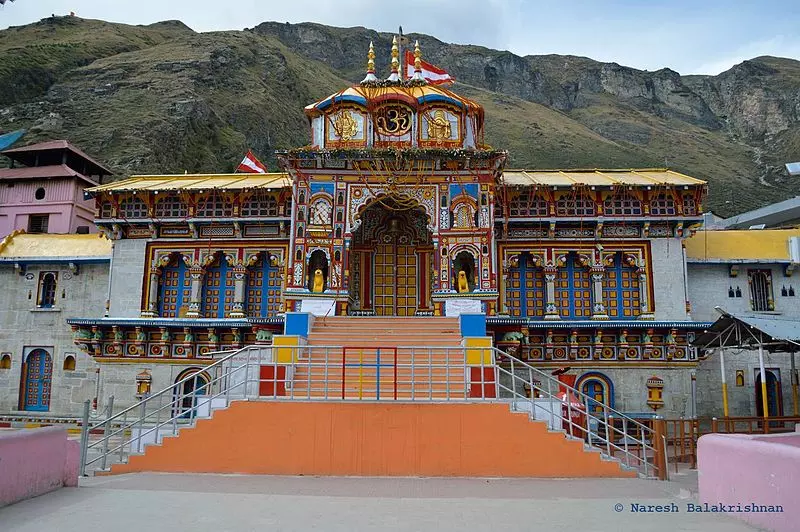
The Badrinath temple in Uttarakhand. Photo: Wikipedia
A push to ‘spiritual tourism’ and ‘faith-based economy’, which could reportedly potentially contribute about 5 per cent of India’s GDP, has been a repeated theme in many of Prime Minister Narendra Modi’s addresses. The past years have seen the Centre and some state governments adopting schemes to revive India’s civilisational pride by developing spiritual circuits and modernising pilgrim amenities. These include redevelopment of temple corridors and pilgrimage sites, such as the Kashi Viswanath Corridor project with a reported cost of Rs 48,459 crores — which has revitalised Varanasi by transforming its ancient ghats, narrow streets and temple access — the Ma Kamakhya Temple development project in Assam, undertaken at a reported cost of Rs 29.80 crore and the Kedarnath redevelopment project, with a reported estimated cost of Rs 207.3 crore. Access to major pilgrimage places has also been boosted or are in the process of being so.
The efforts may already be showing results.
According to the Ministry of Tourism figures, foreign tourist arrivals to India declined in 2025, falling by 9.4 per cent to 9.02 million during the year. The slide was reportedly owing to a steep drop in visitors from Bangladesh. The US remained the top source country with 1.81million tourist footfall, followed by the UK at 1.07 million.
Meanwhile, tourism data shows, foreign tourist arrivals in the Himalayan pilgrim spots have seen a steady increase over the past few years. While the total tourist arrival in Kedarnath Dham was reportedly recorded at 16.56 lakh in 2025, over 10,000 foreign tourists visited Char Dham last year.
Also read: Amidst exploding spiritual tourism, how Tamil Nadu’s Navagraha temples offer a quiet ode to pattern
Now the ban by BKTC has come as a disappointment to some. “As someone from abroad who truly loves India and has always felt deeply drawn to its Hindu culture, this makes me a little sad. What has always inspired me about Hinduism is its openness, its philosophical depth, and the sense that it welcomes seekers from everywhere,” a 59-year-old podcaster based in Louisville, US, who has travelled to India twice in the past two years, told The Federal on condition of anonymity.
He added: “I completely respect that temples are sacred spaces and that traditions must be honoured. At the same time, being able to visit—even quietly and respectfully—has been a meaningful way for people like me to understand and appreciate that spirituality. So, while I understand there may be reasons behind this decision, I can’t help but feel a sense of loss. India, to me, has always stood for inclusiveness and a certain spiritual generosity, and I hope that spirit continues to remain accessible to people from all backgrounds.”
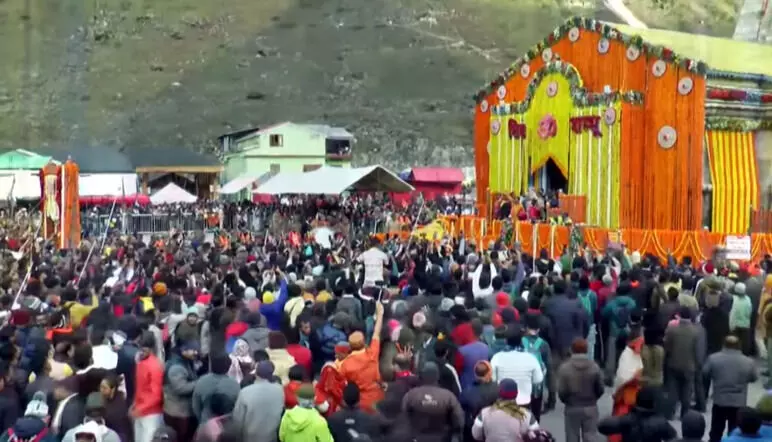
File photo of the sea of pilgrims at the Kedarnath shrine.
For generations, foreigners like this US-based podcaster have been coming to India in search of spiritual awakening and healing. While many have been drawn to worship of the Hindu deity Krishna, joining organisations like the International Society for Krishna Consciousness (ISKON), many can be seen picking up the nitty-gritties of yoga in places like Rishikesh.
The BKTC is not the first Hindu temple committee to ban the entry of non-Hindus. Similar bans exist at the Puri Jagannath temple, the Somnath temple in Gujarat, the Guruvayur temple in Kerala and the Kashi Vishwanath temple in Varanasi, to name a few. Yet, it is equally true that wherever it exists, it has time and again raised questions of the ban being alien to the inherent inclusivity of Hindu philosophy.
"The footfall of foreign and non-Hindu tourists isn't going to be affected much, as 99 per cent of the tourists who go there [Char Dham] are Hindus. Of the minuscule foreign tourists who do go there are likely to be NRI Indians from Mauritius, Singapore and others. The trek to Kedarnath is treacherous and not many are able to complete it. And there is no bar on visiting Kedarnath town as such, only the temple premises and garbagriha [sanctum sanctorum] are out of reach. Many foreign tourists would ideally like to take in the surrounding scenic beauty,” Rajnish Kaishta, senior vice-president, Indian Association of Tour Operators (IATO), told The Federal.
He added, however: “Personally, though, I feel such riders like a ban on entry of non-Hindus should not be there. Because non-Hindus, who are able to complete the Char Dham yatra, would definitely have some reverence and possibly deep devotion for the deity and would abide by the rules of the place.”
His sentiments were echoed, in part, by Surendra Shahpura, president, Federation of Hospitality and Tourism of Rajasthan (FHTR). “This rule is not new and followed by many other temples in India. And one should honour and respect the rules set by the temple authorities. Today, tourists go for immersive and experiential travel experiences, they live and feel the local culture, people and nature and hence should have reverence for the place’s spiritual aspect too. And should abide by the rules.” However, he felt the ban was bound to result in some dip in foreign footfall.
In a post on social media platform Instagram last year, Sara Ali Khan wrote, “Jai Shree Kedar! The only place in the world that feels totally familiar and yet leaves me awestruck and in wonder every single time. Only gratitude. Thank you for giving me everything I have and making me everything I am.”
Were she to revisit the shrine this year, though, Khan would require more than a post of gratitude on social media. She would require a signed affidavit, reaffirming her faith in ‘Sanatan Dharma’.