- Home
- India
- World
- Premium
- THE FEDERAL SPECIAL
- Analysis
- States
- Perspective
- Videos
- Sports
- Education
- Entertainment
- Elections
- Features
- Health
- Business
- Series
- In memoriam: Sheikh Mujibur Rahman
- Bishnoi's Men
- NEET TANGLE
- Economy Series
- Earth Day
- Kashmir’s Frozen Turbulence
- India@75
- The legend of Ramjanmabhoomi
- Liberalisation@30
- How to tame a dragon
- Celebrating biodiversity
- Farm Matters
- 50 days of solitude
- Bringing Migrants Home
- Budget 2020
- Jharkhand Votes
- The Federal Investigates
- The Federal Impact
- Vanishing Sand
- Gandhi @ 150
- Andhra Today
- Field report
- Operation Gulmarg
- Pandemic @1 Mn in India
- The Federal Year-End
- The Zero Year
- Science
- Brand studio
- Newsletter
- Events

How coaching institutes in Kota, Sikar are preparing for NEET-UG re-test
Following the cancellation of the exam held on May 3, amidst allegations of paper leak, and announcement of re-examination on June 21, institutes in these coaching hubs have transformed overnight into 're-test boot camps'.

Days after the National Testing Agency (NTA) announced a re-conduct of the undergraduate medical entrance examination, to be held on June 21, coaching centres in Rajasthan’s Sikar have transformed into a re-examination boot camp. The NTA had earlier cancelled the exams — titled the National Eligibility Cum Entrance Test (NEET) Undergraduate (UG) 2026, held on May 3 — amidst allegations...
Days after the National Testing Agency (NTA) announced a re-conduct of the undergraduate medical entrance examination, to be held on June 21, coaching centres in Rajasthan’s Sikar have transformed into a re-examination boot camp. The NTA had earlier cancelled the exams — titled the National Eligibility Cum Entrance Test (NEET) Undergraduate (UG) 2026, held on May 3 — amidst allegations of paper leak.
When the controversy erupted earlier this month, Sikar, a town that in recent years has emerged as one of India’s most important hubs of medical entrance coaching, found itself at the centre of it.
Shrawan Chaudhary, director and founder of CLC Sikar, one of the town’s biggest institutes, is quick to put the record straight. “Sikar is not where the leak happened; it is where the leak got exposed,” he says.
From what is so far known of the matter, the alleged paper leak purportedly came to light when a medical student from Kerala sent a handwritten ‘guess paper’ — or question bank to his father in Sikar. The father, who runs a paying guest accommodation in town, passed it, in turn, to the coordinator of a coaching centre, who immediately noticed similarities with the actual NEET question paper. The ‘guess paper’ had purportedly been in circulation on WhatsApp for about 15 days before the May 3 exam. Eventually, an email was sent to NTA, which set the probe in motion, and the subsequent cancellation of the previously-held test.
“The toppers, who feel they had performed well, are under stress. After the answer keys were released, there were those who saw themselves in the 650-plus score category, which would have ensured a seat in a government medical college. There is no assurance that their next attempt would be as good,” shares Ashish Arora, chief academic officer of the Jaipur branch of the Narayana chain of coaching centres.
He adds: “For weaker students, the re-test is a chance to improve their scores.”
Also read: With rising incidents of crimes against senior citizens, how to make Indian cities senior-friendly
There’s no denying that the paper leak controversy and the resultant scrapping of the first test and the decision for a re-examination have come as a blow to the students.
Sunidhi Kumar, an 18-year-old NEET aspirant, had been training at an institute in Sikar. Appearing for the first time in an examination which often takes aspirants multiple attempts to crack, Sunidhi felt her chances of clearing the test to be “quite high” after the May 3 attempt. By her calculations, she expected to score approximately 640 on a total 720. But the re-test is a curve ball she is not sure she can win over. “I am no longer sure of scoring high. I had only heard about previous paper leaks and the anxiety which students have to go through. I am witnessing it first-hand now,” she frets.
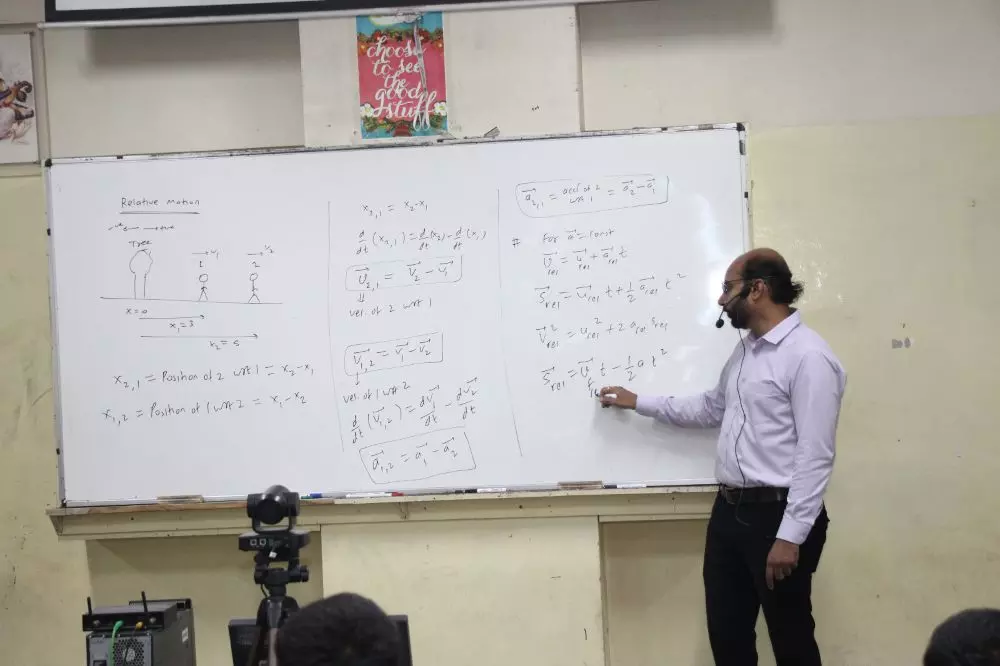
The teaching loop is built on a tight, mandatory 24-hour cycle. There are concept-based lectures, daily practice problems and topic sheets of multi-tiered question banks. Photo: By special arrangement
The stress surrounding the situation reportedly claimed the life of 22-year-old aspirant, Pradeep Meghwal. A resident of Gudha Godji town in Jhunjhunu (Rajasthan), Meghwal allegedly died by suicide following the cancellation of the May 3 exam. Family members were quoted as saying that the NEET aspirant had been preparing for the past three years in Sikar and “expecting a score of 650 this time”. The news of the cancellation resulted in a depression so deep, claimed his father, that he died by hanging himself at home. The family had reportedly invested Rs 11 lakh in his NEET preparation.
From depression to barely suppressed rage, reactions vary, but the underlying frustration remains the same for most students.
“This is not the first time [something like this has happened]. Students who use unfair means are able to buy these papers and get through the coveted seats, while we languish. We study long hours, almost 12-13 hours, stay away from home, sacrifice sleep, do not attend family functions, undergo mental stress but still compete with millions of students for one exam, which decides our fate. But the leaks and those who benefit have shaken our faith in the system,” fumes Pooja Khiledi, another aspirant who had been training at Sikar.
The routine at most coaching centres is indeed punishing.
For years now, coaching institutes across India have acquired tags like ‘cram factories’ or ‘killer factories’, owing to the hyper-competitive teaching methodology, which often puts students under extreme stress. Whether in Kota — which has long held the tag of being India’s NEET-Engineering coaching hub — or Sikar, which has risen to fame in recent years, or Delhi’s Guatam Nagar, which has over the years become a hub for medical coaching, it is the same gruelling, regimented system that is practised everywhere.
The pioneer was engineer VK Bansal, of the Bansal Classes in Kota in the mid-1980s, who started coaching students from his home initially through this unique teaching methodology. It is said that in 1985, when the first student coached by him cleared IIT-JEE, he left his job at JK Synthetics and went on to set up Bansal Classes in 1991.
Most coaching institutes now follow his model, where every single day of an academic year is mapped in advance. The teaching loop is built on a tight, mandatory 24-hour cycle. There are concept-based lectures, daily practice problems (where students receive a short, targeted assignment based on the morning’s lecture) and topic sheets of multi-tiered question banks, divided by difficulty levels.
The coaching centres also have ‘Doubt Counters’ to address individual queries by students which cannot be solved in the classroom.
The growth of the coaching centres has given the entire town an identity, with the city’s economy engineered around the incoming students. Paying guest accommodations, hostels, messes and even local stationery shops have grown up to support the coaching industry.
Students flock here from far and near, for the isolation and the study-focused environment. Being physically surrounded by peers with the exact same singular goal creates a psychological "network effect", which students say forces a level of focus and study stamina that is incredibly difficult to sustain alone at home. It isn’t just lecturing but a highly synchronised, industrial grade academic assembly line system designed specifically to crack the mechanism of multiple-choice, time-bound entrance exams.
It is also why, coaching centres say, despite many online platforms offering coaching now, pull of the traditional institutes remain.
Also read: How professional instability is shaping financial planning, career choices for Indians
Over the years, however, Kota has also drawn a fair bit of negative publicity over cases of students dying by suicide, unable to handle the pressure. Some of the coaching institutes have also been called out for segregating students into elite and non-elite batches on the basis of internal marking. Students have alleged that teachers concentrate more on star performers, who would ultimately create publicity for the institute by their results, therefore drawing more students and revenue for the institute.
Meanwhile, in the past five-six years, Sikar has slowly cemented its position, with at least seven to eight big coaching institutes, such as CLC, Prince, Gurukripa and Matrix, making headlines because of its top scorers. In the NEET-UG 2024, 37 of 50 exam centres nationwide with the highest percentage of candidates scoring over 650 out of the total 720, were located in Sikar, with more than 4200 students crossing the 600-mark threshold.
Following the announcement of the re-test, many non-locals who had left for home after the May 3 exam have started making their way back to institutes in Kota, Sikar, Jaipur and Delhi.
“We are giving test series and question banks again, but those who had come from rural areas would find it difficult to return and take the prep tests again. Online classes are no match for offline classes, which require a higher level of discipline in students. There is no check and minimal interaction to track their progress. Although now AI tools would be installed to assess the students’ progress in Online classes as well,” says Arora, of Narayana, Jaipur.
The momentum of study has been impacted, admits Manoj Sharma, founder and chief mentor, ScholarCITY Eduventures in Kota. “It is going to be a challenge for coaching institutes to bring students out of the trauma. Especially those who feel they have almost touched the finishing line. But counsellors and teachers are again into prep mode, preparing new test series to keep the motivation high.”
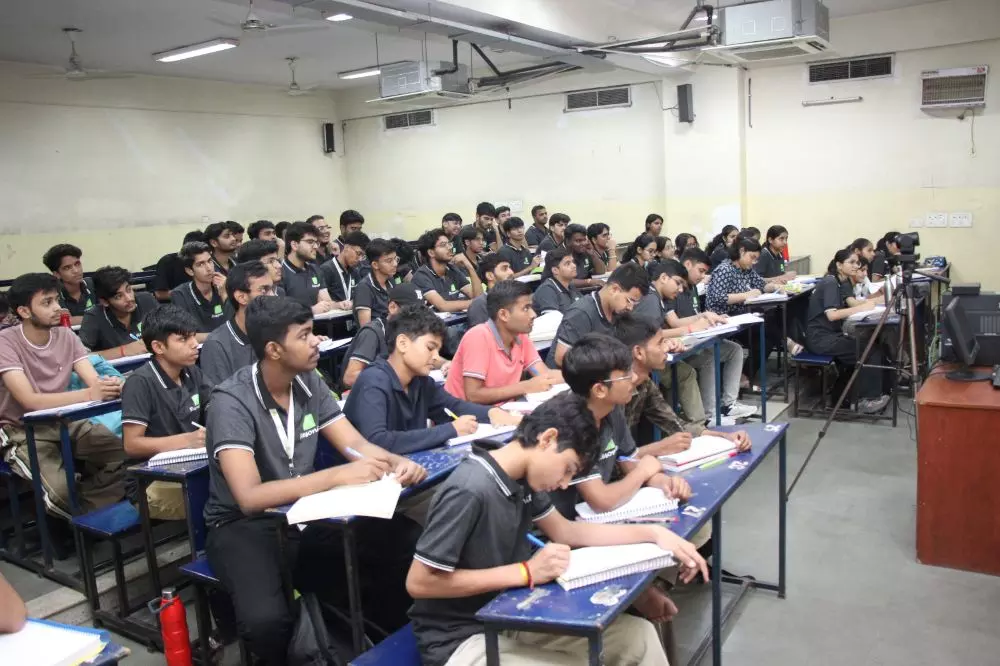
Following announcement of re-test, centres are working hard to keep up motivation in students. Photo: By special arrangement
Satish Kaushik, counselling psychologist and founder, Rajbala Foundation, Gurugram, says what students need now is motivation from institutes, support from family and a full-proof examination system.
“Students are putting up a brave front. And the faculty is here to help students. We are offering free test series and online tests. Our faculty, who are with the students at least 13 to 14 hours a day, are here to help with one-on-one interaction. We know the weaknesses and strong points of each student and are focusing on them,” says Chaudhary of CLC.
Keen to retain their edge, local institutes here have overnight converted into "re-test boot camps". With days to go for the June 21 re-examination, the need of the hour now is more to keep up the students’ spirits than to prepare them academically.