Why in Assam, ‘beef in tiffin box’ row is part of a bigger discourse on food choices, economics
In 2024, the Himanta Biswa Sarma-led BJP government in Assam put a ban on consumption of beef in public places. Earlier this month, a school in the state’s Goalpara district became the centre of a controversy when five students were allegedly found eating beef in the classroom during school hours.

Asha Saikia (name changed on request) remembers a time, a few decades back, when non-vegetarian food cooked at her home in Assam was mostly restricted to game and fish. “We didn’t even eat mutton or chicken regularly, only during festivals. But yes, there was always non-vegetarian food,” she recalls.Talking about beef, the meat that has in the past decade increasingly become a part of...
Asha Saikia (name changed on request) remembers a time, a few decades back, when non-vegetarian food cooked at her home in Assam was mostly restricted to game and fish. “We didn’t even eat mutton or chicken regularly, only during festivals. But yes, there was always non-vegetarian food,” she recalls.
Talking about beef, the meat that has in the past decade increasingly become a part of the country’s heightened Hindutva narrative and politics, she says, “We wouldn’t eat beef. In Assam, beef is not as common a part of diet as in some Northeastern states. But some communities, like the Muslims, would eat it. And there was no controversy surrounding it. I would eat food at Muslim neighbours’ homes, even look forward to the spread during Eid, because it was so different from what I was eating at home. I didn’t eat beef, nor did they offer it to me. That didn’t mean that there was any apprehension about me eating at their house, though.”
And unlike present times, when parts of the country have seen cases of lynchings over the suspected/alleged consumption of beef, Asha remembers no fear of harassment among those who ate the meat back then in her home state.
That changed in 2024 when Assam banned the consumption of beef in public places, including the serving of the meat in restaurants and community events. The 2024 law was an extension of the existing Assam Cattle Preservation Act, 2021, which already imposed restrictions on cattle slaughter and beef sales in certain areas. The 2021 law tightened rules governing cattle slaughter and transportation; slaughter of cattle is allowed only under specific conditions and after obtaining the required certification. The Act also restricts the sale of beef in areas with a significant Hindu, Jain or Sikh population and near places of worship. Then came the 2024 law, which expanded the scope of the ban.
While the Himanta Biswa Sarma-led Bharatiya Janata Party (BJP) government in Assam has maintained that the measures are aimed at preventing cattle smuggling, particularly along the Assam-Bangladesh border, and regulating the trade, and beef consumption inside homes remains legal, the laws have created a deep sense of unease — and in some cases, division — in a state where non-vegetarian food is an intrinsic part of the local cuisine.
Things came to a boil earlier this month, after five class IX students at a school in Goalpara were allegedly found sharing beef inside a classroom during school hours, which one of them had brought in his lunch box. The students, all Muslims, allegedly also offered the meat to two Hindu fellow students, who refused and later reported the incident. As the matter escalated, with parents of the Hindu students seeking an explanation from school authorities and locals staging protests and demanding action, a police case was registered and an inquiry initiated.
Also read: Why new BJP government in Bengal has brought both hope, apprehension to Bengali film industry
The ‘beef in tiffin box’ row comes days after the Muslim community in Assam collectively decided to celebrate last month’s Eid-Ul-Adha, which sees animal sacrifice, without cow slaughter. Muslim clerics across the state emphasised that cow slaughter was not integral to the celebration of the festival. “When our brothers in the country profess the Sanatan faith and are Hindus who worship the cow and consider it as their mother, why should we hurt their sentiments? Sacrifice other animals, not cows,” Badruddin Ajmal, a member of the Assam legislative assembly and chief of the state-based All India United Democratic Front (AIUDF), was quoted as saying. The move had also gained the appreciation of CM Himanta.
The government's stand on beef, however, continues to be a subject of debate in a state where non-vegetarian food is deeply woven into local culinary traditions. Across Assam, fish, duck, chicken, pork and mutton are staples in most households. “An Assamese can never be fully vegetarian,” says Biranjan Rabha, a student leader and resident of Krishnai town in Goalpara district.
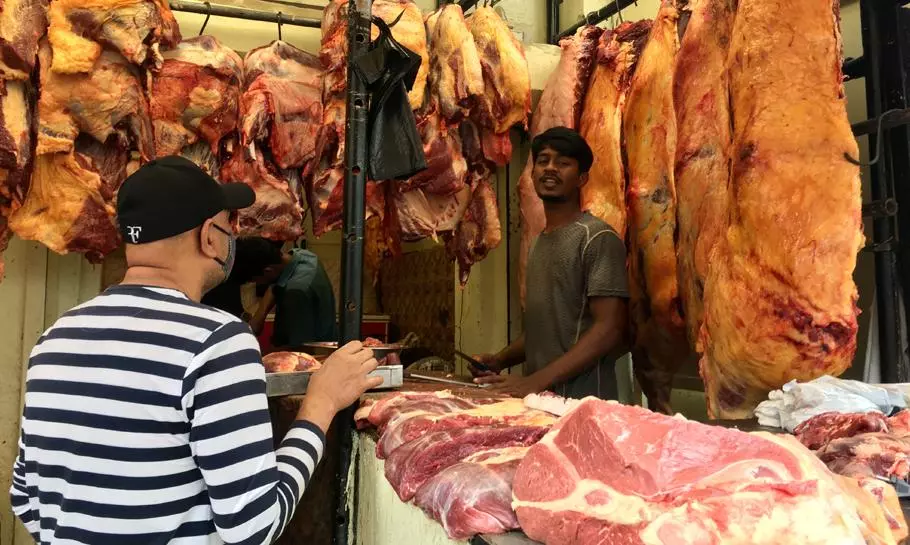
The restrictions have impacted cattle breeders and meat traders in the state. Representational image. File photo
While the state’s Hindu community traditionally avoided beef consumption, say locals, the meat would be a part of the diet of Assam’s Muslim and Christian population, as well as some tribal groups, and there was no stigma, taboo or fear attached to it. Interestingly, now, some among those very communities are being critical of the parents who allegedly put beef in their children’s tiffin boxes in the Goalpara school incident.
Dr Abdul Mannan, a retired professor of Gauhati University, said the guardians had exercised poor judgement in sending beef in a student's tiffin box. “In the Goalpara school case, the guardians were wrong. They should not have sent beef in the student's tiffin. It is a criminal offence under the existing law and cannot be justified,” he said. “It is an offence. Public consumption of beef is banned in Assam. No parent should do it,” said Abul Khayer, a 37-year-old school teacher who teaches English at Gyanoday Jatiua Vidyalaya at Baruajhar, Dalgaon.
Beyond current law, however, some claim Assam has no cultural and social history of cattle worship or treating the cow as ‘mother’, which would justify treating the consumption of beef as taboo.
“Cattle have always played a significant role in Assam's social and economic life. However, Assamese culture has never traditionally regarded the cow as a 'mother',” claims Manoranjan Pegu, executive council member of the Tribal Intellectual Collective, India and co-author of studies on Assamese socio-cultural issues.
He adds: “Cattle are valued and respected and are often seen as companions in the journey of life. The celebration of ‘Goru Bihu’ itself is an expression of gratitude towards cattle for their contribution to the agrarian economy. The growing tendency to view the cow as a mother also has cultural implications and pushes the discourse closer to a more rigid Hindutva framework.”
According to Pegu, “Many communities in Assam consume beef and in various parts of Assam, meat items like pork, beef and chicken are sold in the same market without taboo. If such a discourse [beef ban] becomes rampant in Assam, such social harmony of respecting each other’s food choices will not survive in the future.”
The restrictions on beef consumption have also raised questions of freedom and choice. “It affects the right to consume food of one's choice. Several tribal communities prefer beef as it is their staple diet and easily available,” points out Reverend DC Haia Darnei, of Dima Hasao district.
Beyond ideological outrage and fear of social fracture, however, the legal restrictions on beef consumption have deep economic repercussions for many. “Banning beef means indirectly banning us — it's killing our livelihood,” rued 64-year-old Subhash Murmu, a tribal farmer based in Tamulpur, Baksa district.
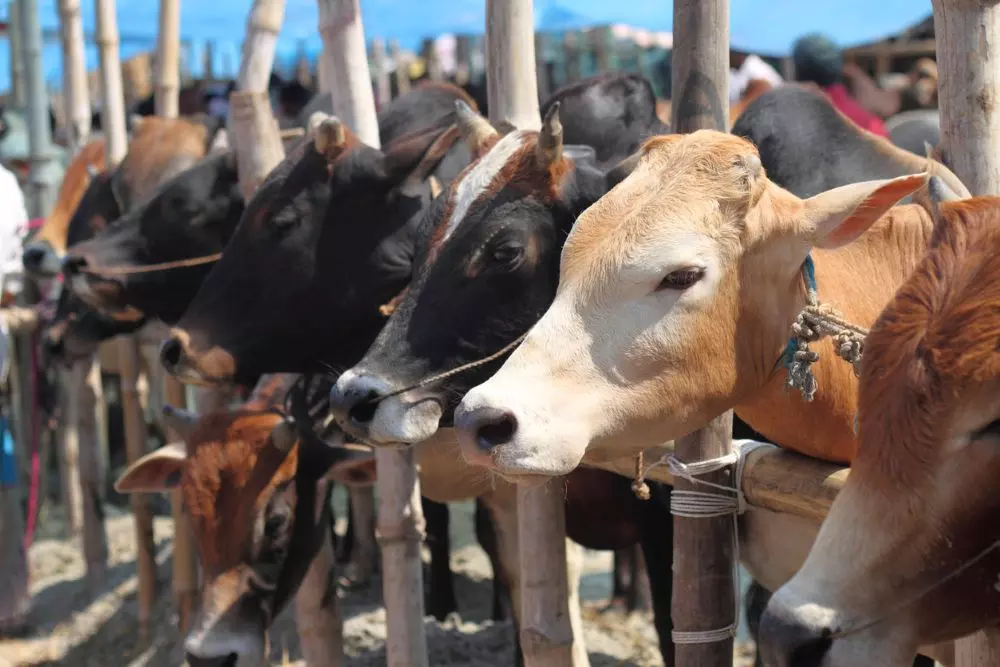
In Assam's flood-prone riverine areas, where agriculture is often vulnerable to natural disasters, livestock remains an important source of income. But with little demand for beef, this source is now closed. Photo: iStock
Across Assam, those who rear cattle, meat sellers and small restaurant owners, The Federal spoke to claimed impact to business following the 2024 curb on consumption of beef in public places. In parts of the state capital, Guwahati, including Six Mile, Hatigaon, Fancy Bazar and Hedayatpur, vendors spoke of declining business, while some establishments have reportedly shut down.
While there is no official statewide data available to indicate the exact extent of the decline in Assam’s beef and cattle trade following the implementation of the Assam Cattle Preservation Act, 2021, and the subsequent restrictions on public consumption of beef announced in December 2024, traders and business owners say the impact is “significant”. A beef seller in the Hatigaon area, who did not want to be named, claimed his daily sales dropped from around 60 kg to virtually nil within weeks of the 2024 restrictions coming into force.
The pinch has also been felt by farmers and rural households where livestock serves as a financial safety net, to be sold during emergencies, to meet sudden medical expenses, children's education or family ceremonies. In Assam's flood-prone riverine areas, where agriculture is often vulnerable to natural disasters, livestock remains an important source of income. But with little demand for beef, this source is now closed. Additionally, farmers are having to bear the burden of maintaining aged cattle, beyond their productive years, which would earlier be sold for meat.
The shrinking trade in Assam has also reportedly impacted beef availability in other Northeastern states, such as Meghalaya, Mizoram, Nagaland and Arunachal Pradesh, where the drop in availability has pushed up the price of the meat. A significant portion of the supply to these states passes through Assam, say those in the know.
Also read: What ‘bulldozer politics’ could change for Kolkata’s iconic New Market
Meanwhile, following the tiffin box controversy in Goalpara, the district administration has reportedly directed educational institutions to allow only vegetarian food in students' tiffin boxes.
“We have arrested the student's mother [who had sent beef in tiffin box] and sent her to judicial custody. The student, being a minor, was apprehended and placed in a children's home. The chargesheet in the case will be filed shortly,” Ananda Rabha, officer-in-charge of Krishnai Police Station, told The Federal.
In an address in Shillong in July 2021, Union Home Minister Amit Shah had stated that protecting and promoting the culture, language, and food habits of the region was among the top three goals of the Modi government. “Firstly, we want to protect and promote the culture, language, food and food habits of the region,” he said. Now the restrictions on beef consumption in Assam have drawn flak from some Opposition quarters.
Indeed, some believe the restrictions have served to stir up more conversation around the consumption of beef than in the past.
“Debates surrounding food habits, particularly beef consumption, have become increasingly frequent in different parts of the state. Over the past few years, several incidents have been reported in districts such as Hojai and Dhubri, where beef was allegedly found inside temples and other places of worship. I believe there may be a vested interest or a third force at work seeking to create divisions within society,” alleges Goalpara-based journalist Manoj Das.
In addition to fostering social unease and a degree of distrust between communities, some claim the restrictions have become a part of an alleged atmosphere of fear that marks life in the state today. “Among certain quarters now, there is a certain sense of threat that wasn’t there before,” agrees Asha.