- Home
- India
- World
- Premium
- THE FEDERAL SPECIAL
- Analysis
- States
- Perspective
- Videos
- Sports
- Education
- Entertainment
- Elections
- Features
- Health
- Business
- Series
- In memoriam: Sheikh Mujibur Rahman
- Bishnoi's Men
- NEET TANGLE
- Economy Series
- Earth Day
- Kashmir’s Frozen Turbulence
- India@75
- The legend of Ramjanmabhoomi
- Liberalisation@30
- How to tame a dragon
- Celebrating biodiversity
- Farm Matters
- 50 days of solitude
- Bringing Migrants Home
- Budget 2020
- Jharkhand Votes
- The Federal Investigates
- The Federal Impact
- Vanishing Sand
- Gandhi @ 150
- Andhra Today
- Field report
- Operation Gulmarg
- Pandemic @1 Mn in India
- The Federal Year-End
- The Zero Year
- Science
- Brand studio
- Newsletter
- Elections 2024
- Events

Consolidation of ongoing political process or new twists and turns — what 2026 could hold for India
India is witnessing the consequences of a regime change based on a majoritarian thought process, effected roughly a decade ago. But experts who believe in the Gandhi-Nehru legacy remain hopeful that the prevalent narrative, based on the RSS-BJP's version of cultural nationalism, will be defeated.

The year 2025 marked a century for two ideologies, on the Left and Right of the political spectrum, which have been influencing and shaping Indian society and politics all these years. Of these, India is witnessing the consequences of a regime change based on a majoritarian thought process, effected roughly a decade ago. Can 2026 be different, or do we see a consolidation of the ongoing...
The year 2025 marked a century for two ideologies, on the Left and Right of the political spectrum, which have been influencing and shaping Indian society and politics all these years. Of these, India is witnessing the consequences of a regime change based on a majoritarian thought process, effected roughly a decade ago. Can 2026 be different, or do we see a consolidation of the ongoing political process?
The Rashtriya Swayamsevak Sangh (RSS), the ideological fountainhead of the BJP-led government at the Centre, completed its 100th year in October 2025. It was set up with the avowed objective of consolidating Hindu society, as its founder K. B. Hedgewar believed that disunity was the primary reason for ‘centuries’ of foreign subjugation. M. S. Golwalkar, who succeeded Hedgewar as the second ‘Sarsanghchalak’ or chief of the RSS, heavily influenced by V. D. Savarkar, a prominent right-wing ideologue, adopted the concept of Hindu Rashtra.
In Savarkar’s worldview, “the day Ramachandra killed Ravan and was victorious” was the “birthday of Hindu people”, according to Vinayak Chaturvedi, professor of history at the University of California. The RSS’s understanding of Hindu history, he says, came from Savarkar. This is crucial and explains the importance of Ram in the Hindutva narrative.
Also read: Why, in 2025, centenarian RSS is having to weather the belief that it has been diminished by Modi
For over a decade, the BJP government has been aggressively establishing Hindu religion as the centrality of its politics, moving away from the original construct of the Indian Constitution that stood for secularism. During this period, not a single Muslim has been granted a ticket in parliamentary elections by the BJP; hate speeches, lynching of minorities, and attacks on their places of worship have become ongoing themes. Recently, on Christmas, churches were vandalised in various parts of India by right-wing vigilantes.
Meanwhile, in August 2020, Prime Minister Narendra Modi laid the foundation for the Ram Temple in Ayodhya. Although incomplete, it was opened for public darshan in January 2024, and in November 2025, its completion was announced with the installation of a large saffron flag. The partisan approach was dismissed by BJP spokespersons, claiming that Modi was ensuring “all-round development of people without appeasement”, as opposed to the 'Nehruvian version of secularism' that focused on 'vote bank' politics.
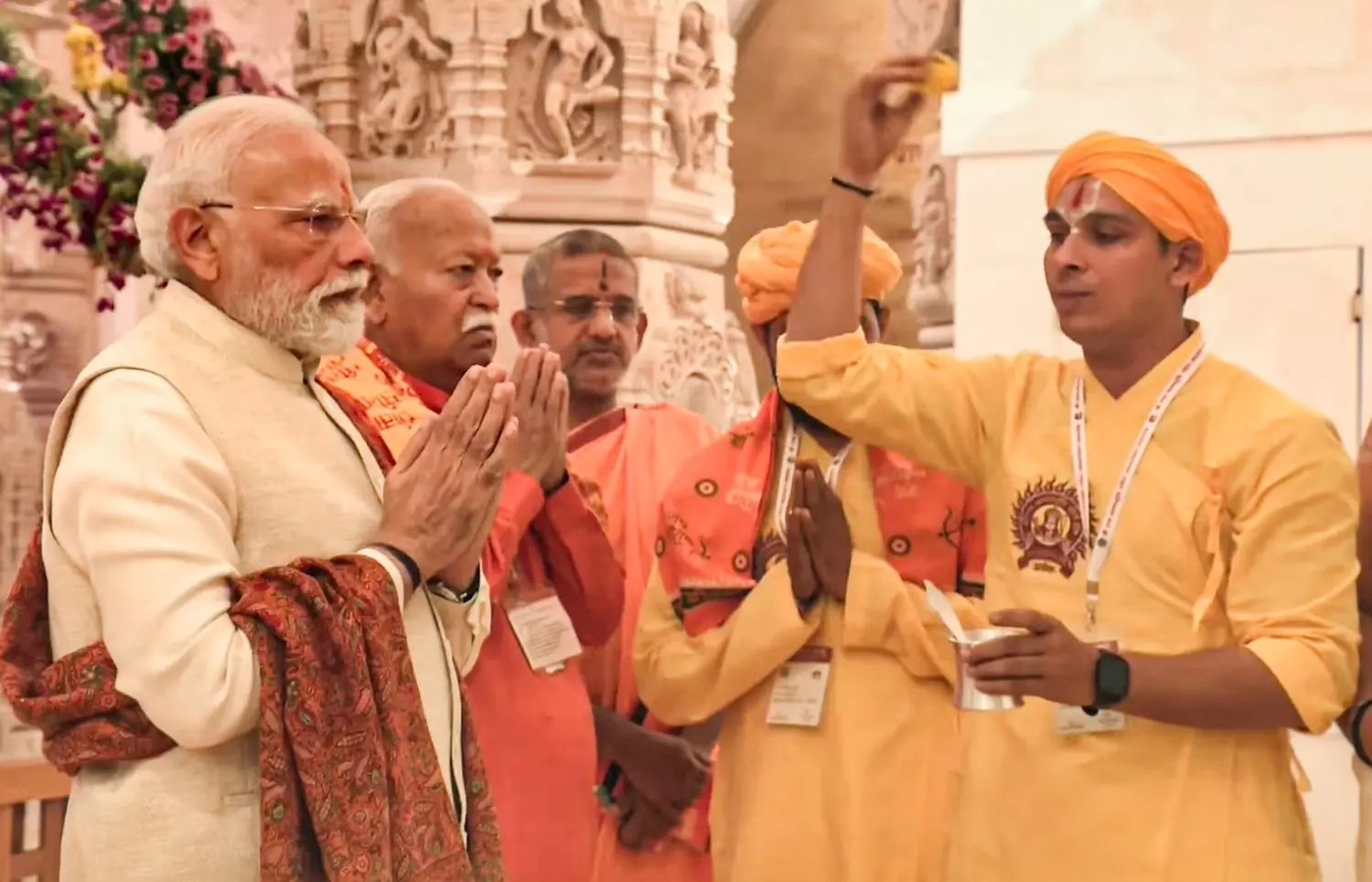
Prime Minister Narendra Modi with RSS chief Mohan Bhagwat at the Ram Temple in Ayodhya. PTI file photo
Though the BJP, helmed by the relatively moderate Atal Bihari Vajpayee, enjoyed power at the Centre on two earlier occasions—in 1998 and 1999, after a 13-day fiasco in 1996—it did not display the kind of aggression witnessed since 2014 when Modi took charge as PM and started moving the needle toward constructing a ‘Hindu nation’ as envisaged by Savarkar.
In 100 years, right-wing politics has moved from the sidelines to the centre stage. The RSS, banned immediately after Mahatma Gandhi’s assassination, now occupies both physical and mental space, with a large new building in central Delhi and its political wing running a muscular government at the Centre. Even a setback in the 2024 parliamentary elections, where the BJP could not muster a simple majority on its own, did not deter its Hindutva march.
On the other hand, the Congress party, which secured nearly 100 seats and delivered a jolt to the Modi regime in the 2024 parliamentary elections, seemed to have lost its way in 2025. Its leader, Rahul Gandhi, who has shed the ‘pappu’ tag and become a vocal critic of the Modi regime, failed to win a single election to state assemblies, causing despair in the opposition ranks. The party celebrated its 140th foundation day on December 28, claiming it never “compromised on its core principles”.
Yet, the brave words from party president Mallikarjun Kharge were an unwitting admission of how it had failed to nurture the extraordinary feats and values of its forefathers. The Congress party stood as an anti-imperialist movement that firmly upheld democracy, secularism, and had a forward-looking, pro-poor orientation.
Also read: Politically vocal but electorally outfoxed — what 2025 has been like for India's Opposition parties
The party, in power for 54 years at various times, lost touch with the masses, compromised on its core values, and ran a twisted, corrupt administration for decades. Now, it finds itself unable to mobilise grassroots support. Once ruling India and almost all its states, the party now holds power only in three places — Karnataka, Telangana, and Himachal Pradesh. It is certain that, due to internal infighting, it may lose Karnataka in the next assembly elections, scheduled to be held in 2028. Another state, Kerala, which in the normal electoral cycle should return to its fold, also faces the risk of slipping away due to multiple claimants to the chief minister’s post. The party, consumed by defeatist attitudes, seems more likely to snatch defeat from the jaws of victory.
The complacency within Congress persists despite facing a formidable rival in the BJP, which has a well-oiled election machine backed by money and administrative strength. Additionally, with a failing media and weakened institutions, Congress has little to lean on. Meanwhile, the Modi regime continues efforts to erase the memories of Congress’s association with India’s freedom struggle — particularly two stalwarts, Mahatma Gandhi and Jawaharlal Nehru, whose ideas helped shape India’s identity. Their legacies continue to haunt the RSS-BJP combine.
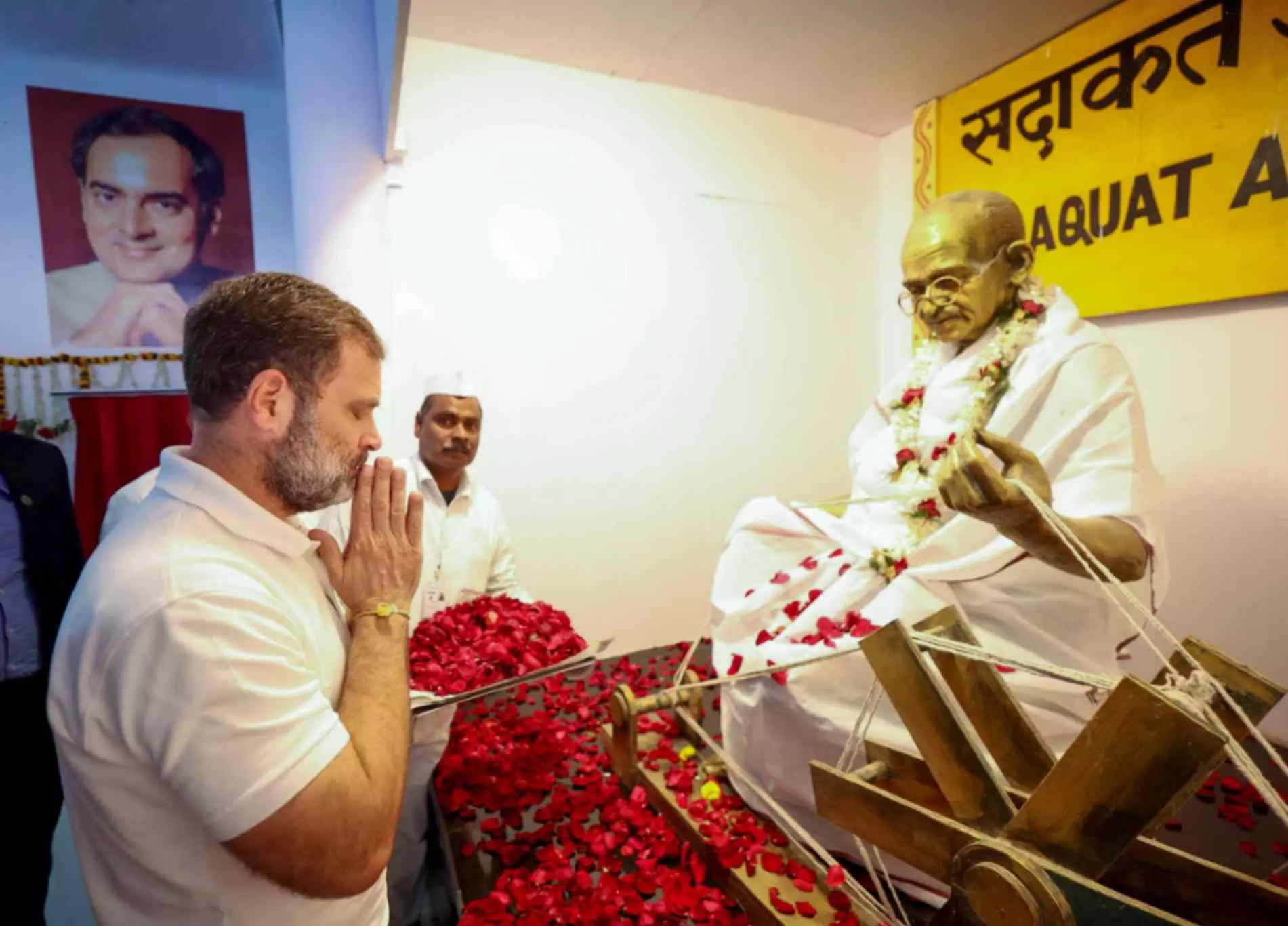
Rahul Gandhi pays tribute to Mahatma Gandhi at Bihar's Sadaqat Ashram. The Modi regime continues efforts to erase memories of Congress’s association with India’s freedom struggle — particularly of Mahatma Gandhi and Jawaharlal Nehru. File photo
While Nehru is the subject of daily harangues in BJP press briefings, where he is held responsible for almost all the country’s ills, the ruling party at the centre finds it somewhat more difficult to deal with Gandhi. But they have not given up. During the 2025 Winter Session of Parliament, the government quickly passed a law — the ‘Viksit Bharat G Ram G Bill’ — which replaced the Mahatma Gandhi National Rural Employment Guarantee Act (MGNREGA), the world’s largest rights-based employment guarantee scheme. It’s not just a change in nomenclature; in one sweep, the BJP managed to turn the rights-based programme into an availability-based work scheme.
Gandhi, who propounded ‘Daridra Narayan’ — the concept of seeing ‘God in the poor’ — stands ignored, with no place in ‘Viksit Bharat’. Meanwhile, the Communist Party of India (CPI), which completed 100 years in 2025, is in total disarray. This was not the case in India’s first parliamentary elections held in 1951-52, where the Left block ended up as the second biggest grouping. They later had opportunities in the 1990s when they could support coalitions at the centre. They withdrew support to the UPA-2 government led by Prime Minister Manmohan Singh, and since then, their decline has been difficult to arrest. Now they are barely in two-digits.
Left observers cite three reasons for this decline: one, their refusal to shed doctrinaire approaches; two, their inability to come to terms with caste realities; and three, globalisation — with state ownership of industries giving way to private ownership. The Indian Left clearly has not learned much from China, which can now intimidate even the US and the West.
Also read: What the world would look like in 2026 if moulded by Trump’s efforts to make America great
In 2026, are these trends likely to continue? Instead of crystal gazing, one can look at possibilities. The government is scheduled to hold the Census in 2027, which will include caste enumeration. State-level caste surveys conducted by various state governments have raised hopes and anxieties among the most backward classes (MBCs), who feel dominated by those above them in social hierarchy. Dalits and minorities, too, will be watching the Census results carefully. In some cases, the size of upper castes and dominant castes appears overestimated — and this too could come under scrutiny.
BJP has shifted from being a ‘Bania’-based party to an organisation with a broader base, including OBCs, MBCs, and Dalits. Except for minorities, the party is wooing all sections. It is more or less certain that Modi will complete his term, with his focus likely on West Bengal, Tamil Nadu, and Kerala, which remain no-go zones. If the BJP manages victories in these states, the slogan “Congress Mukt Bharat” could be replaced by “Vipaksh Mukt Bharat” (Opposition-free India).
But politics is not a zero-sum game. Since even a week is considered a long time in politics, many twists and turns are possible. The economy remains a concern, with U.S. President Donald Trump refusing to budge. Economists doubt the reliability of domestic growth figures, and performance remains uncertain. Historians, political scientists, and other experts remain hopeful. Some, who still believe in the Gandhi-Nehru legacy, argue that the current regime opposes them because they are antithetical to their ideology. The RSS-BJP’s majoritarian narrative, based on their version of cultural nationalism, they believe, will be defeated by true nationalism — propounded by Gandhi and Nehru.
Happy 2026!