- Home
- India
- World
- Premium
- THE FEDERAL SPECIAL
- Analysis
- States
- Perspective
- Videos
- Sports
- Education
- Entertainment
- Elections
- Features
- Health
- Business
- Series
- In memoriam: Sheikh Mujibur Rahman
- Bishnoi's Men
- NEET TANGLE
- Economy Series
- Earth Day
- Kashmir’s Frozen Turbulence
- India@75
- The legend of Ramjanmabhoomi
- Liberalisation@30
- How to tame a dragon
- Celebrating biodiversity
- Farm Matters
- 50 days of solitude
- Bringing Migrants Home
- Budget 2020
- Jharkhand Votes
- The Federal Investigates
- The Federal Impact
- Vanishing Sand
- Gandhi @ 150
- Andhra Today
- Field report
- Operation Gulmarg
- Pandemic @1 Mn in India
- The Federal Year-End
- The Zero Year
- Science
- Brand studio
- Newsletter
- Elections 2024
- Events

Padayatras, weather extremes and packed schedules — how our politicians stay fit for the poll battle
Counting of votes today (May 4) will drop the curtain on the recent election action in Tamil Nadu, Puducherry, Kerala, West Bengal and Assam. From hours on the treadmill, to walking, cycling, swimming and sticking to light, home-cooked food, leaders across political parties have their own ways to remain fighting fit for the job. But post-poll care is needed to ensure the body returns to baseline health, say experts.

Days ahead of the April 23 assembly election in Tamil Nadu, Bharatiya Janata Party’s Coimbatore North candidate, Vanathi Srinivasan, found herself in hospital. The leader had been on the campaign trail since early April and experienced a swelling in her right leg. According to reports, it turned out to be a mild infection. But it could well have been the prolonged hours on her feet...
Days ahead of the April 23 assembly election in Tamil Nadu, Bharatiya Janata Party’s Coimbatore North candidate, Vanathi Srinivasan, found herself in hospital. The leader had been on the campaign trail since early April and experienced a swelling in her right leg. According to reports, it turned out to be a mild infection. But it could well have been the prolonged hours on her feet while campaigning for the polls.
After months of high-octane campaigning for assembly elections in Tamil Nadu, Kerala, Puducherry, Assam and West Bengal, all that is left now for leaders across parties is the wait for the outcome, as counting of votes takes place today (Monday, May 4).
The lead-up to voting had seen leaders brave the summer heat while travelling extensively across the poll-bound states, and an erratic schedule that left, in all probability, little room for enough sleep or proper meal timings. The heat was so oppressive in Kerala that campaigning was restricted to between 9am and 11am and 4pm and 8pm daily, so leaders could avoid being out during the worst of the oppressive warmth.
The situation wasn’t much different in Tamil Nadu, where former World Health Organisation (WHO) chief scientist Soumya Swaminathan reportedly urged the need for institutionalised heat protocol, including crowd management, medical preparedness, hydration and timing of events. Last month, reports claimed that as the temperature in parts of Tamil Nadu touched 40 degrees, campaigners were following a similar split routine as in Kerala. Leaders were also purportedly urging people to stay hydrated, while caps, scarves and water were distributed among supporters.
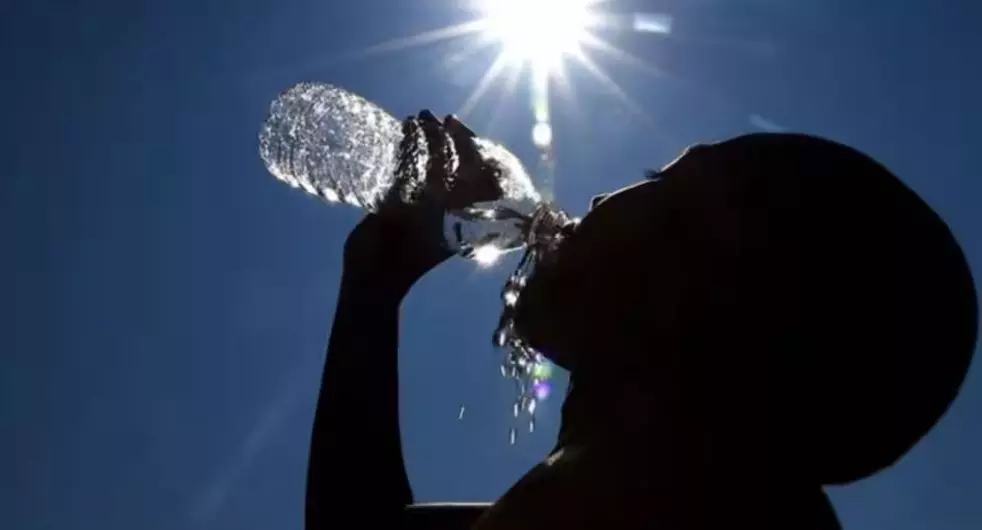
The oppresive summer heat was a factor both during campaigning and voting in these elections. File Photo
In West Bengal, ahead of the first phase of polling on April 23, the Indian Meteorological Office (IMD) issued a heatwave alert, cautioning everyone to stay hydrated.
Yet, despite the extreme weather conditions, the padayatras continued. While the brisk steps of our political leaders might have made it look like a cakewalk, the campaign routine requires a level of fitness which experts insist can’t be achieved in a day.
“The body can’t switch modes in a day. It is important to build stamina, metabolic health and a baseline health,” explains nutritionist Kavita Devgan, author of books such as The Immunity Diet: Fight Of Infections And Live Your Best Life and Fix It With Food: Superfoods To Become Super Healthy.
While she does prescribe simple repeatable meals, not skipping meals and not binge eating as basic guidelines while on the campaign trail, they remain emergency tips which must be preceded with, and followed by, proper investment in health and fitness.
Devgan’s advice is echoed by yoga therapist Hitanshi Jain.
“You have to build up your stamina,” she says, but adds that some easy workouts can help even while on the campaign trail. “They may be sitting for long hours during meetings or travelling. Things like calf raises can be done to help with blood circulation. Non-sleep deep rest, inspired by yoga nidra (a relaxing technique which restores the body while it is awake), can also be tried to help with sleep deprivation from a packed election schedule.”
Also read: Why Bengal's iconic jhalmuri and telebhaja may be seeing a change in fortunes in Kolkata
Incidentally, many of our political leaders seem to have, over the years, realised the need to keep fit, following some sort of workout regimen or other, as well as monitoring their diet.
According to a 2024 news article, while Bharatiya Janata Party (BJP) leader Tejaswi Surya had completed a challenging Ironman endurance race in Goa that year, Jammu and Kashmir chief minister Omar Abdullah participated in an international marathon in Kashmir around the same time; Abdullah reportedly maintained an average pace of 5 minutes 54 seconds per kilometre during the 21-kilometre run.
Congress member of Parliament (MP) Rahul Gandhi’s fitness became a topic of conversation during the 2022-23 Bharat Jodo Yatra. “We would have exercise sessions while on the yatra, and often it would be Rahul who would be handling the training. We benefitted greatly from his expertise,” Anshul Trivedi, a Congress member and Bharat Yatri — those who had completed the entire stretch of the yatra — had said at the time.
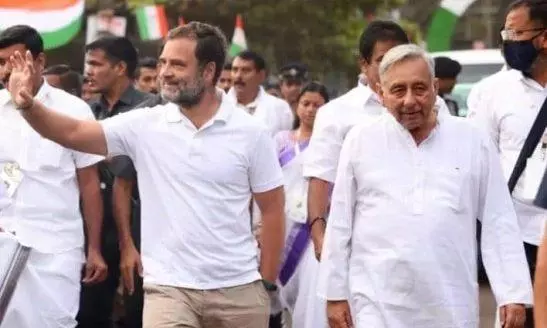
Rahul Gandhi during the Bharat Jodo Yatra. File Photo
The Congress leader has often spoken about his fitness regimen.
He is known to practice various forms of Japanese martial arts, do cardio and weight-training exercises, as well as cycling and swimming. “Rahul has a personal gym and is very disciplined about his workout. If he misses his work out in the morning, he will do it at night,” says a source in the party. The Congress leader is also known to practice vipassana — a meditation technique — like his sister and fellow Congress member, Priyanka Gandhi Vadra.
A personal gym is something that professional rivals like BJP MP and Union minister Kiren Rijiju and All India Majlis-E-Ittehadul Muslimeen (AIMIM) leader Asaduddin Owaisi have in common. While, sources say, Rijiju also cycles, especially when he is in his constituency of Arunachal West (Arunachal Pradesh) and often indulges in a game of football with local boys, Owaisi is said to cycle and do weight training using kettle bells.
Food is also something that the leaders take care of.
Supriya Sule told The Federal that she prefers home-cooked food, in addition to walking as much as she can. The Nationalist Congress Party MP is also known to cycle when she is in her constituency of Baramati (Maharashtra).
Congress Rajya Sabha member Digvijaya Singh, 79, is another leader known to be particular about his food, especially meal timings. “He is an early riser, practices yoga and has been a vegetarian for over 30 years now. For longer journeys, he prefers to travel by train rather than by air, so that he can catch up on his sleep. And despite his age, he prefers padayatras for campaigns,” say sources close to the leader.
Central leaders are not the only ones choosing health over chaos and indulgence; many regional politicians, too, are known to have jumped on the fitness bandwagon.
The preference for padayatras is something Singh has in common with West Bengal Chief Minister Mamata Banerjee. Slight in frame but relentless in pace, Banerjee has made long marches the centrepiece of her politics, taking to the streets both to protest and to connect, earning her the sobriquet “street fighter”.
This year’s election campaign was no exception. Barring a rare pillion ride on a party worker’s motorcycle, her outreach consisted largely of long padayatras, in addition to big rallies.
The secret of her energy lies in long hours on the treadmill, free-hand exercises, and a frugal diet of tea, puffed rice and light snacks. By her own admission, the West Bengal Chief Minister has given up rice years ago.
The 71-year-old politician once posted a video cuddling a puppy while working out on a treadmill. She has said she often works, reviews files, or prepares budgets while on the treadmill.
Banerjee is known to walk approximately 7-8 kms daily on her treadmill, sometimes up to 10 km during, or in preparation for, election campaigns.
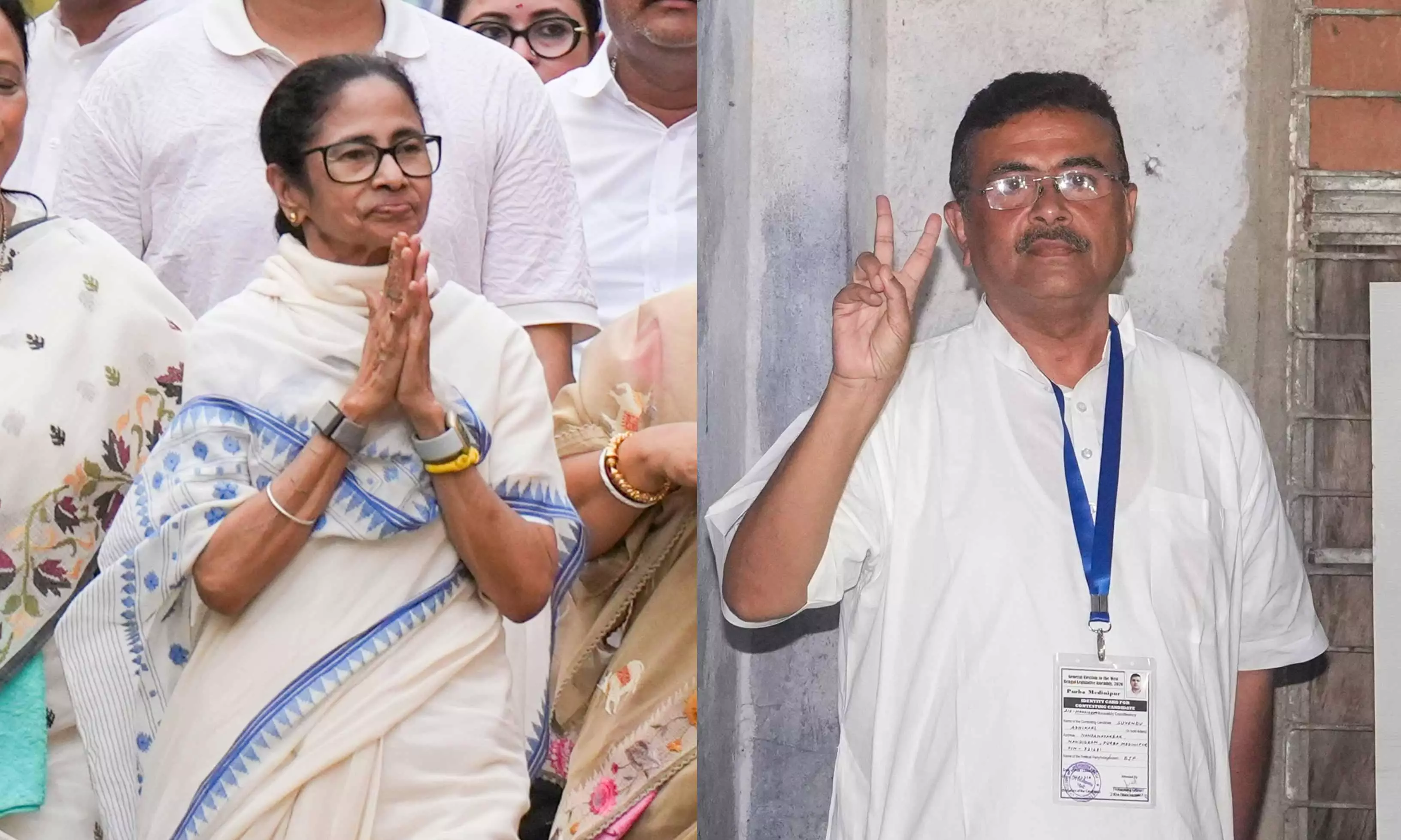
Mamata Banerjee and rival Suvendu Adhikari during the recent campaigning for the 2026 West Bengal assembly elections. File Photo
Her political rival, BJP MLA and leader of opposition in the West Bengal assembly, Suvendu Adhikari, is known to stick to a controlled diet of brown rice, gluten-free water chestnut flour rotis, and to carve out time for a nightly half-hour walk even on days packed with back-to-back poll programmes. “He is careful about what he eats,” admits a party insider, adding, “but the schedule does not always allow a strict routine.” On a recent International Yoga Day at Digha beach, Adhikari gamely joined a public session, attempting Surya Namaskar, drawing smiles for his visibly arduous effort.
Fellow BJP leader Dilip Ghosh is a familiar figure at Kolkata’s Eco Park, where his early-morning walks have become a near-daily ritual. A former Rashtriya Swayamsevak Sangh (RSS) pracharak (those who work to spread the RSS doctrine), Ghosh also carries a public image shaped by physical assertiveness. He has been seen participating in Ram Navami processions where he wielded traditional sticks and swords, a display that feeds into his combative political persona. His diet, according to close aides, is shaped more by field conditions than a fixed routine. An early riser, he is known to often begin his day before dawn with campaign preparations and meetings. Breakfast typically follows morning exercise and political engagements, consisting of simple staples such as roti and seasonal vegetables. He has also expressed a preference for idlis, describing them as a light and nutritious option. Much of his eating during campaigns is informal and situational, often shared with party workers on the move and frequently includes home-cooked food offered by supporters.
But the true legend in the state, who proves that age is just a number, is 85-year-old CPI(M) leader Biman Bose, known to party workers as the “Bhishma Pitamaha” (the grand old man of the Hindu epic Mahabharata) of Bengal’s Left. The veteran leader remains a visible presence on the campaign trail, often walking through neighbourhoods alongside candidates from the party’s younger ranks. Long associated with the austere habits of the Left, Bose is known to follow a simple, home-style diet and domestic routines rather than any formal fitness regimen. Staying at the CPI(M) state headquarters, Muzaffar Ahmad Bhavan in Kolkata, Bose is known to do the household chores, including washing his clothes, a routine he says helps keep him fit.
Also read: How ‘Khela Hobe’ went from an election slogan to one of India's most defining political battle cries
Meanwhile, down south, Tamil Nadu Chief Minister and Dravida Munnetra Kazhagam (DMK) leader MK Stalin, 73, ensured he followed his walking routine throughout the period of campaigning for the 2026 assembly elections. According to those in the know, Stalin would often blend the two, starting his campaign early in the day, as he interacted with morning walkers in parks and walk areas. The chief minister has, in the past, acknowledged that his daughter, Senthamarai Stalin, plays an active role in ensuring he sticks to his daily workout routine, even coordinating with his trainers. Stalin’s disciplined approach, combining walking, light workouts, and a controlled diet, helped him maintain a relentless campaign pace without visible fatigue in these elections.
Rival All India Anna Dravida Munnetra Kazhagam (AIADMK) leader Edappadi K Palaniswami, 72, too, has emphasised the need for routine. Known for his early-morning walks, he reportedly continued with the practice even at the height of the campaign, indicating how leaders have come to integrate fitness into tightly-packed schedules rather than treating wellness as optional.
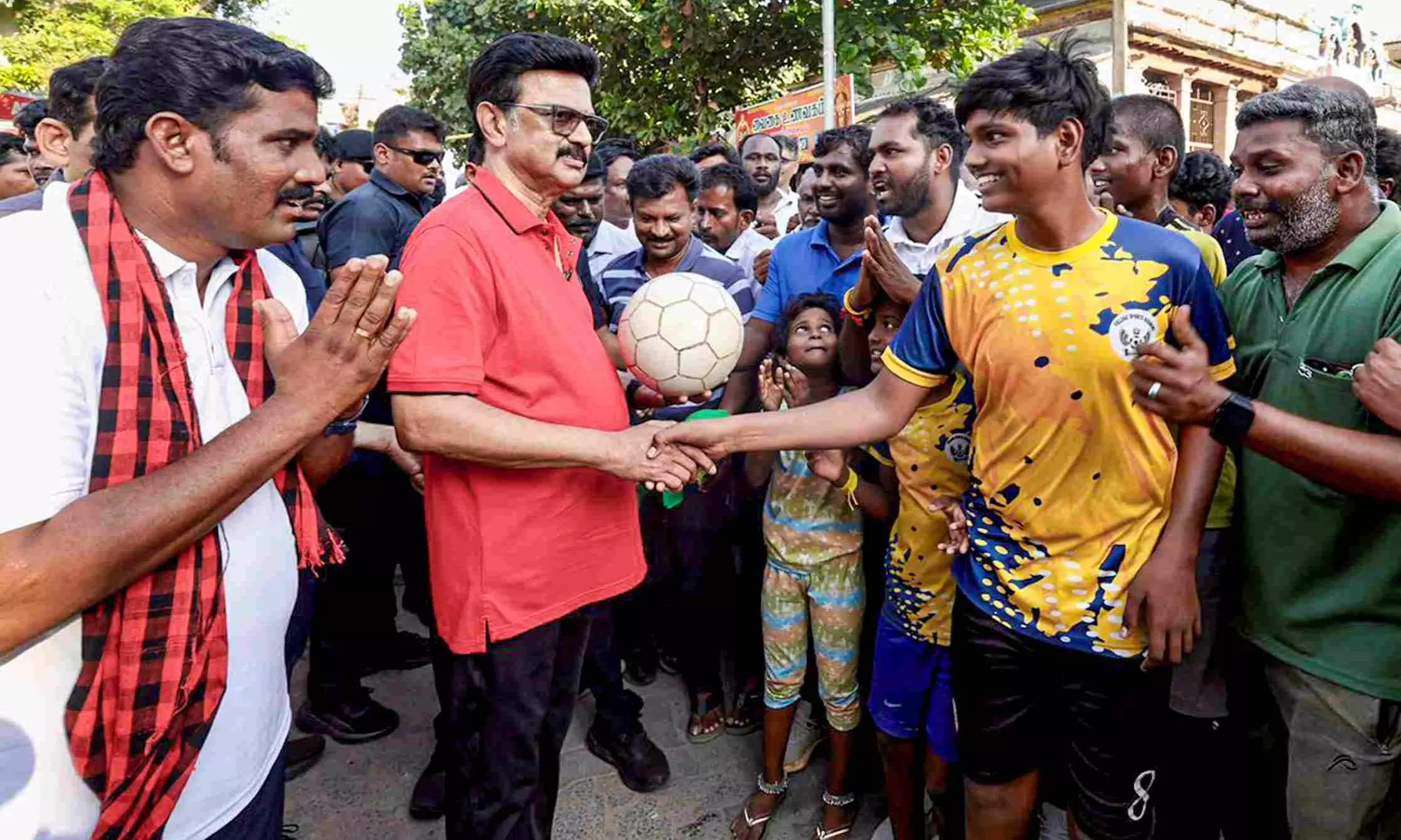
MK Stalin interacts with people during an outreach programme. File photo
Another AIADMK senior leader, D Jayakumar, maintains an almost athlete-like approach to fitness. The 65-year-old told The Federal that he continues with regular swimming sessions and late-night gym workouts, often fitting exercise into his schedule before going to bed. "This consistency becomes especially significant during election campaigns. We struggle with erratic schedules, travel fatigue and lack of rest, but I ensure I spend at least 30 minutes a day on my fitness. This discipline helped me to be active on the ground,” says Jayakumar. The leader is also careful of his diet, “including fish and a lot of vegetables” in his meals.
And so, for many, rather than the campaign being a disruption in routine, it becomes a period of heightened discipline to ensure that ill health, or lack of fitness, doesn’t derail the campaign schedule.
“We make sure he does a full health check-up before the campaign begins. Once the tour starts, the schedule becomes too tight to take any health risks,” says a close aide of Karnataka Chief Minister Siddaramaiah, explaining how preparations start well in advance. “During elections, we strictly avoid non-vegetarian food for him, though as a rule he loves to eat chicken. It [the vegetarian diet] helps him stay light and active through long travel and multiple speeches in a day,” the aide adds.
The same is true of the state’s Deputy Chief Minister DK Shivakumar. “His entire day is carefully planned—from travel and meetings to food and rest. Even hydration is monitored closely,” says a member of the leader’s support team. “We keep lemon water and regular water ready at all times because dehydration is a big concern.”
A second aide added: “We are in constant touch with the family doctor. Blood pressure and sugar levels are checked regularly and medicines are always carried.”
Hydration is also a big part of Janata Dal (Secular) leader HD Kumaraswamy’s fitness mantra. “Tender coconut water is a must. He has it at least twice a day to stay fresh in the heat,” informs a close associate of the leader. “We also ensure simple, home-style food is arranged wherever possible.” On campaign trails, “foot massage is part of the daily routine. It helps improve blood circulation and reduces fatigue after long hours. Sleep may be irregular, but we try to ensure he gets some rest whenever there is a break,” a member of his campaign team adds.
Across the border, 68-year-old Kerala Congress leader Ayisha Potti, too, talks of the importance of hydration to beat the oppressive heat in the state during the recent campaign season. “I usually forget everything when I am with the workers. I always kept water with me. Staying hydrated was the only thing I focused on throughout the campaign,” she says. A three-time MLA from the CPI(M), Potti switched to the Congress ahead of this election and was pitted against state finance minister KN Balagopal.
Also read: Why in Tamil Nadu, elections are busy, happy times for look-alikes of actors-turned-politicians
Despite the growing fitness consciousness among the political leaders, however, experts advise a period of restorative care to ensure the body’s return to base health after the demands of the election season.
“The travel, lack of rest, long work hours and exposure to extreme heat could lead to dehydration, inflammation, wear and tear and nutritional depletion,” says Devgan. To counter the damage, she advises hydration, simple food such as curd rice or khichdi to give the gut rest and fight inflammation, and focus on proper protein intake — dal, fish, egg — for nutritional replenishment. “For improved sleep, dinner has to be three hours before bedtime. Avoid caffeine intake after 4-4.30 pm and drink warm milk or take a few walnuts or pistachios, which build melatonin in the body to induce sleep,” she advises. To repair the circadian rhythm (or body clock), Devgan advises spending 10 minutes in the sun in the morning (which helps produce melatonin). “The morning routine should be hydrate, sunlight, breathe, move [simple exercises], fuel [breakfast],” she adds.
For those yet to pick up a workout routine, Jain advises basic walking, back stretches and calf raises for improved fitness, while life coach and healing practitioner Chetna Chakravarthy talks about the need to build healthy habits.
“Talking about fitness before an election campaign is like a woman wanting to lose weight before her wedding. It has to be a consistent effort,” says Chakravarthy.
For best results, she advises a personal trainer or health coach. For long-term emotional wellbeing, she also stresses on the need for meditation and the need for a social life beyond work — in this case, politics.
“They need to spend time with people outside their professional circuit, have a hobby, do something that is relaxing, basically refuel emotionally,” Chakravarthy explains.
The last may be especially important today, and the days that follow immediately; stress levels are bound to be high as the counting of votes progresses. By the end of the day, the results of the weeks of canvassing and campaigning will be known. Some would win and need to prepare for governance. Others would lose, but as opposition, continue to play an important part in democracy, as well as introspect on the failure and strategise for coming elections.
For both roles, physical and emotional fitness would go a long way in allowing them to give to the job the best they can.
(With inputs from Puneet Nicholas Yadav, Samir K Purkayastha, Rajeev Ramachandran, Pramila Krishnan and Naveen Ammembala)