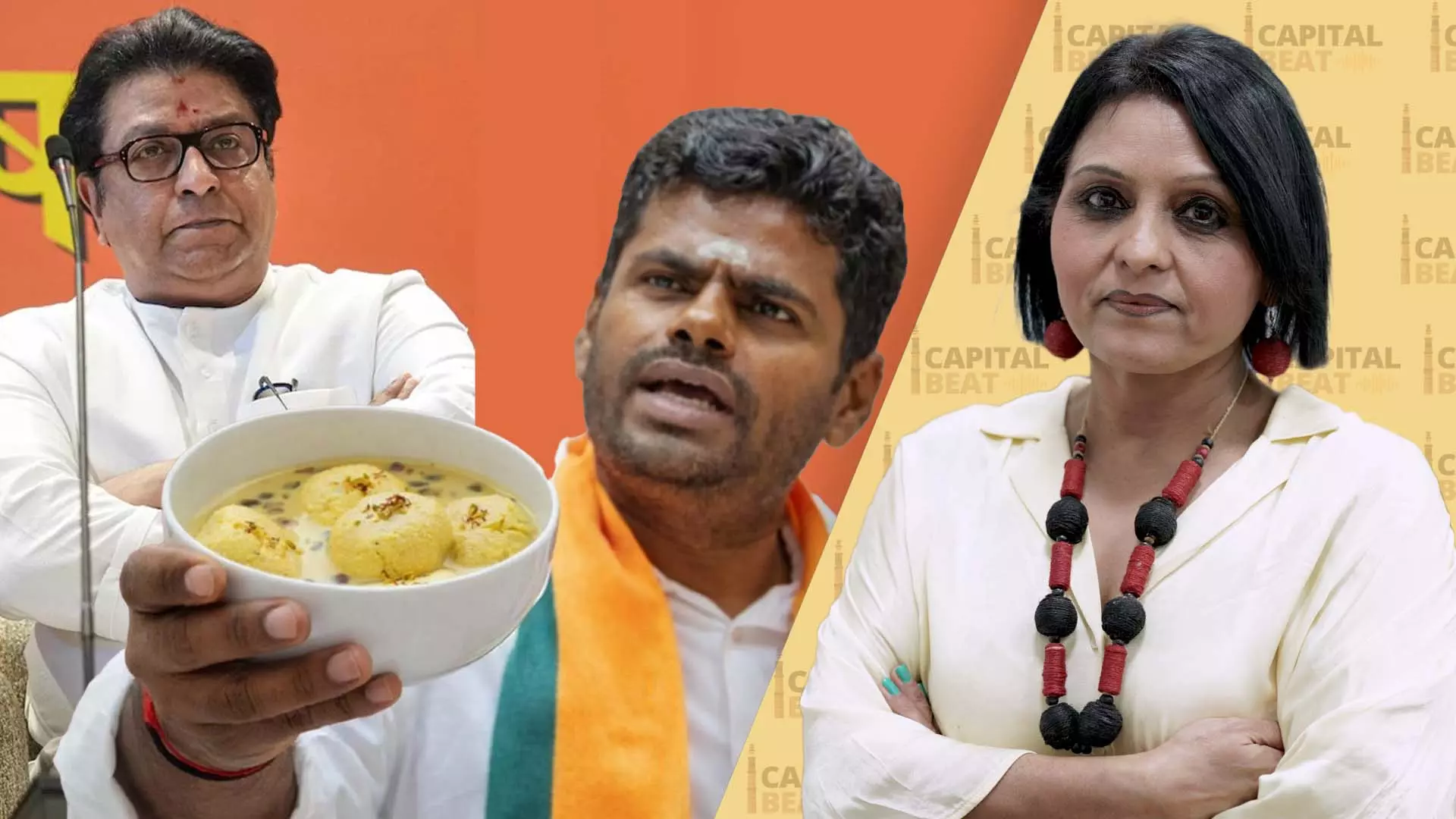
Is Raj Thackeray evoking ‘Marathi manoos’ sentiment with ‘rasmalai’, ‘lungi’ jibes?
MNS chief revives 1960s identity politics to counter BJP leader Annamalai; our panellists discuss the impact of regional rhetoric on Mumbai civic elections

This episode of Capital Beat featured a panel discussion on Raj Thackeray’s remarks at a Mumbai rally, where he referred to BJP leader K Annamalai as “rasmalai” and used crude phrases such as “hatao lungi bajao pungi.”
The discussion examined whether the remarks were intended to revive regional sentiment ahead of the Mumbai civic elections and how political parties responded to the controversy. The panellists for the episode were Pushparaj Deshpande, author and policy expert, and Sanjay Kapoor, editor, Hard News.
Thackeray’s comments triggered political reactions across party lines. The remarks were linked to slogans used in Mumbai politics during the 1960s and raised questions about their relevance in the current political climate.
The panel discussed how the statements had intensified tensions between the Maharashtra Navnirman Sena and the Bharatiya Janata Party, particularly in the context of upcoming Brihanmumbai Municipal Corporation elections.
Historical references
The discussion highlighted that similar slogans had been used in Mumbai during the 1960s, particularly during movements centred on Marathi identity.
Also read: Uddhav, Raj Thackeray reunite for BMC polls to protect Mumbai's Marathi identity
One panellist noted that Mumbai’s status as the capital of Maharashtra had been shaped by historical struggles and sacrifices and that the city remained an integral part of the state. BJP leader K Annamalai's remarks on Mumbai were discussed, with clarification that he spoke about infrastructure needs and budgetary allocations rather than separation from Maharashtra.
The panel stated that the controversy had emerged after political opponents framed the remarks as an election issue, leading to heightened political messaging around identity.
Regional identity debate
The discussion examined whether Raj Thackeray’s remarks were aimed at invoking Marathi pride and positioning his party distinctly ahead of the civic polls. It was stated that political leaders across parties identify as Maharashtrians and that no single party holds exclusive claim over Marathi identity.
The panel noted that Mumbai has historically elected leaders from diverse backgrounds and communities, reflecting its cosmopolitan character. It was stated that Mumbai has provided opportunities to people from different parts of India and continues to function as a city of migration and aspiration.
The panellists discussed demographic realities, noting that Mumbai’s population includes a large proportion of residents from outside Maharashtra, alongside Maharashtrians.
Civic issues and development
The discussion shifted to governance and development issues in Mumbai. It was stated that large-scale infrastructure projects were currently underway in the city, including Metro networks, coastal roads, sea links, and road concretisation.
Also read: Mumbai identity row: Annamalai throws open challenge to Thackerays
Budgetary allocations for pollution control, education, healthcare, water supply, and housing-related issues were cited as part of ongoing civic planning. The panel stated that these development works formed the basis of electoral messaging by the ruling alliance.
It was stated that civic governance failures of previous administrations were being raised as campaign points, particularly concerning roads, hospitals, and basic services.
Political polarization
The panel discussed whether identity-based remarks could polarize voters along regional, linguistic, or religious lines. It was stated that references to mayoral identity, including religion and language, had entered the civic poll discourse.
Concerns were raised that such statements diverted attention from governance and development. The discussion noted that issues such as campaign financing, electoral influence, and opposition unity were also being raised in the context of the civic polls.
One panellist stated that political messaging based on regional or religious identity could have consequences for alliance dynamics and voter perceptions.
Electoral stakes
The discussion examined the political stakes of the Brihanmumbai Municipal Corporation elections, with references to past governance, administrative control, and allegations raised by different political formations.
Also read: Capital Beat | Thackeray cousins’ possible BMC tie-up puts Opposition unity under strain
It was stated that losing or winning a civic election does not end a political party, but internal unity and clarity of purpose were highlighted as important factors. The panel discussed whether words such as “lungi”, “pungi”, and “rasmalai” would influence voters in contemporary Mumbai. It is doubtful whether such rhetoric would resonate with today’s electorate.
(The content above has been transcribed from video using a fine-tuned AI model. To ensure accuracy, quality, and editorial integrity, we employ a Human-In-The-Loop (HITL) process. While AI assists in creating the initial draft, our experienced editorial team carefully reviews, edits, and refines the content before publication. At The Federal, we combine the efficiency of AI with the expertise of human editors to deliver reliable and insightful journalism.)