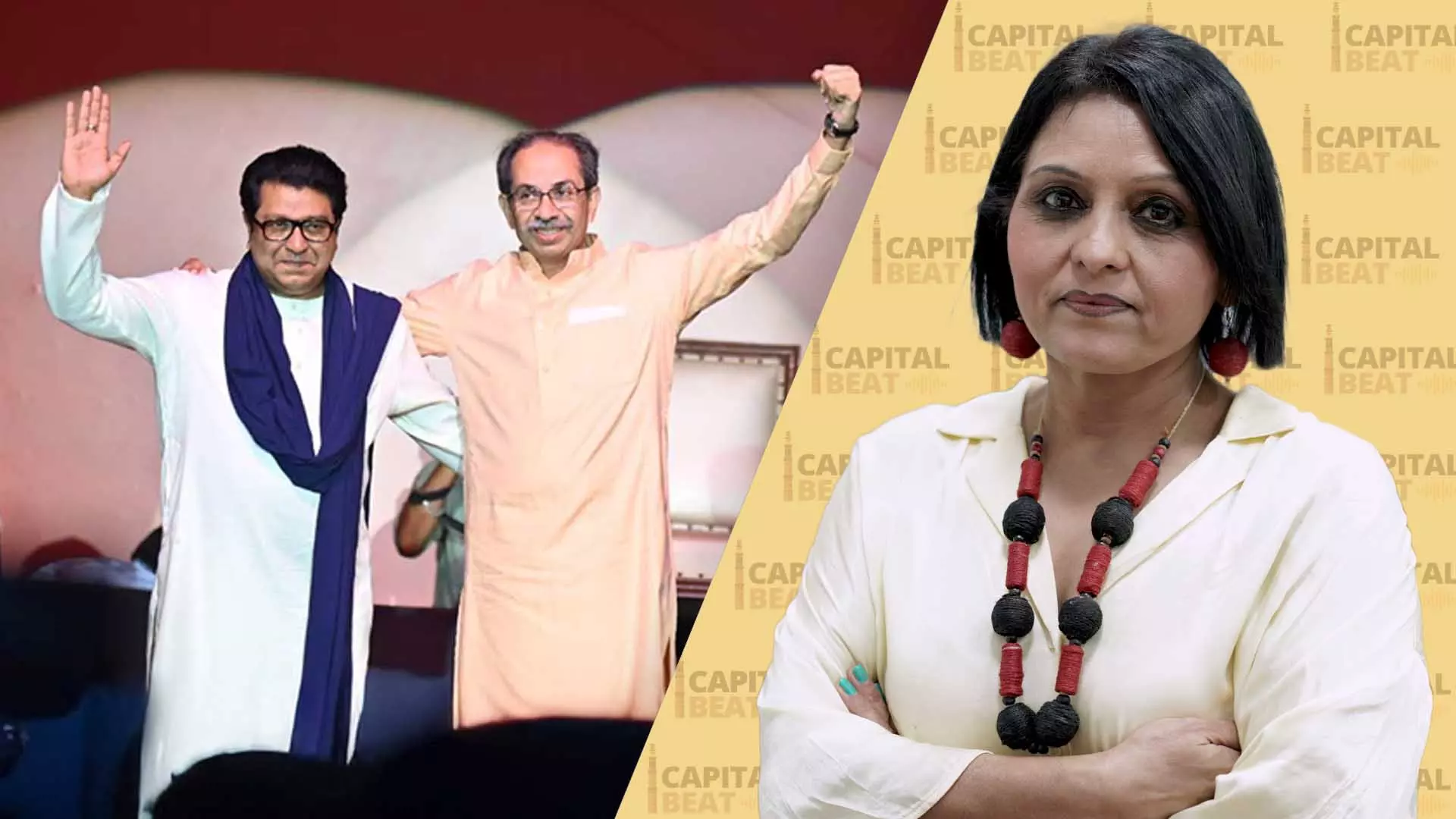
Capital Beat | Thackeray cousins’ possible BMC tie-up puts Opposition unity under strain
Capital Beat panel discusses Uddhav Thackeray-Raj Thackeray reunion, Congress stance, and high-stakes Mumbai civic polls

In this episode of Capital Beat, hosted by Neelu Vyas, The Federal examined the political implications of a possible alliance between Shiv Sena (UBT) chief Uddhav Thackeray and Maharashtra Navnirman Sena founder Raj Thackeray ahead of the Brihanmumbai Municipal Corporation (BMC) elections scheduled for January 15.
The discussion featured Kishore Tiwari, spokesperson of Shiv Sena (UBT), and Vivek Deshpande, senior journalist, and focused on Opposition unity, electoral arithmetic in Mumbai, and the broader challenge posed by the BJP-led alliance.
The discussion opened with a reference to a social media post by Shiv Sena (UBT) leader Sanjay Raut, which featured an image of Uddhav Thackeray and Raj Thackeray with a caption indicating a possible announcement at noon the following day. The post triggered speculation that a formal alliance between the Thackeray cousins could be announced imminently, following months of discussions.
The potential tie-up was discussed in the context of the upcoming BMC polls, one of the most politically significant civic elections in the country. The panel noted that the Mumbai civic body has been under an administrator for the past two to three years due to delayed elections, adding to the stakes for parties seeking control of the corporation.
Signals of a reunion and immediate reactions
The discussion highlighted that the possible alliance has drawn quick reactions from rival parties. BJP leaders publicly dismissed the potential impact of a Thackeray cousins’ tie-up on the BMC election outcome, asserting that it would not alter the electoral balance in Mumbai.
Also read: After BJP's civic poll win, Fadnavis warns cadres against attacking allies
Within the Opposition, the prospect of Uddhav Thackeray aligning with Raj Thackeray has generated visible discomfort, particularly within the Congress. The panel referred to indications that the Congress intends to contest the BMC polls independently, citing concerns over secular positioning and voter outreach.
Kishore Tiwari stated that recent local body election results in Maharashtra have reinforced the need for Opposition unity, especially in the face of what he described as extensive use of resources by the ruling alliance. He underlined that divisions within the opposition could weaken its prospects in Mumbai, where multiple voter blocs influence outcomes.
Congress positioning and alliance dilemmas
The programme discussed the Congress’s parallel preparations for the BMC elections, including the release of a targeted manifesto by Mumbai Congress president Varsha Gaikwad, aimed at North Indian communities in the city. The move was presented as an indication that the Congress is preparing for a standalone contest rather than an alliance-based approach.
Tiwari argued that a divided Opposition would damage the electoral prospects of Shiv Sena (UBT), particularly given the party’s recent reliance on minority, Dalit, and non-Marathi voter support. He also pointed to ideological and political differences between Raj Thackeray’s recent positions and the broader Mahavikas Aghadi framework.
Also read: BJP sweeps local body polls; Fadnavis says fought it on 'development plank'
The panel noted that while there is an understanding allowing Uddhav Thackeray to proceed with discussions involving Raj Thackeray, the absence of a clear, unified opposition front for the BMC elections has raised questions about coordination and vote transfer.
Mumbai as the core political battleground
Vivek Deshpande placed the discussion in historical context, noting that Shiv Sena’s political origins and long-standing dominance are rooted in Mumbai. He recalled that the party expanded from the city to become a statewide force, with the BMC remaining its most symbolically and strategically important stronghold.
Deshpande observed that while Uddhav Thackeray’s party retains a presence across Maharashtra, it has weakened in several regions, including Vidarbha. In contrast, Raj Thackeray’s political influence remains largely concentrated in Mumbai, with limited strength elsewhere in the state.
“The two Thackerays coming together re-establishes the brand, and that brand still sells in Mumbai,” Deshpande said, pointing to the emotive appeal associated with a family reunion in the city’s political imagination.
Electoral arithmetic and the BJP factor
The panel revisited the 2017 BMC election results, when Shiv Sena won 84 seats and the BJP secured 82 in the 227-member civic body. The narrow margin was cited as evidence of the BJP’s growing footprint in Mumbai even then.
Also read: Maharashtra to see big fight for 29 civic bodies, including BMC, on Jan 15
Deshpande emphasised that the BJP has since strengthened its organisational capacity, access to resources, and statewide dominance. He noted that recent local body election outcomes, where the BJP-led alliance performed strongly, underscore the scale of the challenge facing Opposition parties in the BMC contest.
Kishore Tiwari described the BMC election as a high-stakes battle, given the civic body’s massive budget and political influence. He referred to concerns within the opposition about resource constraints and ongoing investigations affecting leaders of Shiv Sena (UBT) and MNS.
Issues, identity, and voter resonance
A recurring theme in the discussion was the declining resonance of the “Marathi manoos” plank, which historically formed the core of Shiv Sena politics. Deshpande argued that Uddhav Thackeray has broadened his political outreach over time, while Raj Thackeray has remained more closely associated with a narrower identity-based appeal.
“The Marathi manoos plank does not have the same promise today that it had five or ten years ago,” Deshpande said, suggesting that emotional consolidation around identity issues may no longer be sufficient to secure victory.
Tiwari stressed that issues related to Mumbai’s economic future, governance, and the shifting of offices and projects out of the city could feature in the opposition’s campaign. He also pointed to the absence of a clearly articulated, unified agenda as a continuing weakness.
Stakes for the Opposition
The panel consistently returned to the characterisation of the BMC election as a critical test for the Thackeray cousins. With recent electoral setbacks in assembly and local body polls, Mumbai remains the most significant remaining bastion for Shiv Sena-linked politics.
Also read: Ajit Pawar skips RSS founder Hedgewar’s memorial visit in Nagpur
The discussion concluded without consensus on whether a Uddhav Thackeray-Raj Thackeray alliance would be sufficient to counter the BJP’s organisational and electoral strength. The panel agreed that the coming weeks of campaigning, alliance clarity, and issue articulation would be decisive in shaping the outcome of the January 15 civic polls.
(The content above has been transcribed from video using a fine-tuned AI model. To ensure accuracy, quality, and editorial integrity, we employ a Human-In-The-Loop (HITL) process. While AI assists in creating the initial draft, our experienced editorial team carefully reviews, edits, and refines the content before publication. At The Federal, we combine the efficiency of AI with the expertise of human editors to deliver reliable and insightful journalism.)