







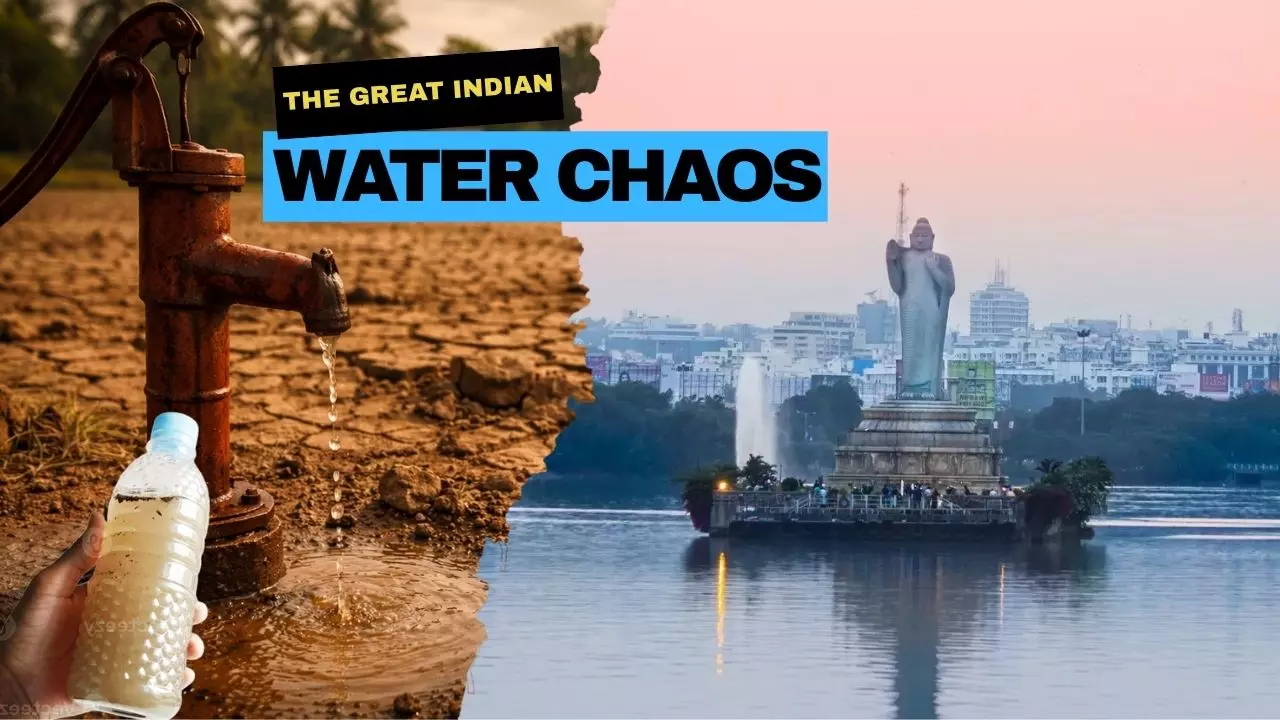
Reckless urban growth under scanner as water quality of Hyderabad lakes plummets
A Telangana pollution board report reveals 185 water bodies in the Hyderabad Metropolitan Area contain toxic heavy metals, potentially threatening public health

Ever since contaminated drinking water in Indore has claimed many lives, authorities in many other cities have ramped up water-quality checks, since potable water remains a fundamental to urban living.
In Hyderabad, a similar initiative has been taken, and to the dismay of environmentalists, the Telangana Pollution Control Board has revealed that the quality of water in as many as 185 (out of which, 23 have dried up) lakes identified in the Hyderabad Metropolitan Area (HMA) is below the prescribed standards.
Less oxygen, high heavy metal content in lake water
Latest data gathered by the board showed that these water bodies contain low levels of dissolved oxygen, high levels of biochemical oxygen demand and heavy metals that are harmful for the ecosystem. The percentage of dissolved oxygen and the concentration of heavy metals in the water are key indicators used to assess the quality of water.
Also read: Chennai’s drinking water crisis mirrors deeper urban failures across India
While Hyderabad has been known for its lakes, successive governments have failed to protect them over time, resulting in their utter pollution, which has made it impossible for the aquatic life to survive in them. In the well-known lakes of Mir Alam Tank, Kotha Cheruvu of Alwal, Pedda Cheruvu of Khajaguda, Kamuni Cheruvu, and Banajara Cheruvu, the oxygen levels have plummeted to alarming levels. In Hussain Sagar and Durgam Cheruvu lakes, which add to the city’s charm, the dissolved oxygen level is between 1.1 to 2.7 milligrams (mg) per litre.
The board’s report has cautioned that the water of these lakes has a high concentration of heavy metals such as cadmium, iron, mercury, zinc, copper, lead, nickel, and chromium, which would threaten the quality of groundwater in the long run, and consequently the city’s public health as it is dependent on that source for the regular water supply.
Reckless encroachment, construction
Environmentalists and urban water-resource management experts have cited reckless encroachment of lake areas and unchecked construction activities for such a state of affairs. The release of untreated industrial waste and the city’s sewage into the lakes also turns them into toxic pits. Lack of an adequate number of hydrologists and limnologists in the Greater Hyderabad Municipal Corporation (GHMC) also leaves such an alarming issue underemphasised.
What experts are saying
Donthi Narasimha Reddy, an environmentalist and policy expert from Hyderabad, said the current urban planning puts less emphasis on the sewage system.
Also read: Indore water contamination: Why 'cleanest city' model is under scanner
“When granting permissions for buildings and layouts, the sewage system should be considered, planned, and implemented. Sewage treatment plants should be set up immediately. However, due to a lack of space for their construction, attempts were made to build them in the lakes. Since there is no proper sewage disposal system, the water is being diverted into the lakes. As a result, the water in the lakes is getting polluted,” he told The Federal.
He added that there should be enough sewage treatment plants, keeping in mind the burgeoning construction of houses, and the government should allocate land for their construction.
Reddy also said that water should be discharged into the lakes and rivers after treatment, and that officials should prepare a suitable plan for an area at the time of granting construction permits.
Also read: Pakistan says India cannot misuse Indus Water Treaty allowance
The Ministry of Environment, Forests and Climate Change mandates that the oxygen level in a litre of water in a lake should be 5 mg per litre. But the lakes in Hyderabad do not match the criteria and are unfit.
Activist-politician expresses surprise
Environmental activist Lubna Sarwath, who is also a member of Telangana’s ruling Congress, expressed surprise at the reduction in the size of Hyderabad’s lakes. Questioning the basis on which the lakes are being reduced, she said it was responsible for causing floods in the city.
"The Jalagam Vengala Rao Park at Nagarjuna Circle was a large lake. There is also a lake in Kasu Brahmananda Reddy Park (KBR Park). Due to the reduction in its area, whenever it rains, the water is unable to flow into the lakes, flooding the Panjagutta and Raj Bhavan areas. A large lake that was in the Public Gardens was connected to Hussain Sagar. Brahmam Kunta, a large lake on the Gachibowli highway, now has a Honda company showroom built on it. How is this possible? This matter is currently in court. Such lakes have been removed from the official records,” Sarwath said.
Also read: Mekedatu project: SC rejects Tamil Nadu’s plea against Karnataka
She also added that the claim that there are only 185 lakes in Hyderabad is wrong, and that many lakes have been removed from the records.
The activist accused the HYDRAA (Hyderabad Disaster Response and Asset Protection Agency) is exceeding its limits, saying it is causing harm to the lakes.
"The Bun Rukn-ud-Daula Lake has an area of 18 acres, but it has been limited to 10 acres, and HYDRAA is building a children's park in the remaining area. The lake embankment has been removed, and a road has been built. The parks next to this lake have been encroached upon, and despite a complaint being filed a year ago, no action has been taken. HYDRAA was established to protect the lakes, which are part of our heritage,” she remarked.
“The lakes are not for encroaching and building parks. A case was filed against a BRS MLA for encroaching on Durgam Cheruvu, but against whom should a case be filed for the park constructed by HYDRAA on this lake?" she questioned. She sought the removal of HYDRAA chief Ranganath for such acts.
Sarwath also alleged that MRDCL is filling up Mir Alam Cheruvu and building a bridge there.
“This will destroy the lake. HYDRAA was established because the GHMC, HMDA (Hyderabad Metropolitan Development Authority), state irrigation and revenue departments were unable to protect the lakes. Now, this organisation is acting as it pleases. There is no oversight mechanism over its actions," she said, adding that lakes are also crucial for preserving biodiversity and protecting birds.
(This story was first published in The Federal Telangana)
