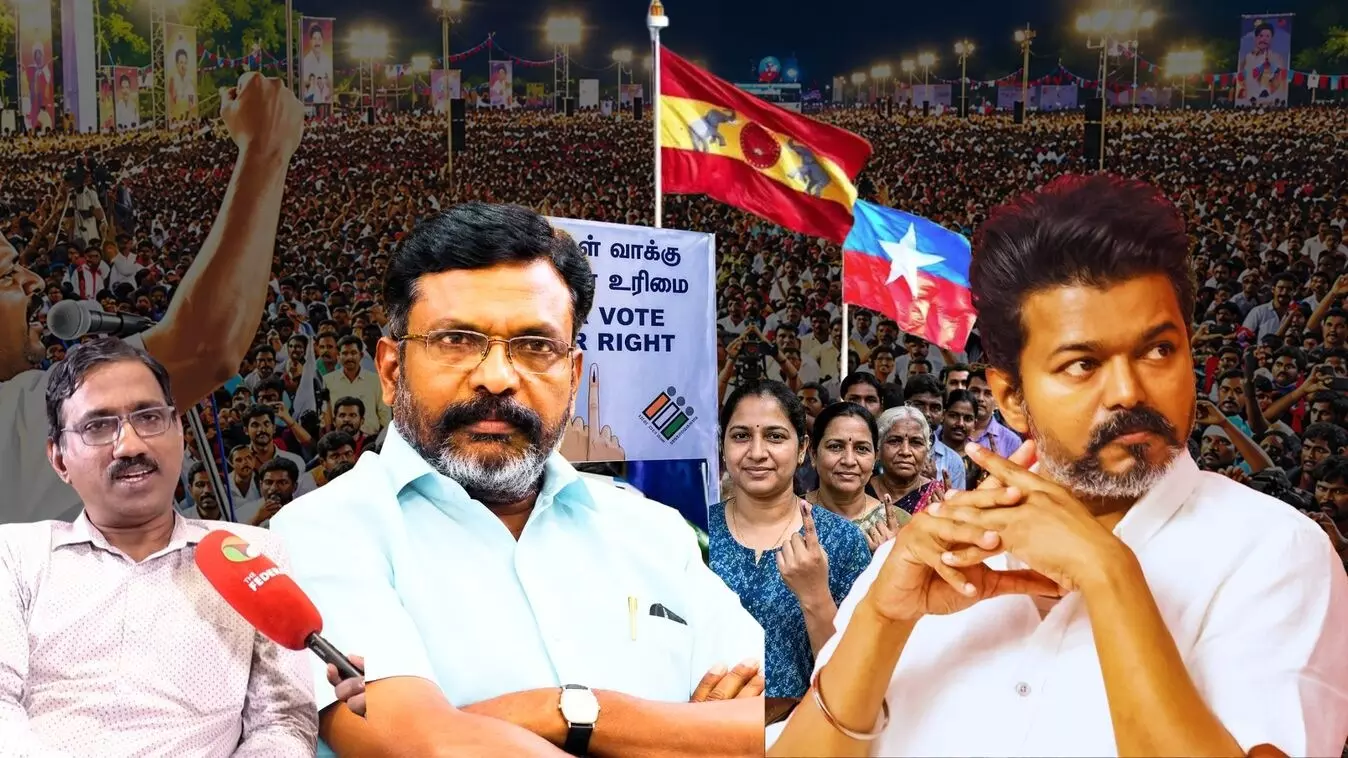
'Rahul vs Vijay PM face debate won't affect TVK-Congress ties'
Political analyst T Ramakrishnan says there is “nothing wrong” with TVK projecting its leader. He also argues that the alliance partners have strong political reasons to stay together

The Congress-TVK alliance in Tamil Nadu is unlikely to be threatened by competing claims over who could be projected as the prime ministerial candidate for 2029, says political analyst T Ramakrishnan.
While Congress leaders continue to back Rahul Gandhi and some TVK supporters are projecting party chief and Tamil Nadu Chief Minister C Joseph Vijay as a potential PM candidate, Ramakrishnan says there is “nothing wrong” with TVK projecting its leader. He also argues that the alliance partners have strong political reasons to stay together.
Also read: Tamil Nadu bypolls will put political defections to the voter test
In an exclusive interview with The Federal, Ramakrishnan discusses the new TVK-led alliance, its relationship with Congress and VCK, the representation of Dalits and minorities in the government, and the electoral arithmetic behind the alliance.
The Left parties have stayed out of the TVK-led alliance. Why do you think they have moved away despite supporting the government?
One thing is that they are not part of the government. Most of those parties, except MDMK, which doesn't have any presence, technically speaking, in the Assembly, are part of the government. Perhaps the Left parties would have sensed that some of the policies that the TVK-led government may have to carry out are not in tune with the thinking or ideology of the Left parties.
For reasons of political expediency, I would say, they have distanced themselves from the alliance. But they are saying that they are supporting the government. They have four MLAs, and their support is crucial. On both sides, that is, on the side of TVK as well as on the side of the Left, there is one thing. The Left parties are not part of the TVK alliance, but they are supporting the government because they say they don't want the entry of the BJP through the back door in the form of President's Rule, etc.
Also read: Politicians today should be responsible and look at facts: N Ram
Congress is a major partner, but there are already competing claims over Rahul Gandhi and Vijay as a possible PM face. How do you see the Congress-TVK relationship?
I think the relationship will continue, notwithstanding the differences between them. Of course, the Congress would like Mr Rahul Gandhi to be the candidate for the post of Prime Minister. But there is nothing wrong on the part of TVK to project its leader, its president, Mr Vijay, as the candidate for the PM post. There is no harm in somebody having aspirations to attain the top post in the country. But how far that will materialise or how far that will progress is another issue.
Also read: DMK paying price for not filing case against Vijay after Karur incident: VCK chief
Could the competing PM claims damage the Congress-TVK relationship at this early stage?
Not necessarily, and I don't think so, because the Congress knows that it is part of a government after a gap of 60 years. Even though it had supported the DMK when the DMK was in power, or the AIADMK was in power, it was never part of the ruling dispensation in the formal sense of the word.
So now, the Congress has got two ministers, and they have been given portfolios. One is higher education, and the other is tourism. These are not insignificant posts. They have been given decent portfolios. So, I don't think the Congress would like to break its ties or fight with the TVK over this issue.
It is too early, number one. Number two, Congress is not going to gain anything by quitting the alliance unless otherwise it is able to stitch another alliance that can form the government. Why should you oppose this demand? After all, everybody knows that the TVK can win, if at all, it can contest all the seats.
How many Lok Sabha seats in Tamil Nadu, Puducherry and, say, even if they put up some candidates in Kerala, Andhra Pradesh, Karnataka and elsewhere, how many seats will they be able to win? That's another issue. The number matters. After all, in a parliamentary democracy, how many seats you have in the Lok Sabha that only decides.
The point is that they are trying to project, I think, after Jayalalithaa, someone from their party, from its ranks. And of course, that happens to be the CM of the day. I don't think there is anything wrong.
Why should Congress feel irritated that TVK should not raise this demand? When the time comes, the two leaders will meet and then sort it out. There is nothing wrong. I don't see this matter developing into a big issue. I don't think that will rock the alliance or rock the ties between Congress and TVK.
Also read: Vijay or Rahul for PM in 2029? Why the new TVK-Congress alliance is under strain
VCK has had differences with TVK. How do you see VCK establishing its space within the new alliance?
There is one popular perception, which is being contested by Thol Thirumavalavan and other leaders of the VCK, that the VCK's base has somewhat been eroded in a big way by the emergence of the TVK. But the fact of the matter is that TVK has got a good base among Scheduled Castes. In the TVK-led ministry, eight Scheduled Caste people have been made ministers. This is for the first time.
It may have symbolic value, or you can say whatever it is, but it has its own message. Let us not gloss over it or underestimate this development. Perhaps the VCK would have been under the impression or conclusion that unless it moves along with the TVK, it will only weaken itself.
So, it stands to gain, or at least it stands to reinforce its position, if not achieve some gains, by going along with the TVK. After all, TVK is the number one party in the alliance and it is the party that is heading the government. So it has become one of the principal players, whether you like it or not.
Moreover, by taking a stand against TVK, it will not help the case of VCK. So, I think, for reasons of political survival as well as the political future of the party, VCK has decided to be with TVK.
The coalition government was formed without many hurdles. What does that say about TVK's approach to coalition politics?
The run-up to the formation of the coalition government did not face very many hurdles. It was a sort of a very smooth transition. Normally, that doesn't happen, particularly in a state which does not have a history of coalition governments. They didn't take very much time.
In that way, you have to give credit to the TVK and Vijay and all those people who made it possible. This is because the DMK and AIADMK have been arguing that Tamil Nadu is not suited for coalition governments. They have been saying that for the last 40-50 years. But TVK has proved that the argument is wrong. It is very weak.
The contradictions will be there. They will all continue to be there. But the point is that they know that not only VCK, but the Left parties and Congress also know that, as of now, TVK enjoys a great deal of goodwill and people are prepared to give TVK a long rope. It is too early to judge this party, TVK, without giving it a fair chance to prove itself.
So I don't think either of the parties, or either of the constituents of the alliance, would like to rock the boat because they know that they will be doing it at their own peril.
Will Thol Thirumavalavan be able to sustain his vote bank by staying with TVK?
In a sense, I would call TVK and VCK natural allies because they complement each other. Their bases are somewhat complementary. One of the constituents of the vote base of TVK is Scheduled Castes, and VCK sustains itself on the basis of the Dalit vote bank. So it complements each other.
As far as TVK is concerned, it supplements the support from VCK. In the case of VCK, it complements.
With regard to DMK and AIADMK, these two parties have been seen, right or wrong, as parties of the intermediate castes.
When it comes to elections, the three caste groups — Vanniyars, Gounders and Mukkulathors — constitute about 45 per cent in the case of AIADMK and about 38 per cent in the case of DMK, broadly.
A significant proportion of the candidates put up by DMK and AIADMK belong to these three communities.
They are called intermediate or backward castes. But the point is that the view has been there that these two parties are seen as parties of these intermediate castes. The real power lies with them. For constitutional requirements, you accommodate Scheduled Castes. That's all. Otherwise, the real power doesn't lie with them.
This criticism has been there against these two parties for a long time.
Whereas with the TVK, the talk doing the rounds among political experts or analysts is that this is a government of Dalit empowerment and Dalit plus minorities.
It is a government that is being sustained by these two groups — Dalits and minorities.
When I say minorities, not only religious minorities, but also political minorities. For example, take the case of Brahmins. Two people have been given tickets and they have been made ministers also. This is somewhat unheard of.
You mentioned Brahmin representation. What is the significance of that compared with the Jayalalithaa period?
Jayalalithaa could become Chief Minister. There was one MLA called TM Rangarajan who represented Mylapore for about two years, and then, unfortunately, he died in a road accident. He was an advocate.
The story went that, in those days, when he went to Jayalalithaa and told her, “Madam, the Cabinet did not have a representative from Brahmins,” she replied, “Am I not a Brahmin?”
So even Jayalalithaa did not like to have one more Brahmin in the Cabinet apart from the Chief Minister. Nothing else, nothing. That was the talk at that time. I am saying this was 30 years ago.
Whereas this present CM did not have any hesitation in making these two people ministers. And somewhat, no issue has been made out of it.
Has this new alliance and government changed the caste calculations of the Cabinet?
Yes, indeed. There is a perception — I am not saying this — that these three intermediate castes are not getting the kind of importance that they used to get when DMK or AIADMK was in power.
That's the talk doing the rounds in certain circles. But I don't know whether that is entirely the case because their representatives are also there. They are also holding important and prominent positions. It is not that they are not there. They are all visible.
I don't want to name or identify the ministers with their communities, but you all know the names.
The point I am making is that this TVK government is seen as one which is being propped up by Dalits plus minorities, political and religious. That way, it helps your basic question about VCK and caste calculations.
It will help Thirumavalavan also, and then he can hope to expand his base socially by remaining with TVK. We don't know whether TVK will remain as a political force in the future or how long it will remain. But I don't think it will remain as a one-election wonder because it has been able to get 35 per cent of votes.
That's 1.7 crore people who voted for TVK. You can say the face of Vijay made wonders or whatever it is, but the point is that 1.7 crore people voted. That's the fact.
The point is this: people like Thirumavalavan and all others might think that, in case TVK undergoes some sort of internal turning or some sort of political crisis, at that time, by remaining with them, they will be able to say that we can provide a better, credible alternative. But if they are against TVK, then they can't make that claim.
What does IUML's presence in the alliance mean for minority rights?
First of all, they will concentrate on the real issues of backwardness concerning the Muslim community. Unfortunately, Muslims have been viewed only as a source of vote bank. I hope the inclusion of a representative from IUML will take this process further.
As of now, we don't see any indication of this government making any tangible step towards uplifting Muslims in a conscious, organised manner. It has been only four months, so we will give them some more time.
But as a political force, I never expected that IUML would be accommodated at one point of time in the Tamil Nadu Cabinet. They were given some symbolic accommodation earlier. For some time, they contested and were part of the AIADMK front also. Most of the time they were part of the DMK front.
At one stage in the late 1980s and 1990s, for about 10 years or so, until the death of MA Latif, there were two Muslim parties — IUML and the Indian National League. They were only given some symbolic accommodation.
The point is that now they have been able to send a nominee of their own to the Cabinet, and that itself is a very significant development. You can't simply dismiss it.
Even if they have done it for reasons of survival, there is a representative from IUML. I hope it will not remain only an act of symbolism. In terms of substantive matters and policy matters, if they take this process forward, then that will be meaningful. Otherwise, it will be another person occupying the post of minister.
Do you expect IUML, MDMK, Congress and the other alliance partners to remain with TVK?
Yes. All these parties — be it IUML or MDMK or Congress, and the Left parties — will be with TVK. They will remain with TVK at least for the next couple of years. Otherwise, their credibility will be at stake. They may keep coming and going. Even if they want to go, their only option is DMK.
Of course, I don't think they have created their relationship to such an extent that they can't establish or re-establish their ties with the DMK. It's not that way. But still, it is too early to go back to DMK. I think they will remain with TVK for the next couple of years, or till the next Lok Sabha elections, which I don't foresee getting advanced. But if, because of some extraordinary reasons, they get advanced, fine. Till then, this alliance will be there. This alliance will remain.
What is TVK's larger electoral calculation in holding this alliance together?
From the TVK point of view, it's not just for sustaining the government. TVK has secured 35 per cent of the votes. I think this is the highest that it can hope to get on its own. It should know that in the next election there will be some erosion.
That erosion can be 2 to 3 per cent, 4 per cent, all that. So, if these three, four or five parties can compensate for their expected loss of vote share, plus increase their vote share — if they can increase the existing 35 per cent by one or two percentage points — then that will be fine. That will be excellent for them.
Because then that will be 37 or 38 per cent, and DMK or AIADMK, I don't think either will be able to exceed 38 per cent unless the political dynamics change drastically. So, for reasons of elections and electoral arithmetic also, I think they have done this. That's my reading.