



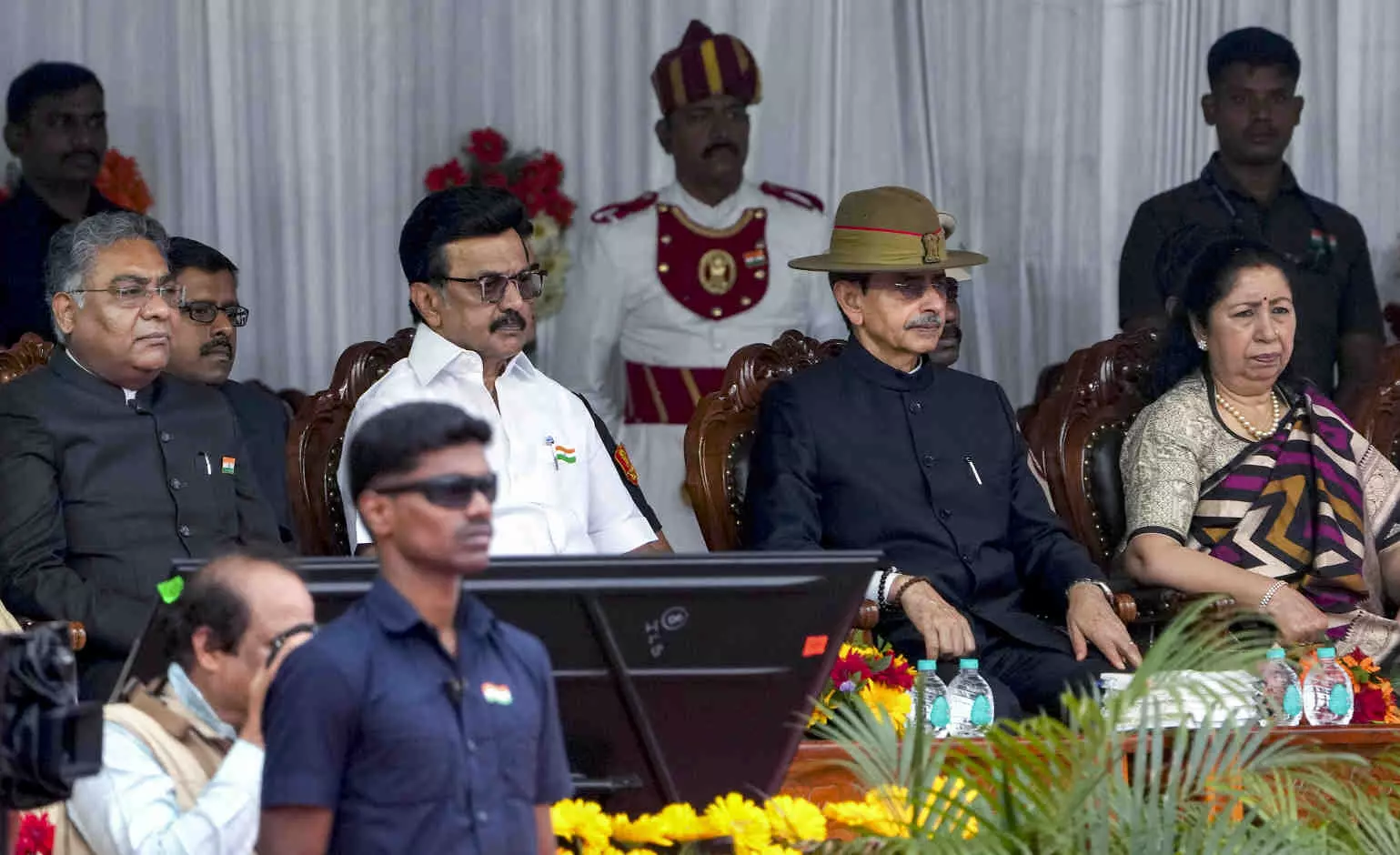
Earlier in the day on Monday (Jan 26), Governor RN Ravi and Chief Minister Stalin were present together during the Republic Day celebrations at the Marina Beach in Chennai in a rare display of protocol adherence. Photo: PTI
TN govt, DMK leaders boycott Governor Ravi's Republic Day tea party
CM Stalin attended the morning parade but leads a boycott of the evening tea party over federal frictions; AIADMK's Palaniswami and PMK founder Ramadoss also skip

The Tamil Nadu government will boycott the traditional tea party hosted by Governor RN Ravi at the Lok Bhavan in Guindy, Chennai, on the occasion of Republic Day. The decision comes amid escalating tensions between the state administration and the Governor's office.
The DMK-led alliance parties have also joined the boycott, with no ministers, key party functionaries, MLAs, or MPs from the ruling coalition attending the event. Sources close to the government stated that the boycott is in condemnation of the Governor's actions, which they perceive as detrimental to Tamil Nadu's interests.
"The Tamil Nadu government will not participate in the tea party hosted by the Governor this evening, and no ministers will attend on behalf of the state," an official statement read.
Governor Ravi, CM Stalin attend R-Day celebrations
However, earlier in the day, Governor RN Ravi hoisted the national flag during the Republic Day celebrations at Marina Beach in Chennai, with Chief Minister MK Stalin standing alongside him in a rare display of protocol.
The ceremony, held near the Labour Statue, featured a ceremonial parade, gallantry awards presented by the CM, and a shower of flower petals from an IAF helicopter, symbolising national unity despite the underlying tensions.
Also Read: TN Governor RN Ravi walks out of Assembly, yet again, amid anthem row
Following the event, Stalin and Deputy Chief Minister Udhayanidhi Stalin departed for Thanjavur to attend the DMK Women's Conference, leaving the Governor's subsequent tea party unattended by the ruling party's top brass. This comes in the wake of the Supreme Court's recent observations on the bill-withholding dispute, where the apex court emphasised the need for dialogue, suggesting that both sides engage in constructive talks, perhaps over a cup of tea, to resolve their differences and uphold cooperative federalism.
EPS, Ramadoss skip event
Notably, AIADMK general secretary Edappadi K Palaniswami skipped the event, opting instead to travel to Coimbatore. In his absence, former ministers D Jayakumar, Valarmathi, and Benjamin represented the party. PMK founder Dr S Ramadoss also boycotted the gathering, adding to the list of prominent absentees. However, senior bureaucrats, including Chief Secretary Muruganandam and acting Director General of Police (incharge) Venkataraman were present at the tea party.
Also Read: Tamil Nadu minister slams Governor Ravi, rejects ‘Tamil exceptionalism’ claim
This annual Republic Day tradition sees the Governor extending formal invitations to government officials, ministers, legislators, parliamentarians, opposition leaders, and representatives from various political parties for an evening tea reception at the Lok Bhavan. The event typically fosters dialogue among diverse political stakeholders.
Simmering tension over the past four years
Tension between Governor RN Ravi and the DMK government has been simmering since he assumed office. Over the past four years, the Governor has repeatedly staged walkouts from Assembly sessions without delivering his inaugural address, citing disagreements. This has led to repeated confrontations, including the government's refusal to participate in university convocation ceremonies presided over by the Governor.
Also Read: Presidential reference: Why Supreme Court’s reply is a big letdown
Last year, Chief Minister MK Stalin boycotted the Governor's Independence Day tea party, and the Higher Education Minister was instructed not to attend university events involving the Governor. Today's boycott extends this pattern to Republic Day celebrations. DMK's alliance-partners Congress, CPI(M), CPI, VCK, and MDMK had already declared their intention to skip the event.
While expectations were high for participation from NDA allies like the AIADMK, BJP, and PMK, the partial boycott by AIADMK and full abstention by PMK highlight fractures even within opposition ranks.
Broader conflict over federalism
Tensions between Tamil Nadu Governor RN Ravi and the DMK-led state government under Chief Minister MK Stalin has escalated further, highlighted by the Governor's recent walkout from the state assembly and ongoing disputes over withheld legislative bills. This pattern of confrontation, which has persisted since Ravi assumed office in September 2021, underscores a broader conflict over federalism, protocol, and governance in the southern state.
Also Read: Karnataka govt to launch ‘Go Back’ campaign against Governor, wants Gehlot recalled
Governor Ravi, a former Indian Police Service officer and Nagaland interlocutor, was appointed amid expectations of smooth Centre-State relations. However, frictions emerged early due to ideological differences and perceived interference in state affairs. The DMK government has accused Ravi of acting as an agent of the BJP-led government at the centre, delaying key reforms and undermining the state's autonomy. Ravi, in turn, has defended his actions as upholding constitutional propriety, often citing inaccuracies or ideological biases in government-prepared documents.
The key flashpoints include:
Disputes over University appointments: Ravi has clashed with the government on vice-chancellor selections, leading to legal battles.
Language and cultural issues: The Governor has laid emphasis on the promotion of Hindi and Sanskrit, drawing the ire of the government in a state proud of its Tamil heritage.
NEET exemption bill: A prominent example where Ravi withheld assent, forcing the state to seek presidential intervention.
These issues have fuelled protests, court petitions, and public debates, with the Supreme Court intervening multiple times to clarify gubernatorial powers.
Also Read: Gehlot leaves Assembly after reading 2 lines of address; Siddaramaiah warns of protest
Compounding the assembly drama is the protracted issue of bills passed by the Tamil Nadu Assembly but withheld by the Governor. As of late 2025, Ravi had received 182 bills since taking office. According to the Lok Bhavan, 152 were assented to, five were withdrawn by the government, and others werereserved for presidential consideration. However, the DMK government alleges deliberate delays, stalling key legislation on education, health, and social welfare.
Notable examples include:
- Bills on online gambling bans, university governance reforms, and appointments to statutory bodies.
- Ten bills reserved for the President's assent, which the Supreme Court in April 2025 deemed "illegal and arbitrary”, ruling that governors cannot indefinitely withhold assent or reserve bills without valid reasons.
- A November 2025 Supreme Court directive emphasised that governors must act "as soon as possible" on bills, setting a three-month deadline in some cases, and said that governors cannot act as a "parallel power" to the elected government.
Also Read: After Tamil Nadu, Governor-state government standoff erupts in Kerala
The court sharply rebuked Ravi, stating his actions violated Article 200 of the Constitution, which mandates timely decisions on bills. Despite this, the Lok Bhavan has denied systemic delays, claiming 81 per cent of bills were cleared promptly.
The state government views this as political vendetta, with Stalin's administration filing petitions that led to these landmark judgements.
