



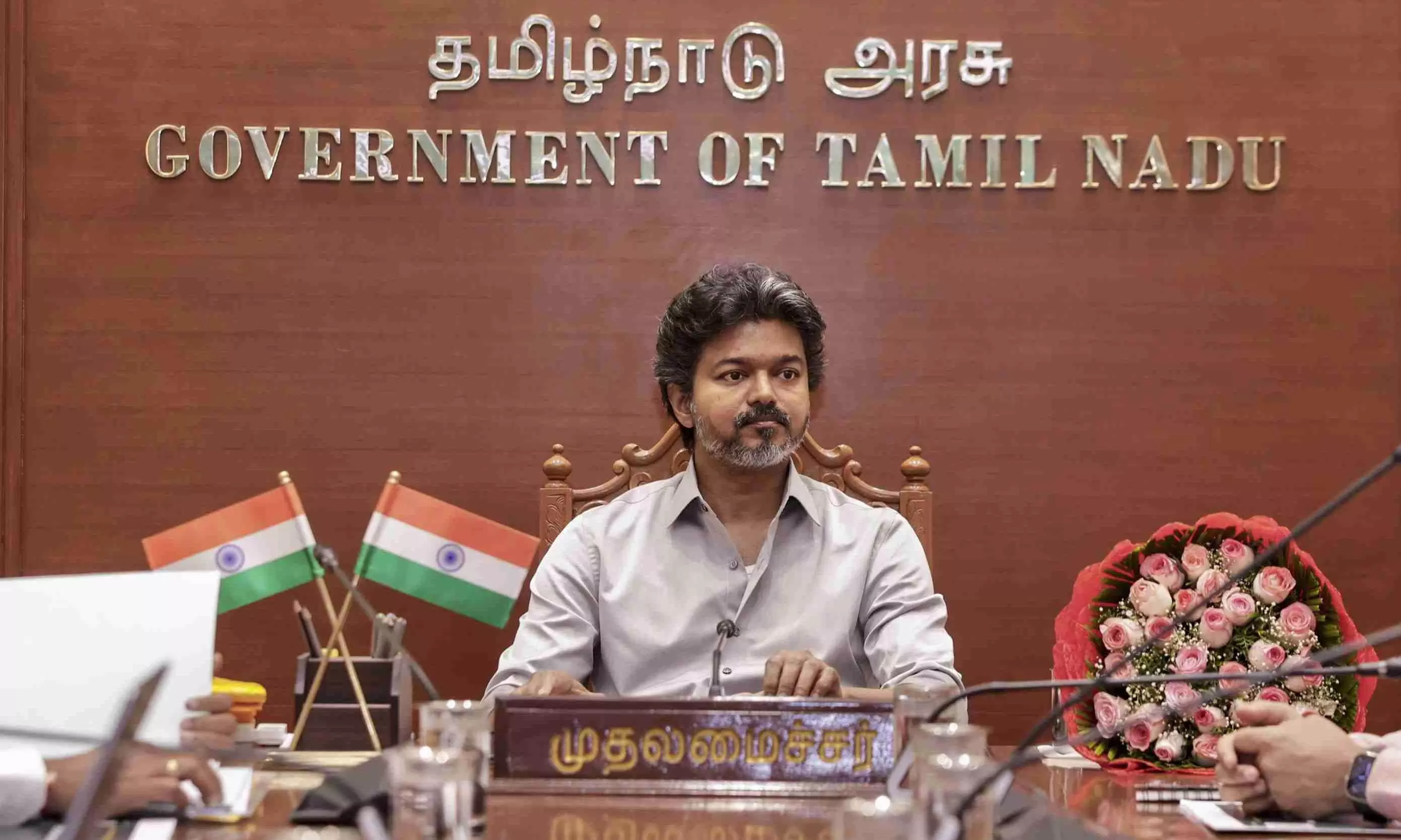
Vijay takes political middle path, declares both Jul 18 and Nov 1 as Tamil Nadu Day
TVK government seeks to end a decades-old political and ideological dispute by recognising both the state's linguistic formation and its renaming

Chief Minister Joseph Vijay on Saturday (July 18) extended greetings to the people of Tamil Nadu on “Tamil Nadu Day”. He also announced that the state government will officially celebrate both July 18 and November 1 as state days, potentially ending years of political and historical controversy over which date truly represents the birth of the state.
In his message posted on X, CM Vijay highlighted the dual significance: the historic resolution passed under CN Annadurai on July 18, 1967, to rename Madras State as Tamil Nadu, and the formation of the linguistic Madras State on November 1, 1956.
Also read: Maraimalai Adigal: The man who fought for pure Tamil, in fluent English
He pledged that the government would honour both milestones while remembering the sacrifices of those who fought for Tamil identity and the state’s borders. The move comes amid renewed debate following government-organised competitions in schools on Tamil language and history tied to July 18.
History of Madras Day
Before Independence, the region was part of the vast Madras Presidency. After 1947, it became Madras Province and then Madras State in 1950. The major moment came with the States Reorganisation Act of 1956. On November 1, 1956, India was reorganised along linguistic lines.
The Tamil-speaking areas were consolidated into Madras State, while Telugu, Kannada, and Malayalam-speaking regions were carved out to form Andhra Pradesh, parts of Mysore (later Karnataka), and Kerala, respectively.
This reorganisation fulfilled long-standing demands for linguistic states but also resulted in the loss of some territories that Tamils had historically considered part of their cultural sphere. Many scholars and leaders have argued that November 1 marks the true “birth” of the modern Tamil Nadu as a distinct linguistic entity.
When Madras became Tamil Nadu
After the DMK’s historic victory in the 1967 Assembly elections, CN Annadurai became chief minister. On July 18, 1967, he moved a resolution in the Tamil Nadu Legislative Assembly to rename Madras State as Tamil Nadu.
Also read: Vijay and Dravidian politics: Is TVK Tamil Nadu’s next phase?
The resolution was passed unanimously, with support even from the Opposition. It was a powerful symbolic assertion of Tamil pride and Dravidian identity. The official renaming took effect on January 14, 1969. This date became deeply significant for supporters of the Dravidian movement, as it represented the culmination of decades of struggle, including the ultimate sacrifice of Thiyagi Shankaralingam, who fasted unto death demanding the name change.
When is actual TN Day?
The debate centres on a fundamental question: Should the state’s official day commemorate its formation (November 1, 1956) or the adoption of its distinctive name (July 18, 1967)?
Advocates for November 1, including PMK leader Anbumani Ramadoss and the previous AIADMK government, argue that a state’s “birthday” should be its formation day under the linguistic reorganisation. They point out that neighbouring states like Andhra Pradesh, Karnataka, and Kerala also celebrate November 1 as their formation day. They view the shift to July 18 as a distortion of history that prioritises symbolism over substance.
Advocates for July 18, primarily the DMK and its allies, emphasise that the name “Tamil Nadu” itself is the ultimate expression of Tamil identity. They argue that November 1, while important, also marks the day Tamil-speaking regions lost significant territories to other states. Celebrating July 18 honours the political and cultural assertion led by Anna.
The date dispute
In 2019, then-Chief Minister Edappadi K Palaniswami (AIADMK) declared November 1 as Tamil Nadu Day. In 2021, the DMK government under MK Stalin reversed this and declared July 18 as the official Tamil Nadu Day.
Also read: Dravidian Model: Decades of work or just one party’s narrative?
Simultaneously, the DMK government designated November 1 as “Border Martyrs’ Day” and enhanced pensions for families of those who sacrificed their lives protecting Tamil Nadu’s borders.
As former minister Thangam Thenarasu explained in a detailed statement: “Both these dates were done by the DMK government itself. Scholars urged the government to celebrate July 18 as Tamil Nadu Day because celebrating November 1, the day of linguistic reorganisation, would be inappropriate, given that Tamil Nadu lost more territory than it gained during that reorganisation.
It was the DMK government under Anna that gave the state the name ‘Tamil Nadu’ after fighting against the dominant mindset that refused a unique identity for the Tamil people. At the same time, to honour the martyrs who laid down their lives protecting Tamil Nadu’s borders, November 1 was declared as ‘Border Martyrs’ Day’ and their pensions were increased.”
Vijay’s middle path
Today’s announcement by Chief Minister Joseph Vijay marks a notable shift. By committing the government to celebrate both dates, he appears to be adopting a unifying approach that acknowledges the legitimacy of both historical milestones. Political analysts view this as a mature and inclusive move from the new administration.
Also read: As Kamal row rages on, linguists say Tamil, Kannada are daughters of long-lost ‘mother’
It honours the Dravidian legacy of Anna (July 18) while recognising the foundational importance of the 1956 linguistic reorganisation (November 1). It also avoids alienating sections of society that strongly associate November 1 with the state’s modern formation.
Could this lead to more confusion?
However, whether this fully resolves the controversy remains to be seen. While some see it as a balanced and unifying approach, political observer Dhayalan Shanmugam strongly criticised the move.
“November 1 is Tamil Nadu Day. It is not possible to accept the announcement that both days will be celebrated. They are creating confusion by mixing Tamil nationalism and Dravidianism. I feel that TVK does not have good clarity on this,” Shanmugam stated.
