







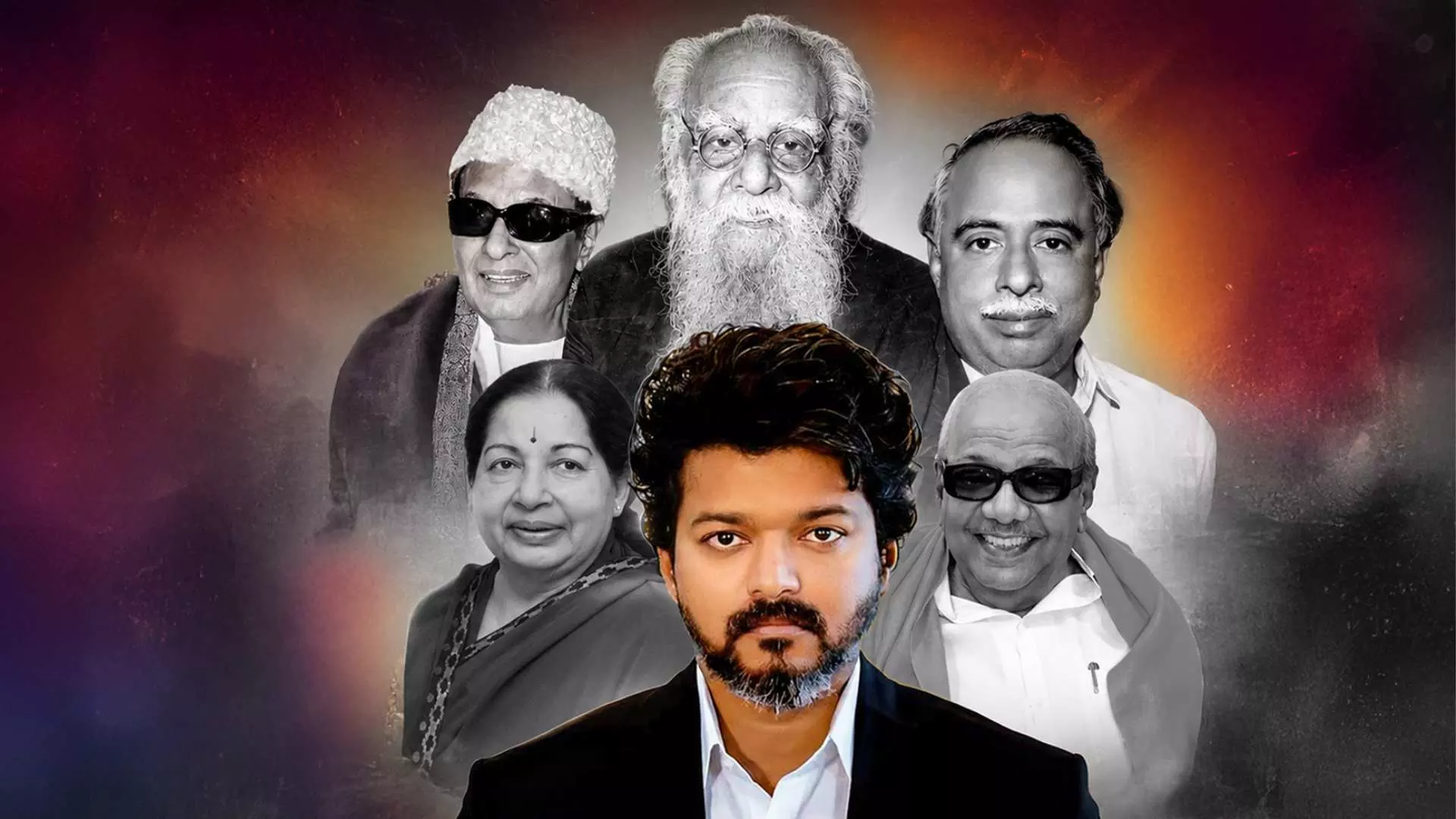
Vijay and Dravidian politics: Is TVK Tamil Nadu’s next phase?
TVK’s rise may not signal the end of Dravidian politics, but its reinvention. From Periyar to MGR to Vijay, TN may be entering a new phase.

Tamil Nadu’s political landscape may have entered a new phase with actor-turned-politician C Joseph Vijay taking oath as Chief Minister after TVK’s dramatic electoral victory. But beneath the shock of the results lies a deeper political story: not the collapse of Dravidian politics, but its evolution.
Political sociologist Max Weber once described “charismatic authority” as moments when people stop trusting institutions and begin placing their hopes in a single figure who appears larger than the system itself. Tamil Nadu, many observers believe, may now be entering such a moment once again.
Also read: TN CM Vijay drops 'VIP' white chair towel after youngster's urge: 'Change is coming'
Massive crowds, emotionally charged speeches and cinematic campaign optics accompanied Vijay’s rise, drawing inevitable comparisons with earlier Dravidian icons such as CN Annadurai, MG Ramachandran and J Jayalalithaa. The question now being asked is whether Tamil Nadu is witnessing another reinvention of Dravidian politics rather than a break from it.
Roots of change
To understand the moment, one has to go back to the late 19th century, when Tamil society was deeply shaped by caste hierarchy and unequal access to power.
An early 1990s study by the Madras Institute of Development Studies noted that in 1886, Brahmins — who formed barely three per cent of the Madras Presidency’s population — occupied 42 per cent of government posts. In higher judicial and administrative roles, the figure reportedly rose to 58 per cent.
Also read: On paper only? Tasmac liquor shops open despite after TN CM Vijay's order
This imbalance laid the foundations for the Dravidian movement, first as a social reform movement and later as Tamil Nadu’s defining political force.
Early non-Brahmin intellectuals such as P Sundaram Pillai, V Kanakasabhai and Maraimalai Adigal revived Tamil linguistic pride and shaped early Dravidian identity. But critics argued that their reforms largely centred upper-caste non-Brahmin interests, leaving Dalits, labourers and women outside the movement’s core concerns.
Periyar era
That changed with the arrival of EV Ramasamy, popularly known as Periyar.
Periyar challenged caste hierarchy, patriarchy and religious orthodoxy with unprecedented intensity. He argued that caste was not an ancient Tamil tradition and that women’s oppression was rooted in religion and social structures.
He said things that made comfortable people deeply uncomfortable, and that was precisely the point.
Periyar’s ideological successor, Annadurai, transformed these social ideas into electoral politics through the formation of the Dravida Munnetra Kazhagam.
In 1967, the DMK ended decades of Congress dominance in Tamil Nadu by winning 137 seats. The victory was seen as a social revolution, with ordinary workers, farmers and weavers entering the state’s corridors of power.
The Congress establishment, however, reportedly dismissed the DMK leadership as inexperienced and unserious. Similarly, now, sections of the political class initially viewed TVK’s rise.
Welfare model
Over the following decades, Tamil Nadu’s two major Dravidian parties — the Dravida Munnetra Kazhagam (DMK) and the All India Anna Dravida Munnetra Kazhagam (AIADMK) — competed fiercely but largely within the same ideological framework.
Welfare politics, social justice, reservation policies and Tamil identity became the defining grammar of governance.
The script argues that these policies helped create a large backward-class middle class and a skilled workforce that powered industries ranging from automobiles in Chennai to textiles in Tiruppur and leather production in Ambur.
By 2024–25, Tamil Nadu had become one of India’s fastest-growing major states with an 11.19 per cent growth rate, while also recording strong performance in healthcare and education.
The ideology created the economy. The economy validated the ideology.
But the deaths of Jayalalithaa in 2016 and M Karunanidhi in 2018 created a leadership vacuum that reshaped the political landscape.
Vijay factor
When Vijay launched the Tamilaga Vettri Kazhagam (TVK) and announced plans to contest all 234 constituencies without alliances, many political observers dismissed it as another failed actor-led experiment.
Comparisons were drawn with Vijayakanth and Kamal Haasan, whose political journeys failed to significantly disrupt Tamil Nadu’s two-party structure.
Analysts repeatedly argued that “fandom is not votes” and “cinema is not politics”.
But the election results overturned those assumptions.
At TVK’s first major rally in Vikravandi, Vijay positioned himself within the larger Dravidian tradition rather than outside it. The stage featured portraits of Periyar, BR Ambedkar, K Kamaraj, Velu Nachiyar and Anjalai Ammal.
The symbolism reflected themes of rationalism, social justice, welfare politics and representation — values deeply embedded in the Dravidian political tradition.
Reinvention debate
Vijay’s biggest political move was not rejecting Dravidianism but presenting himself as part of its continuing evolution.
TVK’s manifesto promised monthly financial assistance for women, free bus rides, subsidised welfare schemes and social justice measures — policies that strongly echoed the welfare-driven Dravidian model established by Annadurai, institutionalised by Karunanidhi, expanded by MGR and intensified by Jayalalithaa.
What has changed is the gatekeeping.
For decades, political legitimacy in Tamil Nadu largely depended on passing through either the DMK or AIADMK. While challengers emerged over the years, most either faded away or became junior allies within the existing system.
Vijay has managed to break that gatekeeping structure, at least temporarily.
He is not replacing Dravidian politics. He is competing for it.
The broader argument is that Vijay’s rise reflects frustration among younger voters and sections of the public who felt alienated by existing political institutions, even while remaining attached to the core ideals of welfare and social justice.
A new claimant
Dravidian ideology itself may not be ending, but rather entering another phase where new claimants attempt to redefine its leadership.
Periyar took it from the Vellala elite. Annadurai turned it into electoral power. MGR wrapped it in cinema and delivered it to the villages. Jayalalithaa made it the governing grammar of a state. And now, Vijay is attempting to weave something new.
Tamil Nadu, it argues, is becoming a contested political space where the ideology remains constant, but the leaders claiming its legacy continue to change.
(The content above has been transcribed from video using a fine-tuned AI model. To ensure accuracy, quality, and editorial integrity, we employ a Human-In-The-Loop (HITL) process. While AI assists in creating the initial draft, our experienced editorial team carefully reviews, edits, and refines the content before publication. At The Federal, we combine the efficiency of AI with the expertise of human editors to deliver reliable and insightful journalism.)


