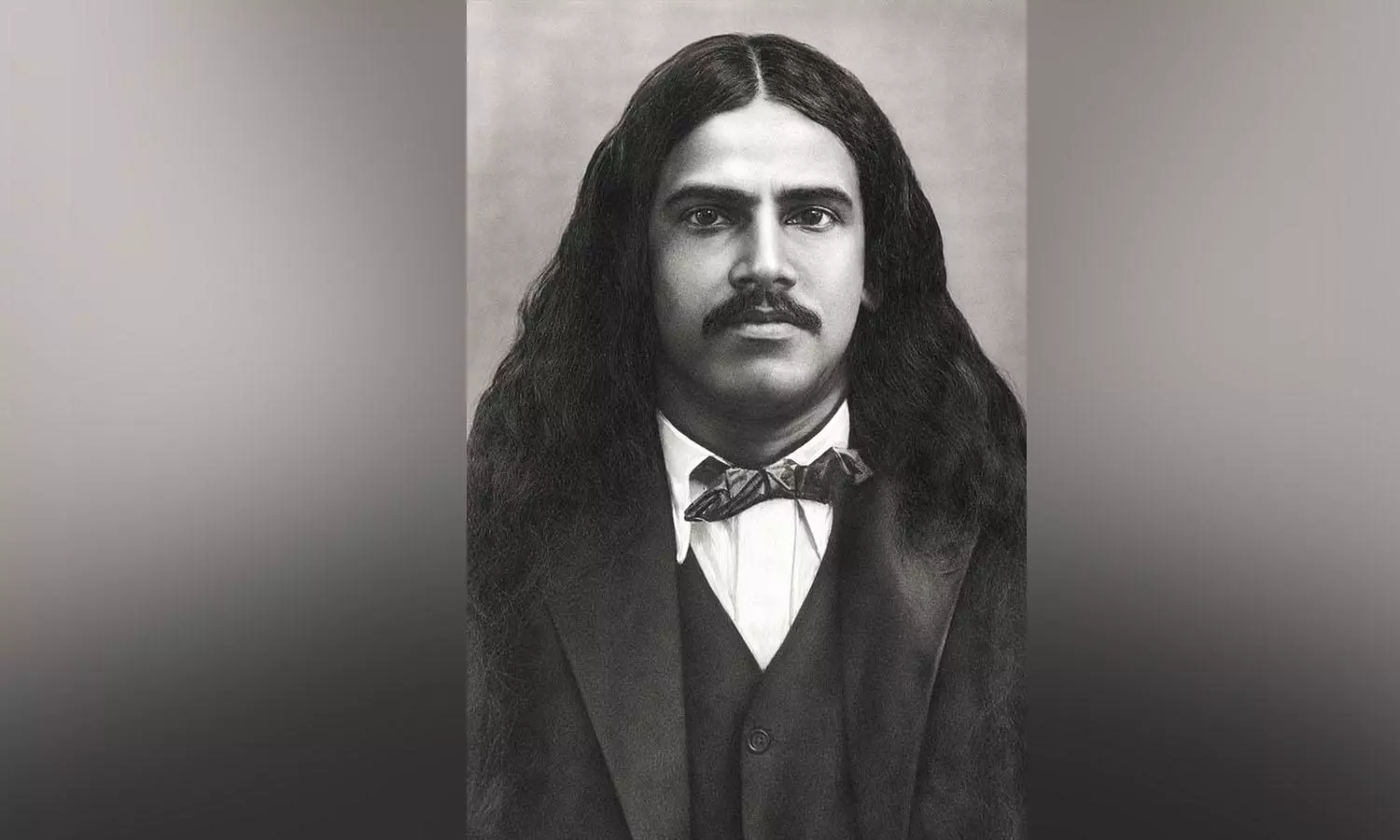
Maraimalai Adigal spent 11 years teaching Tamil at Madras Christian College and had established himself as a researcher of Sangam literature, Tamil grammar and Saiva philosophy by then. Photos: MMA Library, Chennai
Maraimalai Adigal: The man who fought for pure Tamil, in fluent English
In his 150th birth anniversary, scholars highlight how Thani Tamil Iyakkam architect mastered English and Sanskrit to prove Tamil is equal to them

As Tamil Nadu celebrates the 150th birth anniversary of Maraimalai Adigal, contemporary scholars have come forward to debunk the theory that the architect of the Thani Tamil Iyakkam (Pure Tamil Movement) was a linguistic isolationist.
Instead, they describe Adigal’s vision as being far more global and inclusive, as he had mastered English and Sanskrit to prove Tamil could stand shoulder to shoulder with the world's greatest languages.
When one imagines Maraimalai Adigal, the image that often comes to mind is that of a traditional Tamil scholar clad in a saffron dhoti, with well-oiled hair tied up in a bun, immersed in palm-leaf manuscripts. That picture, however, say scholars, is misleading.
Master of English and Sanskrit
The man who laid the intellectual foundations of the Pure Tamil Movement was equally at home in a Western suit. He wrote extensively in English, maintained his diaries in English for nearly three decades, possessed knowledge of Sanskrit, and published an English journal, The Oriental Mystic Myna, to reach readers beyond Tamil.
For Adigal, languages were not rivals but they were tools. His mastery over English and Sanskrit was meant to demonstrate that Tamil could match any classical language in sophistication and express even the most complex modern ideas.
Also read: Why is Murugan called a Tamil God? Indologist explains amid Jr NTR film row
In a chat with The Federal, Tamil scholar Saradha Nambi Arooran, who also happens to be Maraimalai Adigal’s daughter-in-law, said, “He learnt English and Sanskrit not because he wanted to promote those languages, but because he wanted to establish Tamil's greatness before those who questioned it.”
"He wrote English prefaces to many of his Tamil books so that non-Tamil readers could understand his arguments. Even his personal diary was written in English for nearly 30 years," she added.
Teacher to public intellectual
Born as Vedachalam in 1876, Maraimalai Adigal spent 11 years teaching Tamil at Madras Christian College. By then, he had established himself as a researcher in Sangam literature, Tamil grammar, and Saiva philosophy.
His life took a decisive turn when Madras University made Tamil an optional subject while English remained compulsory in 1911.
Maraimalai Adigal in his younger days
Pure Tamil movement and its origins
Five years later, in 1916, he adopted the name Maraimalai Adigal to completely remove Sanskrit and external influences from the Tamil language, and formally launched what came to be known as the Pure Tamil Movement.
The movement is often reduced to replacing Sanskrit words with Tamil equivalents. However, modern scholars argued that its ambition was much larger. According to Sri Lankan historian V Ravi Vaithees, the movement actually sought to create a distinctly Tamil cultural identity.
Vaithees is the author of Religion, Caste and Nation in South India: Maraimalai Adigal, the Neo-Saivite Movement and Tamil Nationalism, 1876-1950.
An oft-repeated anecdote illustrates the movement's origins, and it goes like this: Once, while reciting Ramalinga Swamigal's Arutpa with his daughter Neelambigai at their Pallavaram home, Adigal is believed to have suggested replacing the Sanskrit-derived word thegam with the pure Tamil word yakkai. The simple substitution, he felt, made the verse more authentic.
Ravi Vaithees noted that although Adigal's diaries fail to directly mention this incident, his writings show that he had been advocating that Tamil should become independent of Sanskrit, as early as 1902 through his journal Jnanacagaram.
His objective was to prove that Tamil possessed the vocabulary and intellectual richness to express every branch of knowledge without borrowing from Sanskrit.
Also read: Why fitting Tamil into AI and Large Language Models is a big challenge
Adigal's contribution extended well beyond vocabulary. Through essays, books and speeches, he attempted to create practical models for everyday life using pure Tamil. He wrote about how Tamil could be used in administration, public speaking, literature and education.
Anti-Hindi
The respected Tamil scholar also turned his attention to social customs. His 1936 work, Tamilian and Aryan Form of Marriage, compared indigenous Tamil marriage traditions with Vedic rituals. Adigal argued that many priest-centric customs were later Aryan additions and that Tamil society possessed its own egalitarian traditions.
Decades before the Hindi agitations gathered momentum, he warned against imposing a single language upon India's diverse linguistic communities. In his essay Can Hindi be a Lingua Franca of India?, he argued that privileging Hindi would undermine the cultural autonomy of non-Hindi-speaking regions and weaken India's federal character.
The book later became an important intellectual foundation for the Self-Respect marriages popularised by Periyar, which rejected Brahminical rituals and priestly mediation.
Adigal was also a vocal critic of caste discrimination and consistently argued for social equality within Tamil society. Decades before the Hindi agitations gathered momentum, he warned against imposing a single language upon India's diverse linguistic communities. In his essay Can Hindi be a Lingua Franca of India?, he argued that privileging Hindi would undermine the cultural autonomy of non-Hindi-speaking regions and weaken India's federal character.
No boundaries
Ironically, the champion of Pure Tamil had devoted enormous effort to studying Sanskrit texts. Visitors to the Maraimalai Adigal Library, inside the Connemera library in Chennai, still find thousands of books collected by him across philosophy, religion, history and Sanskrit literature.
"He never believed scholarship should have boundaries," said Rengaiya Murugan, historian and researcher in Tamil studies. "His library reflects his lifetime of learning. He collected books from every discipline and filled them with handwritten notes in the margins. There are nearly 5,000 such annotations. Every book carries evidence of his reading."
Letters penned in English by Maraimalai Adigal
Scholars see 1916 as a watershed year. The launch of the Pure Tamil Movement coincided with the birth of the Justice Party and the publication of the non-Brahmin manifesto. Ravi Vaithees argued that the two developments reinforced each other.
"The rise of the Justice Party created a political environment in which Adigal's ideas acquired legitimacy and wider appeal," he wrote.
Also read: Tamil can relax; languages 'killed' by Hindi up North are making a comeback
According to Ravi Vaithees, the Pure Tamil Movement, in fact, sowed the intellectual seeds of what later evolved into the Dravidian movement. Periyar carried many of these ideas to the masses through the Self-Respect Movement, while Tamil Nadu’s first chief minister CN Annadurai gave them an electoral and political expression.
Greatest legacy
Even today, many words commonly used in government communication, public speeches and Tamil media owe their popularity to Adigal's sustained campaign for linguistic purification.
Tamil professor S Senthamil remarked that Maraimalai Adigal's greatest legacy may not lie merely in replacing one word with another. It lies in his conviction that language could shape identity, challenge social hierarchy and become the foundation of a people's cultural self-respect.
“The irony remains striking. The scholar who became the face of Pure Tamil believed that the best way to defend Tamil was not by shutting out other languages, but by mastering them first,” she said.