



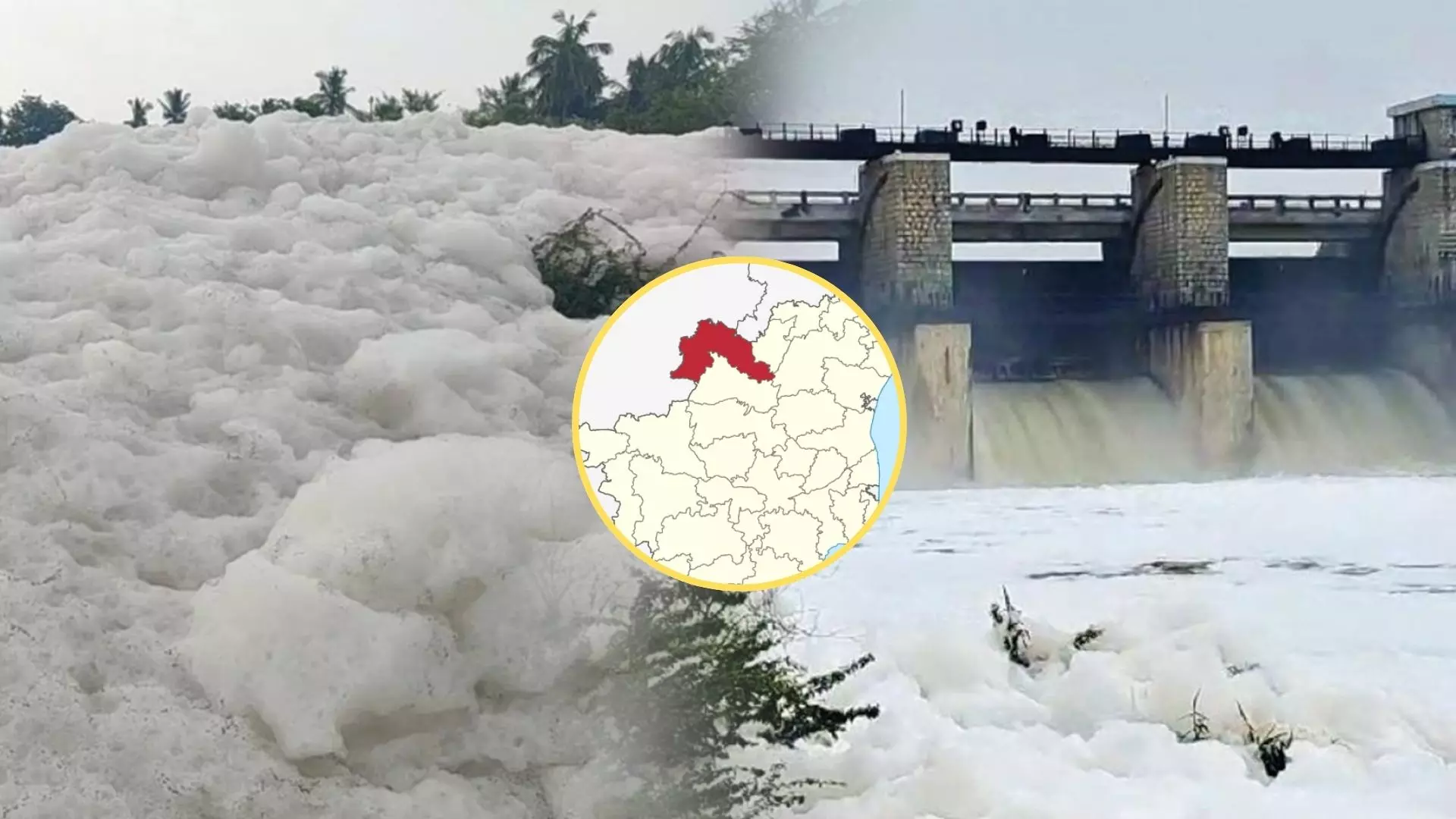
Tamil Nadu toxic foam crisis: Bengaluru sewage chokes rivers and dams
Toxic foam, green-coloured water accumulate at KRP Dam and Palar river; officials say contamination threatens agriculture, aquatic life and public health, while farmers fear damage to irrigation sources

Tamil Nadu is witnessing an alarming environmental crisis as toxic foam and green-coloured water continue to engulf major water bodies, raising fresh concerns over untreated sewage flowing downstream from Bengaluru into the state.
The latest crisis has unfolded at the KRP (Kallavarapalli) Dam in Hosur, Krishnagiri district, where a thick layer of froth has been accumulating for nearly a month following heavy rains. Officials say the contamination threatens agriculture, aquatic life and public health, while local farmers fear long-term damage to irrigation sources.
Also read: How India’s water crisis is not just due to climate change, but also governance failure
Krishnagiri District Collector C Dinesh Kumar has confirmed that the heavy foaming is the result of massive sewage discharge originating from Bengaluru city.
Pollution trail
The environmental crisis has its roots in the South Pennar (Thenpennai) river system. Originating from the Nandi Hills near Bengaluru, the river flows into the Kallavarapalli Dam after passing through heavily polluted upstream lakes such as Bellandur Lake, Agara Lake and Varthur Lake.
Years of untreated and partially treated sewage entering these lakes have significantly degraded water quality downstream. The Central Pollution Control Board (CPCB) has classified this stretch as a Priority-I polluted river segment due to severe contamination.
The situation worsened due to heavy rainfall, which increased the volume of polluted water entering the reservoir and resulted in large-scale foaming.
Farmers alarmed
Farmers dependent on the KRP Dam for irrigation say the crisis has reached an alarming stage.
R Narayanasamy, president of the Kallavarapalli Dam Water Users Association, said the pollution is primarily caused by domestic sewage rather than industrial chemical effluents.
According to him, the contamination threatens more than 8,000 acres of agricultural land dependent on the reservoir for irrigation.
Also read: Packaged drinking water safety in Tamil Nadu under scrutiny
Other farmers have urged both the Tamil Nadu and Karnataka governments to inspect industries and mills situated along the South Pennar river to identify additional pollution sources.
Oxygen collapse
Officials from the Water Resources Department have warned that dissolved oxygen levels in the affected waters have dropped below one milligram per litre, creating conditions in which fish cannot survive.
Legal intervention into the issue began in 2020 when the National Green Tribunal (NGT) took suo motu cognisance of the pollution and constituted a joint committee to investigate the matter.
Also read: Indore-like water contamination scare hits Bengaluru’s Lingarajapuram
The committee concluded that Bengaluru's municipal sewage was the primary source of pollution affecting downstream water bodies in Tamil Nadu.
Sewage gap
Bengaluru generates nearly 1,329 million litres of sewage every day, but its existing sewage treatment infrastructure can process only around 830 million litres.
This leaves nearly 500 million litres of untreated sewage entering downstream rivers every day.
Although authorities are constructing 12 additional sewage treatment plants to bridge the treatment gap, the ecological damage in Tamil Nadu continues.
Pollution confirmed
Water quality tests conducted by the Tamil Nadu Pollution Control Board (TNPCB) between April 2025 and March 2026 detected exceptionally high concentrations of ammonia, nitrogen, phosphates and faecal coliform bacteria entering Tamil Nadu from the Karnataka border.
Also read: Bengaluru’s water crisis deepens as cases of contaminated drinking water surge
The excess nutrients have triggered eutrophication, a process in which nutrient-rich waters promote explosive growth of algae and invasive water hyacinth.
This has given the KRP Dam its distinct green appearance while further reducing oxygen levels in the water.
Authorities are currently removing water hyacinth from the reservoir, while the Tamil Nadu government has formally urged Karnataka and the Central Pollution Control Board to implement a permanent solution to the recurring problem.
Palar concern
A similar environmental concern has now surfaced along the Palar river in Tirupathur district.
In a coconut farm near Vaniyambadi, a farmer found thick foam emerging from his irrigation well after switching on a motor pump, raising fears that groundwater may also be affected.
Also read: Reckless urban growth under scanner as water quality of Hyderabad lakes plummets
District Environmental Engineer Kalaichelvi said an immediate inspection could not be conducted because officials were attending a ministerial review meeting. However, she assured that a team of engineers would inspect the affected well.
NGT findings
The latest incident resembles earlier findings submitted by the Tamil Nadu Pollution Control Board before the National Green Tribunal regarding recurring frothing beneath the Marapattu bridge.
Investigations found that nearly 7 million litres of untreated municipal sewage enter the Palar river every day from Vaniyambadi and Udayendram because of inadequate sewage treatment infrastructure.
Although more than 130 tanneries operate in the region, officials said these industries are connected to a Common Effluent Treatment Plant (CETP), and recent inspections did not find evidence of direct industrial discharge into the river.
Groundwater contamination fears
A local resident alleged that groundwater contamination has become a serious concern.
"The groundwater has been polluted. Many companies have installed borewells and are mixing sewage into them. The nearby panchayat and municipal sewage is also directly discharged into the Palar river," the resident said.
Also read: Packaged drinking water safety in Tamil Nadu under scrutiny
As farming communities across Krishnagiri and Tirupathur continue to grapple with deteriorating water quality, experts say comprehensive municipal sewage treatment and stronger interstate cooperation remain critical to protecting rivers, agriculture and public health.
The content above has been transcribed from video using a fine-tuned AI model. To ensure accuracy, quality, and editorial integrity, we employ a Human-In-The-Loop (HITL) process. While AI assists in creating the initial draft, our experienced editorial team carefully reviews, edits, and refines the content before publication. At The Federal, we combine the efficiency of AI with the expertise of human editors to deliver reliable and insightful journalism.


