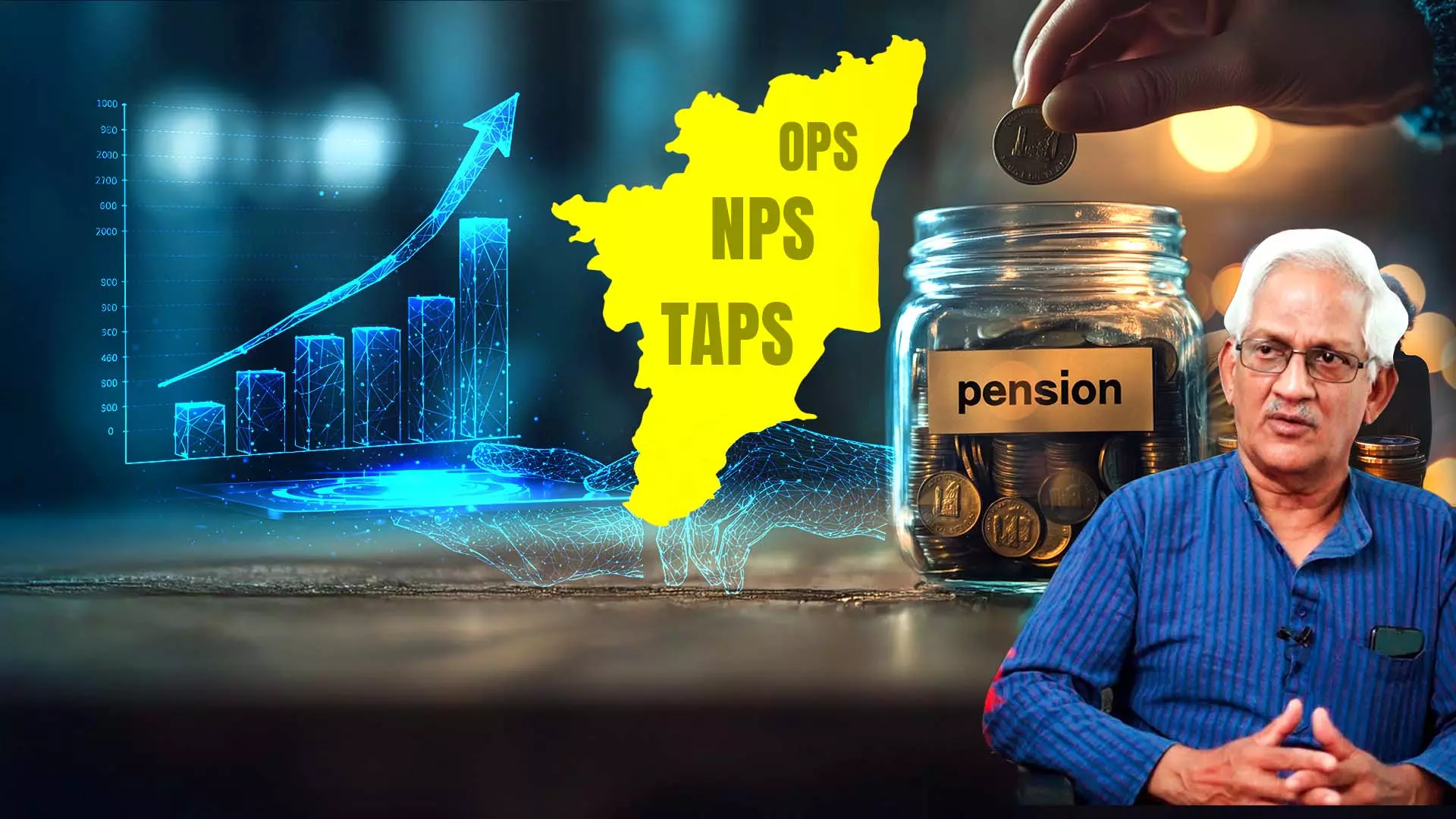
TN’s Assured Pension Scheme: Welfare or vote promise? Economist Athreya explains
Venkatesh Athreya explains the economic rationale behind the move, its long-term viability, and what it reveals about India’s pension reforms and federal structure

The Tamil Nadu government’s decision to reintroduce an assured pension scheme has reignited debates on fiscal sustainability, welfare economics, and Centre–state relations.
The Federal spoke to Venkatesh Athreya, economist and professor, to understand the economic rationale behind the move, its long-term viability, and what it reveals about India’s pension reforms and federal structure.
Why did the Tamil Nadu government reintroduce an assured pension scheme now?
When the DMK came to power in 2021, it made a clear promise in its election manifesto to restore the old pension system. The real question is not why it is being done now, but why it took so long. What has been introduced is not exactly the old pension scheme but a modified version, which is understandable given the severe fiscal pressures faced by the state.
These pressures are largely because the Union government continues to deny Tamil Nadu its legitimate share of resources and revenues. Elections may have played a role, and Opposition parties calling it an election gimmick is expected. But those same parties distribute money to women in Bihar on election day and call it an incentive. That too is a political gimmick.
The DMK has finally delivered close to 90 per cent of what it promised. Economically, this is not a major stress. Historical data in the public domain shows that pension-related payouts have consistently been around 20 per cent of the state’s own tax revenue. As the economy grows, state revenues will also grow. This is not a static fund. With investment, economic growth, and revenue expansion, the scheme can be stabilised and sustained.
Also read: AIADMK alleges Rs 4 lakh crore corruption under DMK govt, submits dossier to governor
Is the state government really contributing enough to the pension fund?
It is incorrect to say the state government is not contributing. The government has committed an initial contribution of Rs 13,000 crore and will add more than Rs 11,000 crore annually. This is clearly stated.
The state is guaranteeing pensions instead of leaving them to the volatility of financial markets. This protects workers from speculative risks linked to stock markets. That is precisely what employees wanted — an assured pension, not a fluctuating one tied to market performance.
This approach insulates pension security from financial uncertainty and aligns with the demand of workers who have consistently opposed market-linked pension systems.
Also read: Deepam ruling in a nutshell: Why it’s a rebuke of DMK govt’s ‘meaningless’ stance
How does this scheme differ from the National Pension Scheme introduced in 2004?
Both the Congress-led government in 2004 and later the BJP supported the National Pension Scheme, and the DMK was part of that alliance at the Centre. So the party is fully aware of the arguments that were made then.
The problem with the National Pension Scheme is that it demands contributions from employees while corporates continue to receive tax concessions. Pension is a return for a lifetime contribution to the country’s economy. In the absence of robust geriatric care or old-age security, a pension becomes essential.
All modern societies have pension systems. They can be publicly funded or partially funded by beneficiaries. The argument that liabilities had to be reduced by shifting away from old pensions is not entirely valid. This shift was part of a broader neoliberal framework of privatisation, globalisation, and deregulation pursued by successive governments.
While the DMK has followed neoliberal policies, it also carries a legacy rooted in social justice and inclusion. That legacy has exerted pressure to respond to long-standing worker demands.
Are government employees being unfairly favoured?
There is a perception problem. Citizens may have negative experiences with government offices, but that does not reflect the entire workforce. Government employees in sectors like health and education often work far beyond regular hours with dedication.
It is unfair to stereotype all government employees as inefficient. Corruption exists in the private sector just as much as in the public sector. Pension demands are justified because government employees deliver public services on behalf of an elected government.
Their demands did not emerge from generosity but from sustained struggle. That is how rights are secured.
Can Tamil Nadu afford this scheme given its infrastructure and funding challenges?
State governments cannot be blamed alone. The Union government has failed to honour Finance Commission commitments and continues to centralise revenues. There is a clear need to restructure Centre–state financial relations.
The 16th Finance Commission’s approach also appears to further centralise resources. This must be resisted collectively by states, not just by Tamil Nadu and Kerala.
The Tamil Nadu government did not rush into this decision. A committee led by Additional Chief Secretary Gagandev Singh Bedi, known for integrity, examined the issue. The finance secretary and key ministers were involved. Projections show that over 15 years, pension liabilities can be contained between 14 and 20 per cent of the state’s own tax revenue.
The government has done its homework.
Will pension spending force cuts in other welfare or infrastructure sectors?
There is no reason it should. With better taxation, improved industry performance, and higher revenues, states can manage multiple priorities.
The GST regime has centralised taxation and disproportionately hurt the poor. When corporate tax concessions are given, states lose revenue shares without consultation. Fiscal prudence should not mean avoiding taxation of the wealthy.
Workers generate wealth, as clearly demonstrated during the COVID-19 pandemic. Governments must recognise this reality instead of glorifying corporate wealth creation.
How does the new pension scheme improve security for retirees?
The scheme removes the minimum service requirement. Even employees with 10 years of service are eligible for pension. A minimum pension is guaranteed.
The pension calculation is based on the last drawn salary instead of the average of the last 12 months, which benefits employees. This change does not significantly increase liabilities but provides a sense of security and dignity.
What about concerns raised by the Comptroller and Auditor General?
The CAG has raised concerns about future liabilities, but committee projections indicate that liabilities will stabilise at around 20 per cent of the state’s own tax revenue over the next 12-14 years.
The solution lies in a national campaign to restructure Centre-state relations. States carry the bulk of development responsibilities but are denied fiscal autonomy. Excessive centralisation in education, pensions, and governance undermines federalism.
India, with its linguistic and cultural diversity, requires maximum state autonomy. The Union government should focus on defence, foreign affairs, and interstate coordination.
Why are informal and scheme workers excluded from pension security?
This is a legitimate concern. Scheme workers, Anganwadi workers, ASHA workers, and daily wage labourers form a large section of the workforce and contribute significantly to the economy.
Labour codes introduced by the Union government have weakened worker rights. Most governments view scheme workers as liabilities while benefiting from their labour.
The only way these workers can secure pension rights is through sustained struggle, just as government employees did. Trade unions like CITU have taken up these demands nationally.
Development narratives must centre people, not corporations.
(The content above has been transcribed from video using a fine-tuned AI model. To ensure accuracy, quality, and editorial integrity, we employ a Human-In-The-Loop (HITL) process. While AI assists in creating the initial draft, our experienced editorial team carefully reviews, edits, and refines the content before publication. At The Federal, we combine the efficiency of AI with the expertise of human editors to deliver reliable and insightful journalism.)