



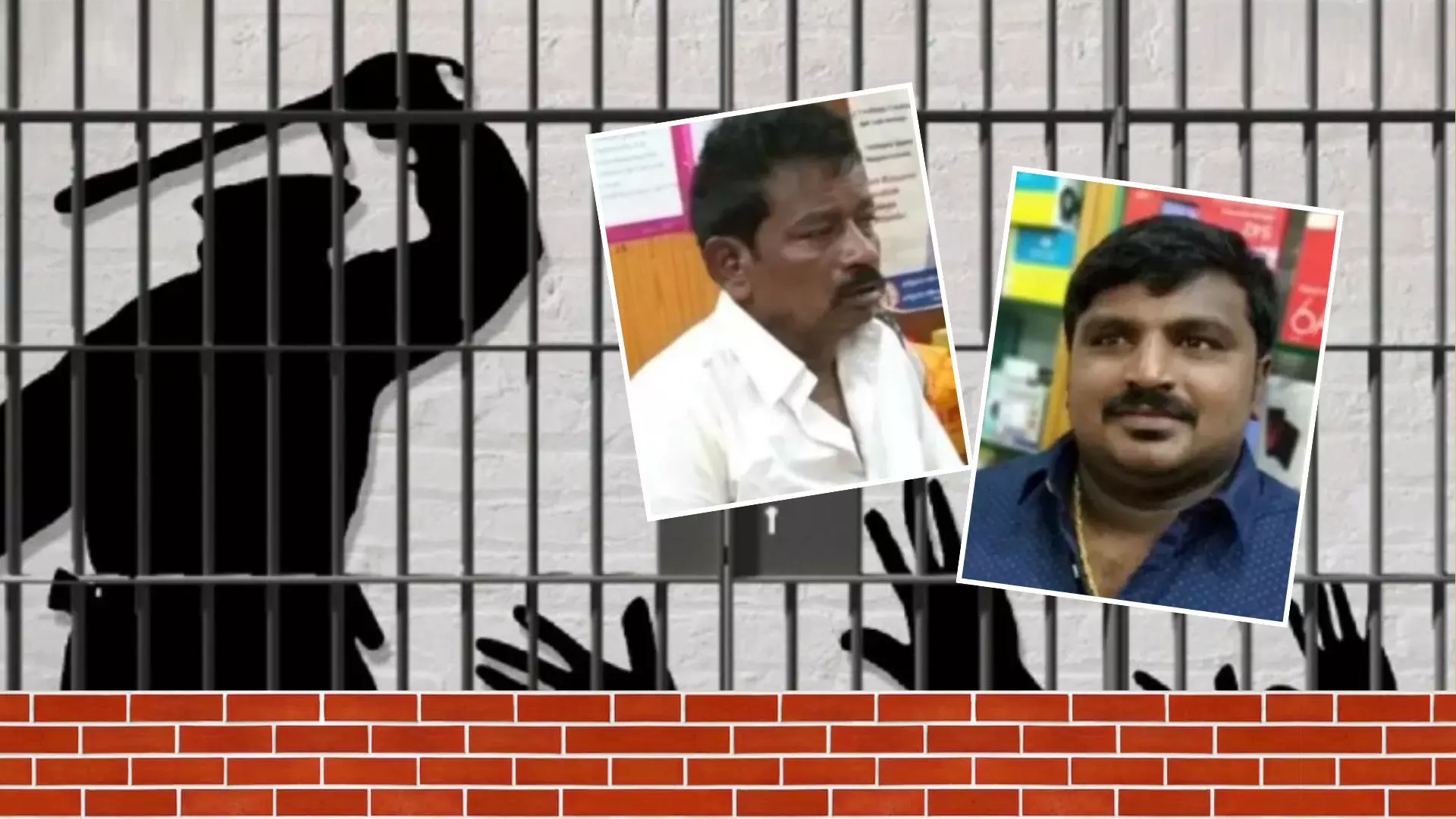
Sathankulam case raises brutal question: Who protects citizens from police?
Six years after the Sathankulam case shocked India, a Madurai court verdict indicts nine officers for conspiracy and torture. Will this finally push for police reforms?

The 2020 Sathankulam custodial deaths case in Tamil Nadu has returned to the spotlight after a Madurai court’s explosive judgment, indicting nine police officers for criminal conspiracy and brutal torture. The court has sentenced nine police officers to death, calling it a “rarest of rare” case. The verdict raises a critical question – why has India still failed to prevent custodial deaths despite repeated outrage?
On June 19, 2020, a father and son, Jayaraj and Benix, were taken into custody in Sathankulam, Thoothukudi district, for allegedly keeping their mobile phone shop open beyond COVID-19 lockdown hours. Within four days, both died in custody, sparking national outrage and drawing comparisons with the killing of black man George Floyd in police custody in Minneapolis, Minnesota, in the United States.
While Floyd’s death triggered global protests and police reforms, the Sathankulam case exposed what many describe as a deeper, systemic issue in India — unchecked custodial violence.
Case details
According to the CBI’s petition, the incident began on June 18, 2020, when Sub-Inspector Balakrishnan and a colleague allegedly threatened locals outside the shop of the victim, Jayaraj. “I will return and peel off your skin if anyone is still standing here,” the officer allegedly warned.
Also read: Sathankulam case: Why it is a rare vedict and what are its implications
The arrest, investigators say, was not routine enforcement but retaliation after Jayaraj remarked on police behaviour. Both Jayaraj and Benix were allegedly subjected to severe custodial torture over two nights.
The FIR filed by the Sathankulam police claimed the duo sustained injuries by rolling on the road, an explanation widely disputed. There were also allegations of evidence tampering after the incident.
Evidence trail
What made this case stand out was the availability of CCTV footage, rare in custodial death cases. Despite visible injuries, the victims were produced before a magistrate, who reportedly did not fully acknowledge their condition.
Doctors who examined them allegedly issued “fit for custody” certificates. Both the magistrate and doctors later cited COVID-19 protocols as the reason for not following standard procedures.
Also read: Sathankulam case | What key witness constable Revathi said in July 2020
The court observed that the accused officers, “educated government servants”, had abused their power and acted with deliberate intent to instil fear, violating Supreme Court guidelines on arrest and detention.
Reform debate
Human rights activist Henri Tiphagne called the verdict a wake-up call. “India needs an anti-torture legislation. It has been a long time since we have had one,” he said, urging both the Union and Tamil Nadu governments to act.
He added that India has still not ratified the UN Convention Against Torture despite multiple recommendations, calling the judgment an opportunity for reform.
The case also reignites comparisons with the conviction of Derek Chauvin in the United States, where Floyd’s death led to sweeping police reforms, including body cameras and stricter accountability laws.
Global contrast
In May 2020, Floyd’s final words, “I can’t breathe”, sparked worldwide protests and policy changes across several US states. In contrast, despite similar outrage in India, systemic reform has remained limited.
The Sathankulam case became a national symbol of police impunity, prompting the Madras High Court to order a CBI probe.
Also read: Sivaganga and more: Why do erring cops escape penalty for brutality?
However, experts warn that punishment alone may not address the deeper issue.
System failure
Veteran legal journalist V Venkatesan said, “Custodial violence is not an ordinary murder because the state itself is responsible.”
He questioned whether the death penalty alone sets the right precedent, noting that debates against capital punishment often depend on whether the system itself rejects custodial violence.
“The extreme nature of the violence has shaken society,” he added, pointing out that the victims were only accused of violating COVID-19 guidelines, charges later found to be false.
Pattern emerges
Even as the nation focused on Sathankulam, reports indicate over two dozen custodial deaths in Tamil Nadu since 2020. The judgment itself points to a pattern - illegal detentions, targeted assaults, and attempted cover-ups.
Also read: TN custodial death: Why theft complainant’s testimony is now under lens
India still lacks a specific law treating custodial death as a distinct offence. Existing safeguards, including Supreme Court guidelines and NHRC protocols, often suffer from weak enforcement and low conviction rates.
Experts attribute this to police patronage, lack of political will, and an outdated policing framework rooted in colonial-era laws.
The larger question
The Sathankulam verdict demonstrates that accountability is possible when evidence is strong and courts intervene decisively. But it also highlights that justice in such cases remains rare.
Also read: Delhi HC refuses to suspend Sengar’s 10-year jail term in Unnao custodial death case
Calls are growing for structural reforms — mandatory body cameras, tamper-proof CCTV systems, independent oversight bodies, and fast-track courts for custodial deaths.
Until such measures are implemented, the question raised by the Sathankulam case will continue to haunt the system: who protects citizens from those sworn to protect them?
(The content above has been transcribed from video using a fine-tuned AI model. To ensure accuracy, quality, and editorial integrity, we employ a Human-In-The-Loop (HITL) process. While AI assists in creating the initial draft, our experienced editorial team carefully reviews, edits, and refines the content before publication. At The Federal, we combine the efficiency of AI with the expertise of human editors to deliver reliable and insightful journalism.)