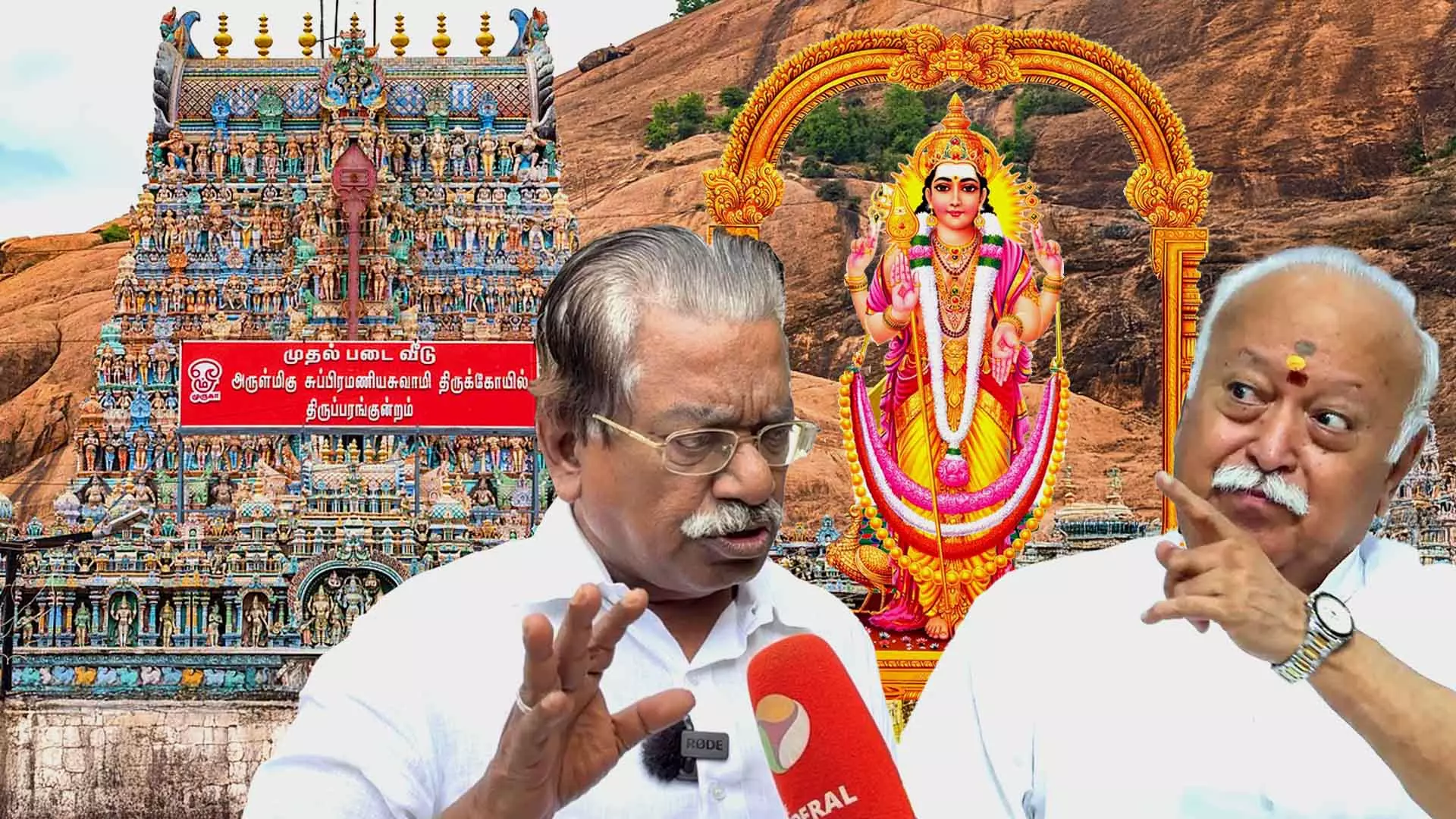
Bhagwat ‘awakening’ claim sparks row: DMK’s Elangovan hits back, says BJP against Hindus
Speaking on Thiruparankumdram row, the leader alleges outsiders tried to disrupt a centuries-old Muruga tradition and harm local Hindu–Muslim harmony

Rashtriya Swayamsevak Sangh (RSS) chief Mohan Bhagwat’s recent comment about “awakening of Hindus in Tamil Nadu“ has intensified the debate around the ongoing dispute over lighting a lamp at Thiruparankundram Hill. TKS Elangovan, spokesperson of the state's ruling Dravida Munnetra Kazhagam (DMK), has reacted sharply, accusing right-wing groups of disrupting a centuries-old religious practice in Tamil Nadu and attempting to strain local communal harmony. He also said the Bharatiya Janata Party (BJP) is against the Hindus and Tamil culture.
The Federal on Friday (December 12) spoke with Elangovan on the matter, and here are some excerpts from the interview.
What is your response to the RSS chief’s statement that there is an "awakening of Hindus in Tamil Nadu", especially in connection with the Thiruparankundram lamp-lighting case?
Time and again, we have been saying that Hindus were lighting lamps in that area for hundreds of years, not others. But people who have no connection with Thiruparankundram want to create trouble against the Hindus who have been lighting lamps there for hundreds of years.
Also read: Why Justice Hari Paranthaman suggests 'immediate impeachment' of Justice Swaminathan
They are opposing the Hindus who light the lamp there. Who are these people to go and light a lamp in that area? Muruga devotees residing in Thiruparankundram have been following the traditional practice. They are all Hindus. Why do these outsiders want to create trouble? Let them answer this.
In fact, when these right-wing people — BJP supporters — went there to light a lamp in a different area against Section 144 and police instructions, they violated all restrictions. They went there to light the lamp, but were chased away by the police. The people living in Thiruparankundram welcomed this; they even clapped when these people were sent away.
This clearly shows that these right-wing people were outsiders with no connection to Thiruparankundram. But the people of Thiruparankundram wanted to light the lamp in the traditional place where they have been doing so for many years. These outsiders opposed it. Not all Hindus are with these right-wing people. Hindus will not believe the BJP or others because they will once again be treated as "shudras".
Also read: The sacred hill of Madurai: Two faiths and one dispute
Their issue is not lighting the lamp. They want to break the good relationship between sections of Muslims living there and the Hindu community, who have long shared a brotherly bond. This group wants to break that harmony. They are against the Hindus who are living in Thiruparankundram.
Are you saying they want to disrupt the communal harmony between Hindus and Muslims there?
Yes. They have no connection whatsoever with Thiruparankundram. They are from other areas. For quite some time, courts have ruled that long-term practices should not be changed. This is one such long-term practice they are trying to disturb, only to create enmity between two religious groups.
There is a debate that Lord Muruga is often described as a Tamil god rather than a Hindu god. Why is he referred to as a Tamil god?
When you look at our literary works, you will understand. There is only one literature on the life of Murugan — Thirumurugan Padai — written 2,000 years ago. It is part of Pattupattu, Tamil Sangam literature.
Also read: Ground Report: How fake narratives have kept Thiruparankundram on its toes
Neither in Ramayana nor in Mahabharata does Murugan appear. So, their god is not Muruga. Nobody in the north has the name Murugan, while many here do. In the north, they use names like Subramanya, not Murugan. That itself shows Murugan is a Tamil god. And we have a literary record of his life from 2,000 years ago.
There are no Muruga temples in the north. Only Subramanya temples exist there, and Subramanya is not a Tamil name.
Can you explain more about Muruga’s connection to Tamil culture and language?
Muruga’s places of dwelling have always been in Tamil Nadu. He is a hill god. He belongs to the Kurinji land. He even married a Kurinji girl, Valli. His life and activities were rooted in Tamil culture.
When Murugan opposed his father, Shiva came, sang to him, called him back, and guided him. These narratives appear in Tamil literature and Tamil cinema as well.
Also read: Watch | Tension at TN's Thiruparankundram amid Hindu-Muslim row
Murugan’s stories are all centred in Tamil Nadu. The only book with his complete life history is Thirumurugan Padai in Tamil. In the north, there is no story of Murugan. There is not even any evidence that he is recognised there as a god. In Ramayana or Mahabharata, his name does not appear, though other gods are mentioned.
Right-wing supporters say the Thiruparankundram issue has strengthened their base in southern Tamil Nadu and will help them gain a big vote share in the 2026 elections. Your response?
The people of Tamil Nadu will never accept the BJP or support them because the BJP is against Hindus. Even in Thiruparankundram, they opposed the Hindu practice of lighting the lamp. They are against the Tamils.
They claim they want to uphold Tamil rights but oppose Tamil culture here. They will not recognise the Keezhadi findings. They will not do any good for Tamil Nadu. They will not construct AIIMS here. They will not build metro systems in Coimbatore and Madurai. They will do everything against the Tamils and then claim Tamil people will support them. Poor people — they don’t understand how the Tamil mind thinks.
The content above has been transcribed from video using a fine-tuned AI model. To ensure accuracy, quality, and editorial integrity, we employ a Human-In-The-Loop (HITL) process. While AI assists in creating the initial draft, our experienced editorial team carefully reviews, edits, and refines the content before publication. At The Federal, we combine the efficiency of AI with the expertise of human editors to deliver reliable and insightful journalism.