







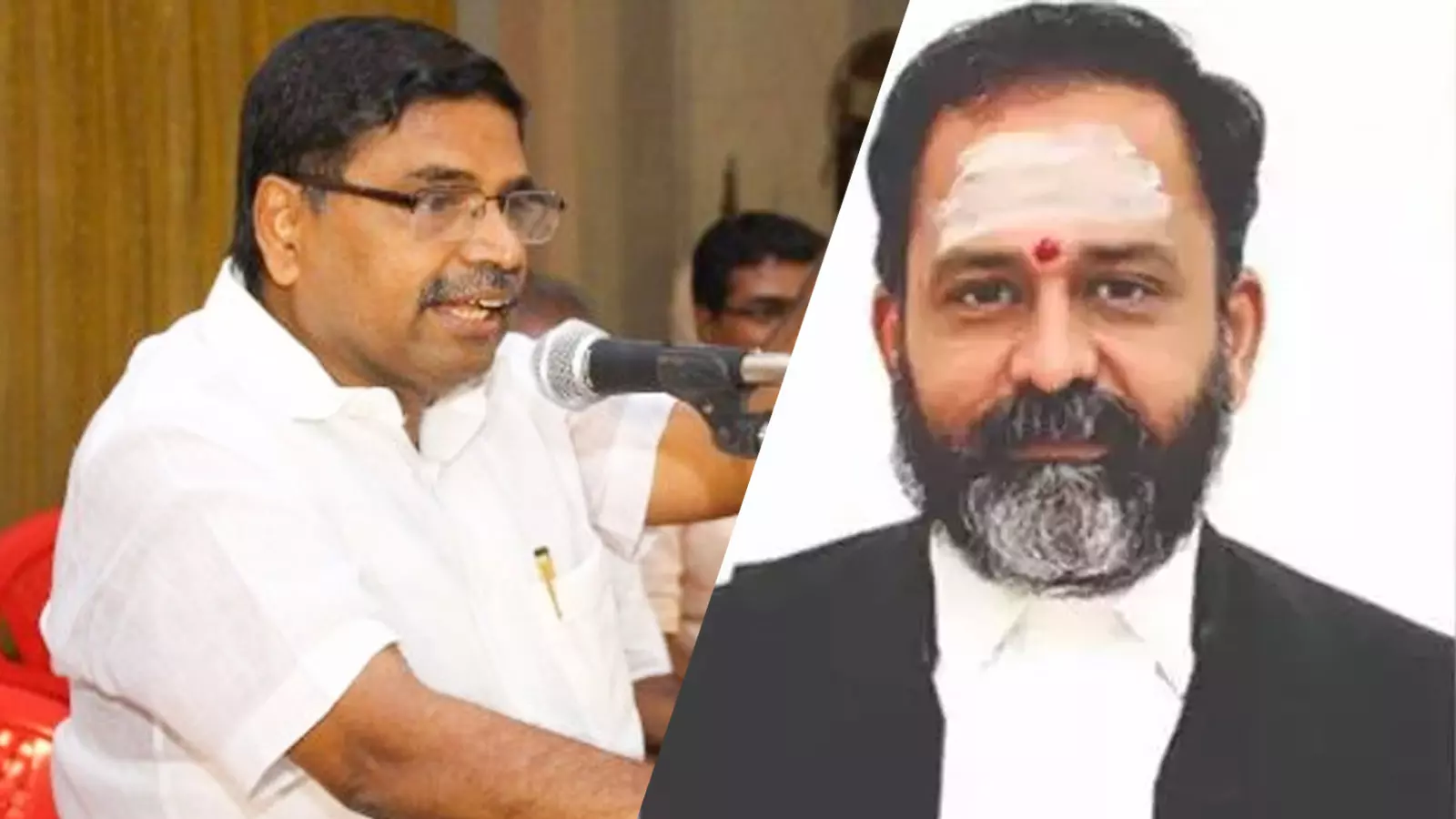
Why Justice Hari Paranthaman suggests 'immediate impeachment' of Justice Swaminathan
Whether HC judge belongs to RSS or not is irrelevant; in Thiruparankundram case, communal harmony was treated as if it meant nothing, he tells The Federal

Retired Madras High Court judge Justice K Hari Paranthaman has called for immediate impeachment proceedings against sitting judge Justice GR Swaminathan over his controversial order in the Thiruparankundram hill lamp-lighting case.
Speaking exclusively to The Federal, Justice Hari Paranthaman said: “The Chief Justice of the Madras High Court must initiate impeachment proceedings against Justice GR Swaminathan. Political parties have already raised this demand in Parliament, but the strongest pressure must come from within the High Court itself.”
The retired judge accused Justice Swaminathan of completely disregarding religious harmony in Tamil Nadu. “Whether Justice Swaminathan belongs to the RSS or not is irrelevant. Personal ideology must never influence judicial orders. But in this case, communal harmony was treated as if it meant nothing,” he said.
Key objections
These are some of the key objections raised by Justice Paranthaman:
1) How could a contempt of court case be filed on the very same day (December 3) the order was passed?
2) The right to light the Karthigai lamp rests solely with the temple administration (HR&CE Department). The District Collector and SP acted correctly in maintaining peace.
3) Ordering officers to appear in court within hours was a direction that was practically impossible to follow and showed disregard for law and order.
Also Read | Deepam row: INDIA bloc MPs move impeachment motion against Madras HC judge Swaminathan
4) Over 100 cases are pending before Justice Swaminathan — why were similar urgent directions not issued in those matters?
5) Most critically, the judge had no power to suo motu revoke a standing Section 144 prohibitory order without a proper petition and full hearing.
“A High Court judge cannot behave like H Raja or Governor RN Ravi. Political ideology, if any, must never enter judicial pronouncements. Justice Swaminathan was more concerned with enforcing his order than preserving law and order,” the retired judge alleged.
Advocate Vanchinathan's questions
Advocate S Vanchinathan, coordinator of the Madha Nallinakka Makkal Kootamaippu (Alliance for Communal Harmony), has also raised some questions:
1) How did the judge identify the boundary stone near the Dargah as "another lamp pillar" when no one mentioned it in court?
2) How did the court conclude that the site claimed by Hindu Munnani for lamp-lighting belongs exclusively to the temple? And is it the Civil Court's or High Court's role to determine property boundaries?
3) The judge stated that lighting a lamp at the boundary stone is necessary to protect temple property. Did the temple administration ever claim in court that its land or assets were under threat?
Also read: Thiruparankundram Deepam row: Madras HC flags contempt, asks state govt to explain
4) Neither the Dargah, Waqf Board, nor the opposing parties were granted adequate time; what was the urgency to expedite a century-old issue and conclude it in days?
5) The judge inquired if the Dargah has a compound wall, recorded it, and declared the boundary final. Does the court have authority to allow entry through Dargah premises without permission, overriding a privy council-confirmed title?
6) After two judges ruled that lamp-lighting could occur at Uchi Pillaiyar temple (as determined by chief priest Raja Pattar), can a single judge override that?
Protected archaeological status
Vanchinathan also revealed to The Federal that his organisation has filed a petition with the Madurai District Collector seeking protected archaeological status for two 216-year-old British-era survey stones near the Sekkandhar Dargah on Thiruparankundram hill.
“These are Great Trigonometrical Survey (GTS) stones installed in 1808–09 and 1871. We have submitted RTI documents and colonial-era survey records as proof. One stone is damaged, but the circular marking on the rock is still visible,” Vanchinathan said.
He said the actual Nayak-period lamp pillar (Deepa Sthambam) authorised for public lamp-lighting stands near the Uchi Pillayar temple, with an inscription explicitly permitting devotees to light lamps there. “Historical records show attempts to light lamps near the dargah in 1862 and 1912 were stopped by courts themselves, citing a threat to peace. There is no tradition of lighting lamps at the survey stones,” he added.
Also Read: Madras HC controversy: Can a judge hear a case against self? What experts say
The organisation has urged the government to officially declare the survey stones as protected historical monuments and name them after Thiruvalluvar and Colonel William Lambton (founder of the Great Trigonometrical Survey) as a symbol of communal harmony.
The controversy has snowballed into a major political and judicial row, with demands for Justice Swaminathan’s impeachment gaining momentum both inside and outside the court.
