Jnanpith Award for Vairamuthu draws praise and criticism in equal measure
Vairamuthu becomes third Tamil writer to receive the prestigious literary honour, sparking debate over his literary contributions and past sexual misconduct allegations

Tamil lyricist and author Vairamuthu has been selected for the Jnanpith Award, the country’s most prestigious literary honour. He becomes the third Tamil literary figure to receive the award, after a gap of 24 years. After winning the Sahitya Akademi Award in 2003, Vairamuthu has now gained renewed recognition on the national literary stage with the Jnanpith honour.
Vairamuthu’s first book, an anthology of poems titled Vaigarai Megangal (Clouds at Dawn), was released in 1972 when he was 18 and a student at Pachaiyappa's College. The collection received critical acclaim and was even prescribed as part of the curriculum at Women's Christian College while he was still a student.
Award sparks fresh debate
In several interviews and public platforms, Vairamuthu has said that his childhood in rural Theni district, witnessing poverty, village life, and migration shaped his literary voice. He has often cited the influence of Tamil writers such as Subramania Bharati and Dravidian leaders including CN Annadurai.
Also read | Tamil poet Vairamuthu faces backlash from BJP over remarks on Lord Ram
While many admirers have congratulated him on the honour, several writers, literary enthusiasts, and filmmakers have also criticised the decision to confer the award on him, citing the sexual misconduct allegations raised against him during the #MeToo movement. Some writers have declared that they would not comment on the award.
Vairamuthu’s works span multiple forms including film songs, poetry, novels, and cultural essays. His poetry draws from classical Sangam literary structures and explores symbolism, social themes, and universal humanism. His novels often portray rural life, migration, and livelihoods, frequently using regional dialects while documenting cultural traditions.
He has published nearly 39 books across genres, ranging from poetry and fiction to essays on science, social change, and the relationship between land, people, and Tamil identity. In cinema, he has penned nearly 7,500 film songs and has won the National Film Award for Best Lyrics seven times. Supporters of Vairamuthu claim that his books have sold close to three million copies.
Supporters welcome Jnanpith honour
Congratulating Vairamuthu in a post on X, Tamil Nadu Chief Minister MK Stalin said the announcement made him happy.
“I met Vairamuthu on Saturday morning and was conversing with him before the news arrived. Moments later, this sweet news arrived, doubling the delight of that meeting. If leader M Karunanidhi had been here, he would have embraced and praised Kaviperarasu with great pride. Standing in his place, I extend my congratulations to Kaviperarasu Vairamuthu,” Stalin said.
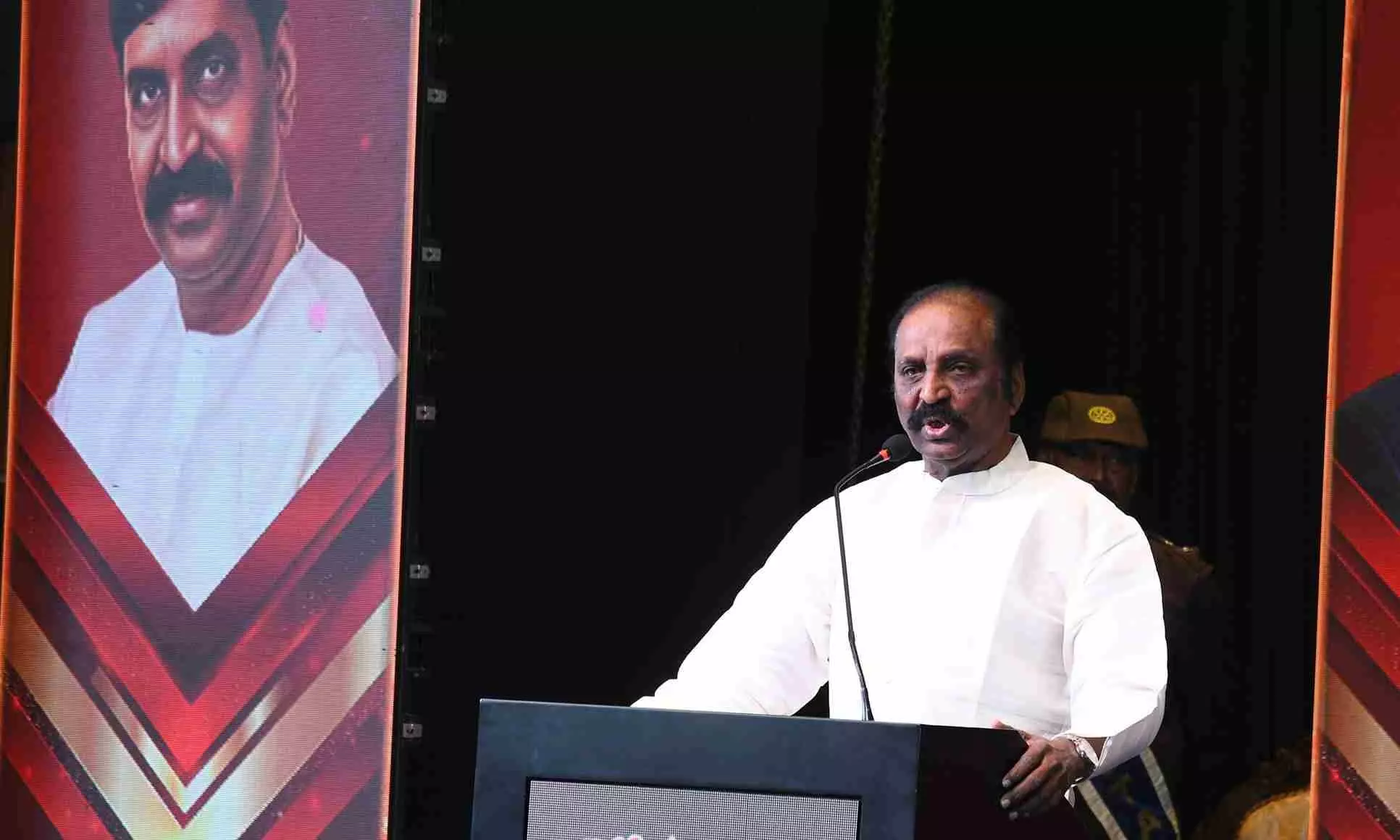
In March 2025, an international literary conference titled Vairamuthiyam was organised by his supporters to examine his literary works. Writers and researchers presented papers analysing his poetry, novels, and film lyrics. During his speech at the event, Vairamuthu said his novel Kallikaatu Ithikasam, which won the Sahitya Akademi Award, should be placed alongside The Old Man and the Sea by Ernest Hemingway. “It has the potential to win a Nobel Prize in the future. But there is no organisation outside the state to highlight this novel,” he said at the event.
Also read | Thoothukudi teen murder fuels row over TN’s ‘improving’ crime stats
Welcoming the decision to honour Vairamuthu with the Jnanpith Award, writer and Tamil professor P Vijayakumar told The Federal that the award fills a long gap in national recognition for Tamil literature.
“He experimented with various literary forms such as poetry, film songs, novels, short stories, and modern haiku. One of his works, Kavirajan Kathai, a poetic biography of Subramania Bharati, demonstrates his linguistic skill. He did not restrict himself to one format and enriched Tamil by using words from Sangam poetry that are rarely used today,” Vijayakumar said.
Sexual misconduct allegations resurface
However, the award has also revived controversies surrounding the poet. During the #MeToo movement in 2018, playback singer Chinmayi Sripada accused Vairamuthu of sexual misconduct, alleging that he asked her to “co-operate” in 2005. Around the same time, several other women also shared allegations against the lyricist on social media. Vairamuthu denied the accusations.
Chinmayi has said she faced professional backlash in the Tamil film industry after speaking out and has continued to question the platforms and honours given to the poet.
Veteran composer Gangai Amaran recently expressed support for Chinmayi, saying people should stand by women who raise such complaints. Referring to Vairamuthu, he said, “He is a good poet but not a good human being. Vairamuthu is my friend, but I cannot ask Chinmayi not to speak about him.”
In a post on X on Saturday, Chinmayi said she paid a heavy price for speaking out. “In 2018, multiple women of different age groups named one poet-lyricist as their molester. Today the Jnanpith is awarded to the man… The collective voices of the women who named him were silenced. I paid a very heavy price — the rest of the women who left their dreams behind weren’t half as lucky as I,” she wrote.
Writers voice professional concerns
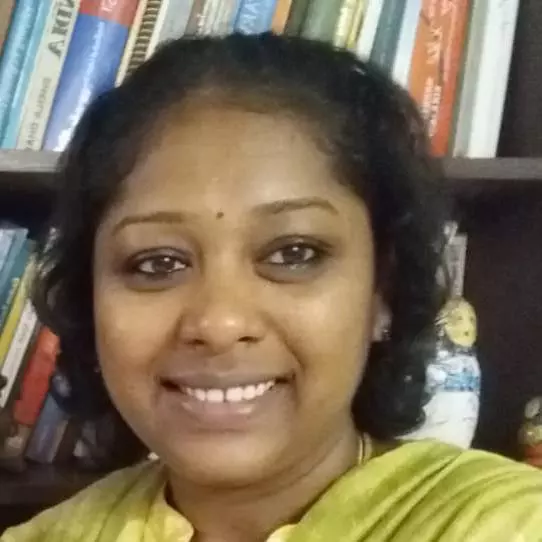
Some writers contacted by The Federal declined to comment on the award. Writer Ayeesha Natarajan said she did not wish to respond to the development. “I do not want to comment on this instance of him getting the award. Many writers like me do not wish to comment,” she said.
Writer AK Perumal said he had no personal animosity towards Vairamuthu but questioned the decision on professional grounds.
Also read | Tamil Nadu elections: Caste still counts, but the old vote-bank playbook could fall apart
“Vairamuthu is well known as a commercial writer who earned his living through film lyrics. His works have largely been commercial successes. But when we look at previous awardees, particularly from Malayalam literature, very serious writers were honoured. Vairamuthu’s genre does not match that tradition,” Perumal said.
He added that Tamil literary circles had celebrated when the award was given to writer Jayakanthan, but the same spirit was not visible now. According to him, when a writer receives the Jnanpith Award, their works are translated into multiple Indian languages and English to promote wider literary exchange. “However, when readers go through Vairamuthu’s writings, it may diminish the reputation Tamil holds as a classical language,” he said.