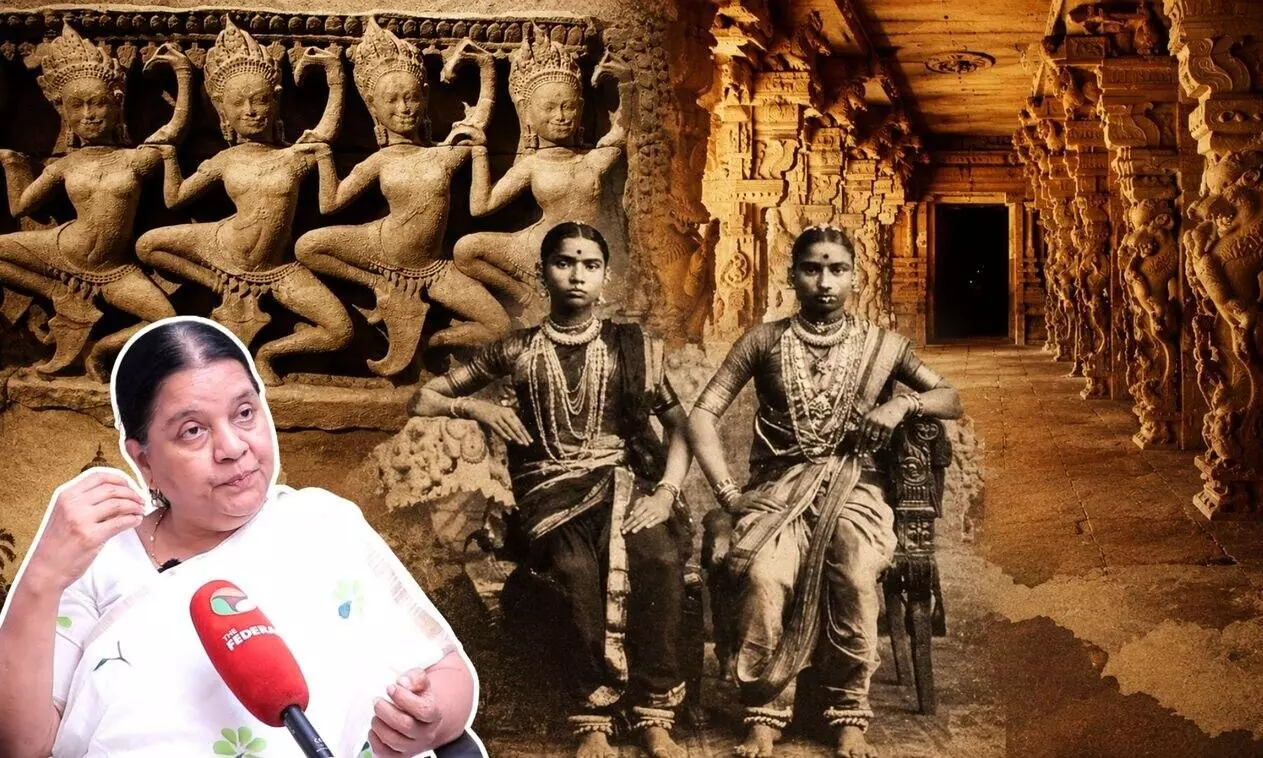
Dravidar Kazhagam leader, advocate Arulmozhi, says celebrating the cultural contributions of Devadasis without discussing the exploitation risks romanticising a system that reformers fought to end.
'Art was preserved, but women were exploited’: DK leader Arulmozhi on the Devadasi debate
Advocate Arulmozhi says discussions praising the Devadasi system must also address the exploitation, and highlight reformers who fought to abolish the system

The debate over the history of the Devadasi system has resurfaced in Tamil Nadu after a literary collective, Nayagi, organised a seminar discussing its abolition as well as the artistic and cultural contributions of Devadasis. Advocate Arulmozhi, propaganda secretary of the Dravidar Kazhagam, says such discussions cannot ignore the exploitation that accompanied the system or the reformers who fought against it.
The Federal spoke to Arulmozhi about the controversy, and the Dravidar Kazhagam’s decision to hold a separate symposium.
Why did the Dravidar Kazhagam organise a counter-event?
I would like to clarify that the Dravidar Kazhagam did not jump into the debate. It was a debate started by the group that organised the meeting.
Now, what is the necessity to speak about the Devadasi system at this stage when there are so many social issues overpowering our day-to-day activities and causing security issues for women and, mostly, children? We are now facing extreme crimes in Tamil Nadu. Is this the time to talk about an age-old system that was eradicated or abolished by the rule of law?
Also read: Why in Karnataka, 'Devadasis' and their families continue to suffer the damages of a banned practice
A group of people organised a meeting and invited speakers who praised the system disproportionately, for the purpose of accusing the legislation.
Their intention is not just about being entitled to speak about or praise an age-old culture or practice. They can do that, but it should not be in a way that tries to accuse the reformists, the revolutionaries, and the women who fought for abolition of the system.
Therefore, the thoughts being spread through these kinds of meetings sow seeds for the system to be revived. There is a hidden agenda. This has been going on for more than 20 years in Tamil Nadu.
A group of people interested in reviving the old culture in temples, especially the Devadasi culture, have been appearing under so many masks. Whenever it comes up, naturally there has to be a counter.
Is it not the duty of the reformers? Is it not the duty of the movement which supported the warriors who fought against this system? If we don't do this, we are failing in history. We are failing in our duty. That is why we are organising this event.
In fact, I participated in the meeting organised by Nayagi. I did not raise any objection there because it is their right. It is now our duty to counter it in a separate symposium.
What about the artistic contributions of Devadasis?
Is this the first time that such a meeting has been organised? Don't we know that Devadasis were the custodians of Bharatanatyam and other forms of Carnatic music? The art was protected, preserved, and handed over to the next generation by them.
But why was the Devadasi system abolished? It was not to abolish the art and culture. It was to protect women who were introduced into the system against their wishes and made the ‘wife of God’ as a pretext, while being manipulated and subjected to torture by men in power.
What was meant by arangetram? Is it only that a girl dances for the first time, exhibiting her talents and what she has learnt so far?
Also read: How R Muthukannammal, Tamil Nadu’s last Devadasi dancer, keeps Sadir tradition alive
That was a word covering a metaphor. Arangetram meant that powerful and rich people would bid for the girl. One would say, ‘I will pay Rs 60,000,’ another would say, ‘I will pay Rs 75,000.’ The man who was going to be the partner of the girl, or the man who was going to molest the girl on that day, would be the chief guest of the arangetram.
We have read all this history. We are not against praising their art. We are only worried that you are not talking about the art; you are lamenting and accusing the abolition of the system.
Why should reformers like Muthulakshmi Reddy and Ramamirtham be discussed?
They spoke about the history of a woman called Bengaluru Nagarathnamma. Of course, her life history has so many messages to be passed on to the next generation. We should learn about such personalities from every sphere of life. Bengaluru Nagarathnamma's life is a challenge that has to be discussed.
At the same time, who are these two women whom I referred to? What was the difference between these two?
Moovalur Ramamirtham was born in Thanjavur. She was born into a poor family that was acquainted with this system. Her parents were very poor. They were not able to provide for her. So, she was sold to a Devadasi for an old sari and Rs 10. She was brought up by a Devadasi.
At the age of eight or nine, they prepared her for the salanga puja, and that was also performed. She was taught Telugu, Sanskrit, and English.
But when she came to the stage of understanding what was going to happen after the arangetram, she realised, "I am going to be exploited. I am going to be led into an immoral life. In the name of the temple, I don't want to do that."
So, she wanted to marry someone. She married her own guru, Swayambhu Pillai. She didn't stop with that.
She found out which family had the next girl who was going to be dedicated. Somehow, she would reach them, advise them, and give them courage. In some places, she even kidnapped them and got them married so they could lead a decent life.
There were cases of kidnapping, attempt to murder, or murder foisted on her. She faced everything. She took risks to save girls and protect them from getting into this practice of pottukattudhal and the Devadasi system. Her life is, of course, a message.
Dr Muthulakshmi Reddy, by that time, was the first woman doctor in South India, and maybe the second in India. She was also born into the same community, but her father and her family did not let her enter into this system. Her sister was educated in London and Dr Muthulakshmi studied MBBS. She married Mr Reddy, who was also supportive of her reformative ideas.
In her biography, she has written that she was not much aware of the exploitation and the issues faced by Devadasi women. But as a doctor, when she came across certain reports about Devadasi women and their health conditions, she found out that 75 per cent of them were affected by venereal disease.
Then she delved into the issue and enquired why it happened. If it was such a pure and sanctified system, and they were just married to God and not to a human being, how did they get this disease? What would their life turn out to be? What would happen to their children?
Also read: Caste subjugation: How we deny dignity to hereditary Bharatanatyam dancers
Then she became an activist. She became the first woman legislator of the Madras Legislative Council, and this was the first law that she introduced.
These two women, born in the same community, fought against that system and fought for legislation to abolish it. Should we not discuss their lives?
When you are discussing the history of Devadasis and Madam Nagesh, who was a leader of an association of South India. She was in a very powerful position. Her patrons were great lawyers and judges. She therefore had the clout. She did not want the legislation to be passed. So she sent a memorandum to the Governor and to others not to abolish the system.
You are discussing the life of a woman who fought to preserve the system. Should you not discuss the life of the woman who fought to abolish the system? That should be the core of the meeting.
What response are you expecting to the Dravidar Kazhagam event?
We are receiving overwhelming support and expectations are high because this is an issue which is like a wound. We cannot touch it.
One of the speakers at the Nayagi meeting recalled the history of women who "sacrificed their lives for art". She said that, like another vahini, their life is running below the earth. Then I thought - not only their life, but also the blood of nine and 10-year-old children who were dedicated — this should not be repeated.
What are we going to achieve by discussing this now? Is it necessary? We are going to highlight what the danger of the system was, and why the reformists sought to abolish it.
Of course, a few of them might have enjoyed some status.
One of the speakers in the same meeting had quoted that a Devadasi who was appointed by the king would enjoy a status. But there is another Devadasi who sold herself. Will she be treated similarly?
One or two were married by kings. It is not because they wanted to give priority or respect to this community or category. Probably, that king liked that girl and it was his wish; it was his discretion. It was not the option of the Devadasi.
Some people spoke on the day that if she wanted, she could even become a queen. Can she become a queen? If the king wants, she can become a queen. The next day she can become anything else.
People have to be reminded about all these things, they need to be cautious and not encourage these new debates.
That is the purpose of our meeting.
Also read: Dance of Freedom review: Leela Samson traces Bharatanatyam’s roots, revival and reach
There is another reason. I have seen some of the posts written by a dancer and scholar who comes from the same community. She has highlighted the points from both sides and from various angles. But the underlying pain is: why are you people now talking about it?
If you come to know I belong to that community, the next day you will see me differently. You and I, if we do not belong to that community, we do not know their pain.
Can we just declare it like any other community? We should understand and try to respect the fact that it affects their dignity.
The system was abolished. Then the debate comes: why was it abolished? Will you not ask me, "You belong to that party, tell me why your party abolished a 'great' culture? Then I am bound to answer.
So, the spark was lit by the persons behind that meeting.