



Annamalai’s secular rebranding: Political reinvention or BJP’s B-Team?
Former BJP Tamil Nadu president K Annamalai has made a major political shift, making a pitch for “secular and centrist” politics

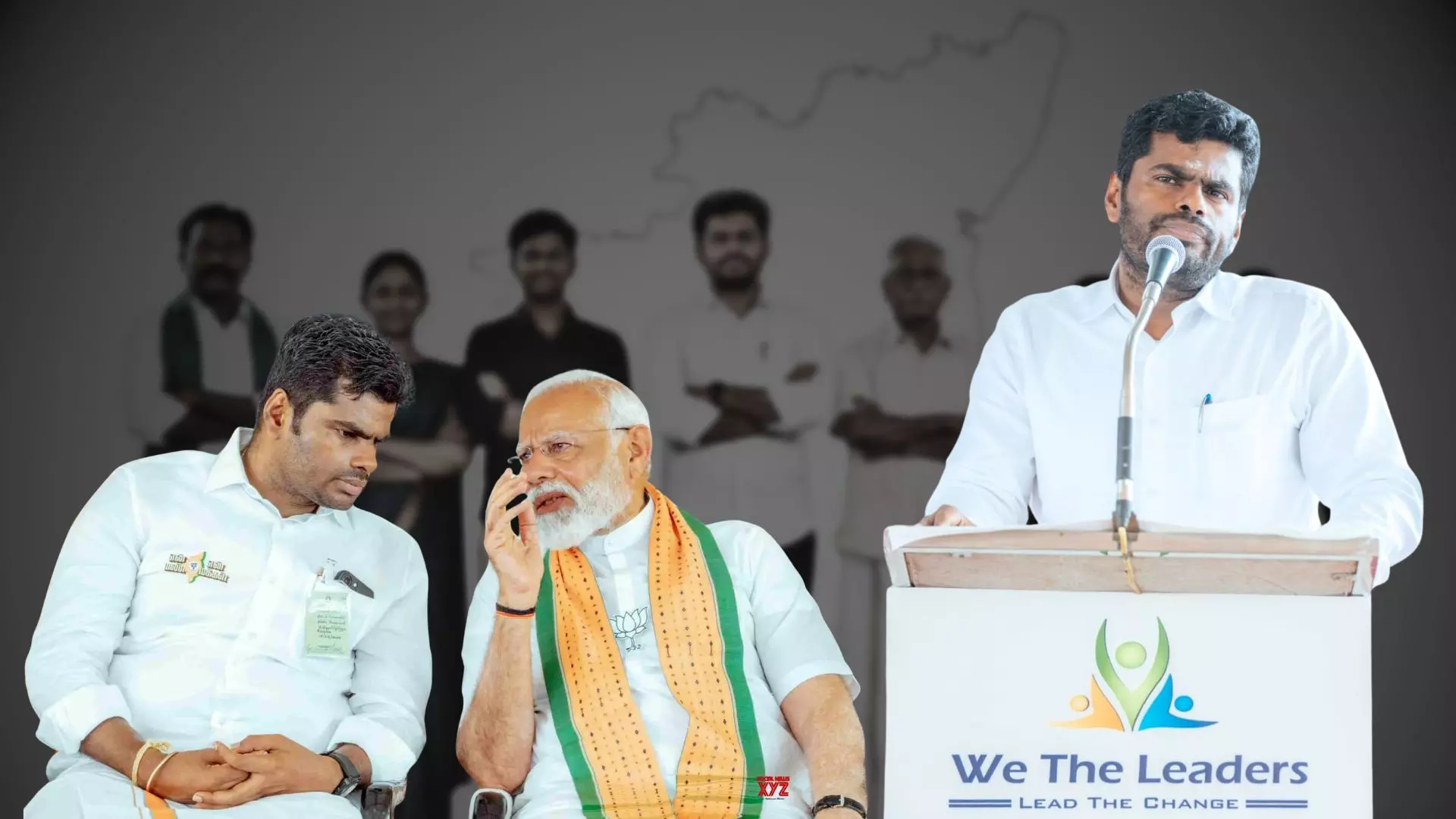
Former Tamil Nadu BJP president K Annamalai has taken the first major step in his post-BJP political journey. At the inaugural conference of his We The Leaders (WTL) movement in Pollachi on Sunday (July 12), Annamalai unveiled what appears to be a new political identity—one centred on secular, issue-based politics rather than religion or caste.
The conference, organised under the banner 'Drug-Free Tamil Nadu', drew thousands of supporters and marked a significant shift in Annamalai's political messaging. Once regarded as the BJP's most aggressive face in Tamil Nadu, he now says caste and religion should remain private while politics should focus on people and governance.
The event has sparked a larger debate: Is this a carefully planned political reinvention or a long-shot gamble ahead of the 2031 Assembly election?
Political shift
Annamalai declared that he had "locked up (his) caste and religion at home", signalling a conscious departure from identity-based politics.
Also read: Annamalai’s exit from BJP looks less like betrayal and more like math
He also said he respected the 2026 Assembly election mandate that brought the Tamilaga Vetri Kazhagam (TVK) government to power. Rather than immediately opposing the government, he argued that it should be given an opportunity to govern.
Pollachi agenda
The Pollachi conference adopted six resolutions aimed at creating a drug-free Tamil Nadu.
Among the key proposals were a state-wide white-band awareness campaign during July, closure of TASMAC liquor outlets near schools and temples, and stricter regulations for bars.
Annamalai also announced ambitious organisational goals. The movement aims to enrol 50 lakh members before transforming into a full-fledged political party.
Future plans include establishing an APJ Abdul Kalam Leadership Training Centre, planting 50 lakh trees, and dedicating the next six months to women’s safety and child welfare initiatives.
Long game
Annamalai indicated that he would give the ruling TVK government three years before launching sustained criticism.
His long-term political target is clear: A change of government in 2031.
Also read: Annamalai vs BJP: Rift widens as NEET row sparks war of words
Senior journalist Savitri Kannan observed that national parties have rarely succeeded in Tamil Nadu without strong regional personalities.
According to the analysis presented, Annamalai appears to have recognised this reality by prioritising his personal appeal and state-first politics over national ideological messaging.
New strategy
The political analysis argues that opposing the BJP alone is insufficient in Tamil Nadu, while continuously attacking the DMK often strengthens the ruling party politically.
It also suggests that Hindutva has limited electoral appeal in the state and that a more secular positioning may help attract a broader voter base.
The focus on prohibition and anti-drug campaigns is also seen as an attempt to appeal to women voters, many of whom have long demanded stronger action against alcohol-related social problems.
Strengths ahead
Supporters argue that Annamalai enters this new phase with several advantages.
These include strong appeal among young voters and women, with the movement claiming that 54 per cent of its early members are below the age of 35.
Also read: If Annamalai parts ways with BJP, whose loss is it?
His clean public image, strong digital presence and attempt to occupy the moderate, anti-corruption political space between the DMK and TVK are also viewed as potential strengths.
Challenges remain
Despite the ambitious vision, several challenges remain. Questions continue to be raised over the movement's funding model.
Critics also point out that prohibition has historically been a difficult political promise in Tamil Nadu, with both J Jayalalithaa and M Karunanidhi facing setbacks over liquor policy during their respective tenures.
Another challenge is that TVK has already built support among many secular young voters, while Annamalai continues to face questions about whether he can completely distance himself from the BJP after years as one of its most recognisable leaders.
Political response
Leaders from both the AIADMK and the ruling TVK have responded cautiously to the launch of We The Leaders.
Some have even welcomed Annamalai's emphasis on anti-drug initiatives, though the real political test will come when the movement begins sustained grassroots mobilisation.
Interestingly, despite leaving the BJP, Annamalai has avoided directly attacking Prime Minister Narendra Modi or the party. Critics describe this as a "B-Team strategy", while Annamalai maintains it reflects responsible politics.
Road to 2031
Annamalai is betting that Tamil Nadu is ready for a different political model—one that is issue-based, leader-centric and consciously secular.
His objective is to build a credible political alternative before the 2031 Assembly election.
Whether this political rebranding succeeds will depend on execution, organisational expansion, transparency and the movement's ability to grow beyond the popularity of a single leader.
Also read: Can Annamalai's experiment succeed after Vijay's rise? | Talking Sense With Srini
In a state known for powerful regional identities and charismatic political personalities, Annamalai is attempting to redefine himself as a leader who belongs to everyone—and to no single political identity.
(The content above has been transcribed from video using a fine-tuned AI model. To ensure accuracy, quality, and editorial integrity, we employ a Human-In-The-Loop (HITL) process. While AI assists in creating the initial draft, our experienced editorial team carefully reviews, edits, and refines the content before publication. At The Federal, we combine the efficiency of AI with the expertise of human editors to deliver reliable and insightful journalism.)