



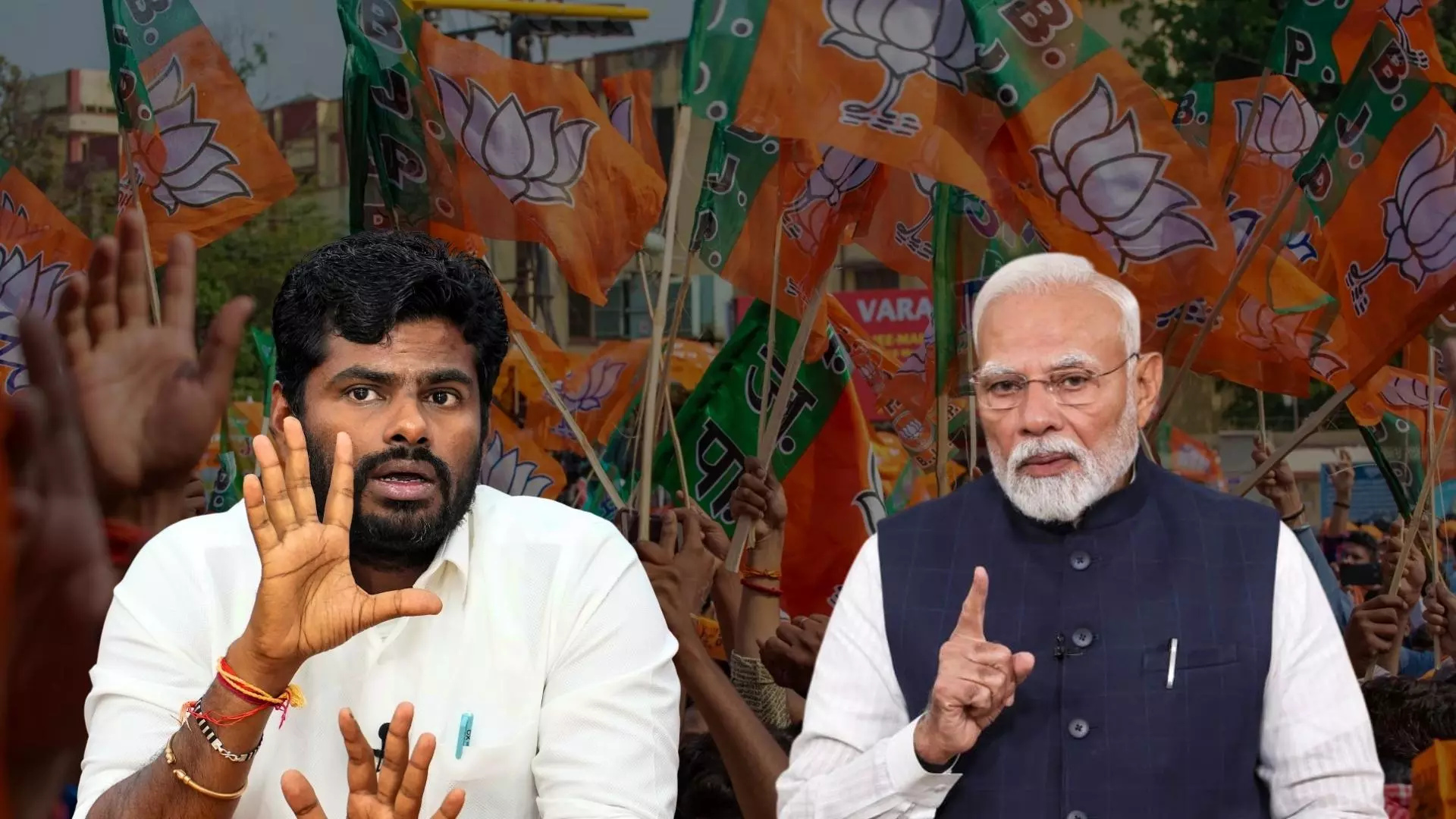
Annamalai vs BJP: Rift Widens
Annamalai vs BJP: Rift widens as NEET row sparks war of words
Days after quitting the BJP and launching We The Leaders, K Annamalai faces BJP and RSS criticism over NEET remarks. Will the rift widen?

K Annamalai’s political journey after exiting the BJP has quickly turned into a direct confrontation with his former party. Days after launching his new movement, We The Leaders, the former Tamil Nadu BJP chief has found himself at the centre of a growing political clash with BJP and RSS leaders over the conduct of the NEET re-examination.
The latest flashpoint is Annamalai’s criticism of the extensive security arrangements put in place for the NEET-UG re-test scheduled later this month. His remarks have triggered strong reactions from BJP functionaries and RSS ideologues, exposing the widening gap between him and the party he left just days ago.
The confrontation comes at a time when Tamil Nadu politics is undergoing significant changes following the 2026 Assembly elections, which saw the C Joseph Vijay-led TVK emerge as the dominant political force in the state.
New beginning
On June 5, 2026, Annamalai resigned from the BJP’s primary membership and described the move as “a new beginning”. Soon after, he launched a people’s movement called We The Leaders, positioning it as a platform focused on grassroots engagement, ethical governance, leadership training and public participation.
The response was immediate. More than 13 lakh people enrolled in the movement within 24 hours of its launch, signalling substantial public interest in Annamalai’s next political move.
Annamalai has indicated that the movement could eventually evolve into a full-fledged political party capable of contesting future elections.
Why he quit
The former IPS officer had increasingly differed with the BJP leadership over the party’s political strategy in Tamil Nadu.
One of the major points of disagreement was the BJP’s alliance with the AIADMK ahead of the 2026 Assembly elections. Annamalai had favoured a more independent path for the party in the state and was reportedly unhappy with the renewed alliance arrangement.
Following the Assembly election setback and continuing differences with the central leadership, Annamalai formally ended his association with the BJP and embarked on a separate political journey.
NEET controversy
Even before his resignation, Annamalai had begun publicly questioning certain decisions of the BJP-led Union government.
His latest criticism relates to the NEET-UG re-examination. Annamalai argued that the deployment of CRPF and CISF personnel, biometric checks, facial recognition systems and multiple layers of frisking could add to the anxiety already experienced by students preparing for the exam.
He also questioned whether such extensive scrutiny was necessary and pointed to difficulties faced by students in downloading admit cards. According to Annamalai, increasing procedural hurdles risks placing an additional burden on aspirants.
“Increased scrutiny for the NEET re-test will add pressure on students,” he said while raising concerns over the revised examination arrangements.
BJP strikes back
Annamalai’s remarks prompted an immediate response from BJP leaders.
SG Suryah, president of the BJP Youth Wing in Tamil Nadu, defended the security arrangements and argued that stringent checks were necessary to prevent examination irregularities and paper leaks.
According to Suryah, conducting NEET for lakhs of students across thousands of examination centres requires robust safeguards to ensure fairness and credibility. He questioned how critics could demand a leak-proof system while simultaneously objecting to strict security measures.
Suryah also reminded Annamalai of his earlier support for NEET during his “En Mann En Makkal” yatra, when he had argued that the examination created opportunities for economically disadvantaged students and accused political parties of creating unnecessary fear among aspirants.
Another BJP leader, Vinoj P Selvam, also defended the security arrangements, comparing them with international examination standards and arguing that they help protect merit-based admissions.
RSS criticism
The criticism was not confined to the BJP. RSS ideologue S Gurumurthy also questioned Annamalai’s recent political positioning. Referring to the former BJP leader’s earlier remarks about migrant workers, Gurumurthy expressed concern over the repeated use of terms such as “North state” and asked whether Annamalai’s new movement was beginning to resemble a Dravidian-style political platform.
The comments reflected broader concerns within sections of the Sangh Parivar about the direction Annamalai may take after leaving the BJP.
New political space
The confrontation highlights the challenges facing Annamalai as he seeks to establish an independent political identity.
Supporters argue that his freedom from party constraints allows him to speak more openly on issues relating to education, governance and youth concerns. The overwhelming response to We The Leaders has also reinforced perceptions that he retains significant political appeal among sections of Tamil Nadu voters.
However, critics within the BJP contend that some of his recent positions appear inconsistent with his earlier views and may create confusion among supporters who backed him during his tenure in the party.
What next?
Tamil Nadu’s political landscape is now more crowded than it has been in decades. The rise of TVK has already disrupted the traditional dominance of the DMK and AIADMK. At the same time, Annamalai’s emergence as an independent political force has opened up a new arena of competition.
Whether We The Leaders evolves into a significant political force or remains a pressure group will depend on its ability to sustain momentum beyond its impressive launch. For now, however, the sharp exchanges over NEET have made one thing clear: the relationship between Annamalai and the BJP has entered a new and confrontational phase.
The content above has been transcribed from video using a fine-tuned AI model. To ensure accuracy, quality, and editorial integrity, we employ a Human-In-The-Loop (HITL) process. While AI assists in creating the initial draft, our experienced editorial team carefully reviews, edits, and refines the content before publication. At The Federal, we combine the efficiency of AI with the expertise of human editors to deliver reliable and insightful journalism.
