







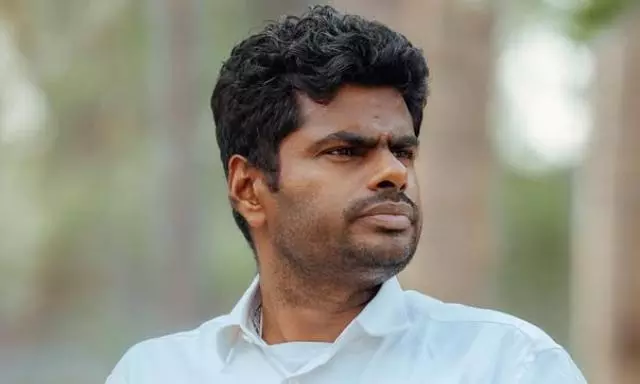
K Annamalai quits BJP and starts his own political movement. Photo: annamalai_kuppusamy / Instagram
K Annamalai quits BJP: New party motto to Tamil identity, everything he said
After six years in the BJP, K Annamalai is out and he's launching 'We the Leaders', a new political movement aimed at winning Tamil Nadu

K Annamalai, former Tamil Nadu state president, has finally put an end to all the speculations and confirmed that he has quit the BJP. The former IPS officer formally ended his association with the Bharatiya Janata Party and announced the launch of a new political movement, 'We the Leaders', signalling his intention to enter the next phase of Tamil Nadu politics on his own terms.
Here are the ten most significant things he said.
He told BJP months before leaving
Annamalai made it clear that this was no impulsive decision. "On December 4, I told the Bharatiya Janata Party that I am going to leave the party," he said. "For 18 months, I have been very patient in expressing my views, without shouting about it." He added that the party itself had asked him to stay on until the elections before making a final call. The deliberateness of the timeline matters."I have been telling this to the leaders of the Bharatiya Janata Party for almost a year,” he said.
He will contest the next assembly election
There was no ambiguity about his political ambitions. "Let's start a political party in Tamil Nadu. Our party will definitely win the next Tamil Nadu election. There is no change in that," he declared. He acknowledged the scale of the task that leaders need to be built, cadres trained, volunteers prepared, but was unequivocal that the destination is government, not merely opposition. "We will start it as a movement. We will bring in many people. We will teach them politics in some places." He compared it to building muscle at a gym, you don't start with 50 kilograms. "We will go from 10 kgs to 50 kgs," he said. "If we build that muscle and build fiber in the metal for our colleagues, it will become a political party."
Tamil identity was always the conflict
Perhaps the most revealing and politically significant part of his speech was when Annamalai spoke about the question that has quietly haunted his entire six years in the BJP. "Many people ask me if I am Tamilian or Indian. This gives me a lot of conflict," he said plainly. He insisted he had never surrendered his Tamil roots during his time in the party. "I have not given up the identity of Tamil Nadu. I have not given up the soil. I have not given up the tradition of culture. I have not given up the water," he said.
Also Read: ‘Will eliminate cult politics’: K Annamalai announces launch of new party
This tension is not personal to Annamalai — it is the central fault line of Tamil Nadu politics. The state has historically been governed by two Dravidian parties, the DMK and the AIADMK, both of which built their entire ideological architecture on Tamil identity, Tamil language and Tamil cultural pride. The BJP, perceived widely as a Hindi-belt, Hindu nationalist party, has consistently struggled to breach that wall. Despite Annamalai's aggressive grassroots campaigning, padayatras and social media blitz over five years, the party's vote share remained in low single digits. His argument, that the BJP needed to root itself in Tamil identity rather than impose a national template, was precisely what the party's central leadership found inconvenient. "In Tamil Nadu's politics, if you want to be a proud Tamilian, there are many parties who say that there is no need to say that I am an Indian," he acknowledged. His answer to that was not to choose one over the other. "I always say that I am a proud Tamilian," he said. "That's how it should be in this association." The BJP's decision to ally with the AIADMK — effectively subordinating itself to a Dravidian party to gain electoral traction — was the final proof, in his view, that the party was unwilling to fight for a Tamil identity of its own.
He left with respect, not bitterness
Despite the differences, Annamalai was careful to frame his exit without rancour. "Today, I am coming out of that party with a lot of respect. You can even call it the Tamil Nadu tradition. It is our tradition to come out with respect," he said. He described personally meeting every leader, going to them face-to-face, including Amit Shah, and explaining his position before walking out. "I am not a person who will sit in Tamil Nadu and cry that I am resigning from the party. I don't have that habit. I will come and look into your eyes and tell you." He was also careful to draw a distinction between his disagreements with the party's Tamil Nadu strategy and his regard for the institution. "Even if there are some mistakes, I will tell you and leave. I will do what I can."
He respects Modi but disagreed on three language policy
He was deliberate about separating personal regard for Narendra Modi from his political disagreements with the party. "I am a man who has great respect for Mr Modi. He is the Prime Minister of the country, a man who is protecting the country," he said. But he was equally clear that respect has limits. "When it comes to a certain level, when these small problems come together, we should not continue to be a problem for them. We should take one problem at a time." One of those problems was the three-language policy. "We are changing the third language in the timetable brought in recently," he said, referring to the National Education Policy's language provisions, which Tamil Nadu has fiercely resisted. "We raised our voice. There is no change in that."
He wants to end cult and dynastic politics
"We have to come out of cult politics," he said, more than once. "They say politics is a change, but it is still cult politics. We are not going to be in it." He pointed to the culture of birthday celebrations, banner politics and personality worship as symptoms of a deeper disease in Tamil Nadu's political culture — and said his movement would have none of it. "Do we have to celebrate my birthday? That's why we didn't do anything on my birthday. My birthday is like your birthday." On dynastic entrenchment, he said, "Permanent leaders, permanent MLAs, permanent ministers, permanent MPs — we are going to break that." He announced that his party would introduce term limits from day one, so that politics remains a public service and not a family inheritance. "No chair is permanent for anybody. We are very clear about this. New people should come. They should keep coming. It should flow like water."
APJ Abdul Kalam is his lodestar
The choice of APJ Abdul Kalam as the symbolic anchor of his movement seems to be telling of the kind of identity Annamalai wants to have for his party. Kalam, a Tamil Muslim scientist from Rameswaram who became India's President, embodies an identity that is a perfect blend of Tamil pride, Indian patriotism, scientific temper and moral authority, all in one life.
Also Read: Annamalai quits BJP, likely to float own party: Reports
"I have seen him as a student. I have seen him as an IPS officer. I have heard him speak live," Annamalai said. "All the concepts he said — when did we understand them? When did he say Vision 2020? He said in 2000." He announced the creation of the APJ Abdul Kalam Centre for Ethics and Politics in Coimbatore, under the banner of We the Leaders, to train candidates standing at every level of election — from panchayat to Parliament. "He is a wonderful person who has lived and died as a proud Tamil person," Annamalai said. "We need him in all walks of life."
‘I come from the common man’
Annamalai repeatedly returned to his origins as the source of both his credibility and his politics. "I was born in a village. I came from an ordinary family, a farmer's family," he said. "We are all middle class, common people. We don't have a pedigree. We don't have a business. We don't have a star value." In a state where politics has long been the preserve of film stars, dynastic families and party strongmen, this is a pointed contrast. He spoke about having spent 17 years struggling — from his internship with Vijayakanth at 25 to his six years in the BJP — and framed the new movement as the culmination of that journey. "People are going to look at us like neighbors. We are not going to show our hands from a distance (like all leaders). Because none of us came from such a family. We did not grow up like that."
BJP should have gone in alone
He reiterated, with barely concealed frustration, the argument he had been making inside the BJP for years. "Only if the Bharatiya Janata Party is united with the identity of Tamil Nadu can it take forward the development of Tamil Nadu," he said. He believed the party had the potential to build a genuine base in the state — but only if it was willing to fight on Tamil terms rather than shelter behind a Dravidian alliance. He pointed to specific battles his unit had fought: on water rights, on coal mine issues, on what he called the tungsten problem, on Mekedatu. "We never gave up our rights," he said. "At the same time, there is no need to shout about the conflict. We can talk about it calmly, without giving up our rights." The BJP's eventual decision to ally with the AIADMK, and to ease him out as a precondition, seems to be, in his reading, a surrender of exactly that identity.
The movement's motto says it all
He closed with a call to action: "From today, we have to start a new path, a new movement, a new political movement. We have to start our movement with a new attitude, a new perspective," he said. He claimed his motto to be: "Let us change to bring change”. He added, "I want all of you to join together and start it.”
Also Read: If Annamalai parts ways with BJP, whose loss is it?
He directed supporters to the official website: theleader.org and spoke about bringing in technocrats, young professionals, and first-generation politicians into the fold. "Today, we are going to America and Europe. We should be proud of ourselves. Take NVIDIA, Micron, Samsung, Intel — a Tamilian is sitting there as Vice President. Why can’t we do it all here?”
He added, “We have to change our political grammar and language… We will dedicate our lives to that. He then reiterated, “I say this again, let us change."