Welfare push and Vande Mataram: Satheesan govt faces early political tests
Welfare promises, caste debates, and coalition pressures mark VD Satheesan government’s opening moves in Kerala. Can it shape its own narrative?

The new Kerala government led by VD Satheesan in Kerala has begun its tenure with a series of welfare-focused decisions that have immediately triggered a political and economic debate.
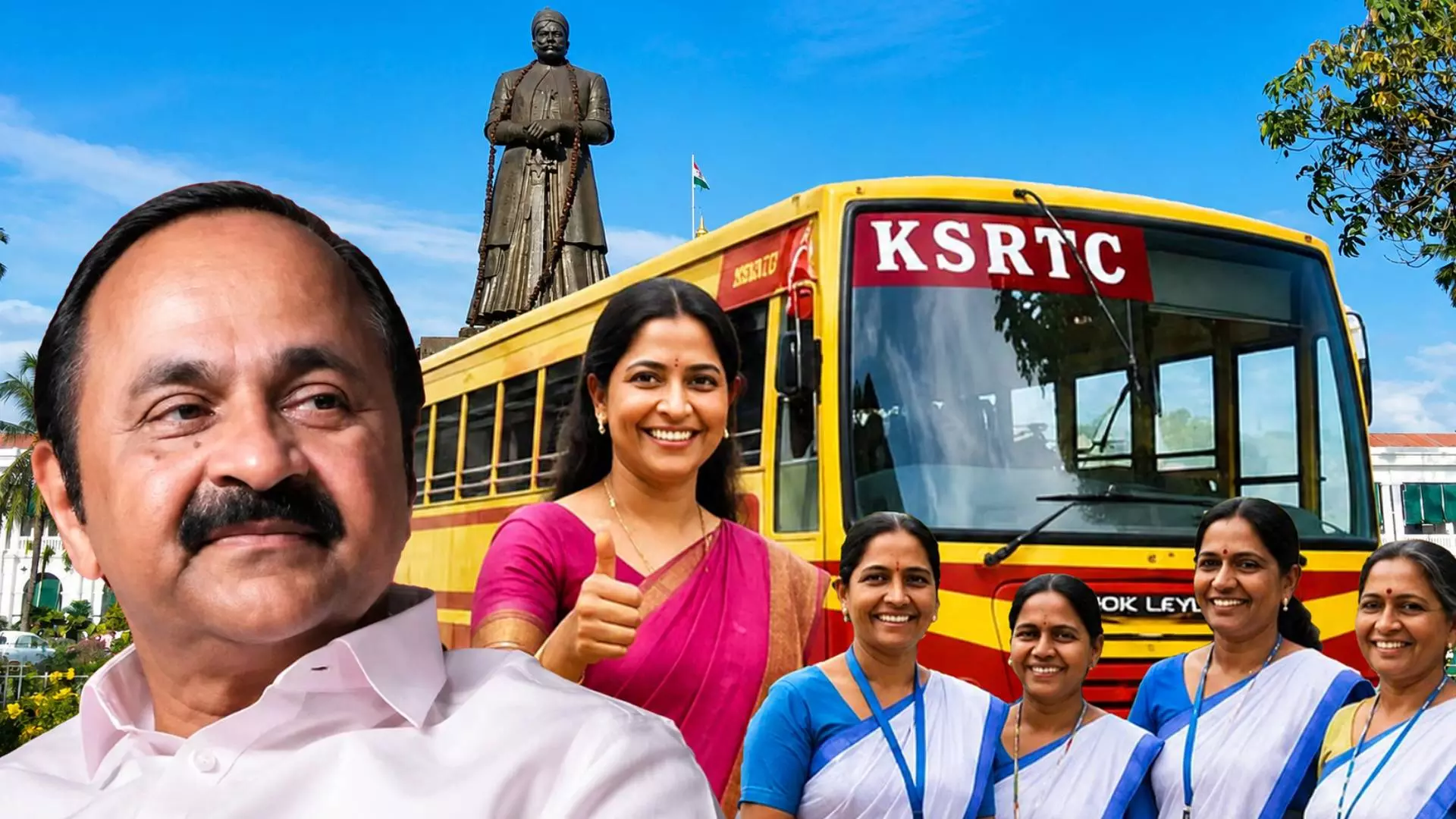
The first Cabinet decisions were aimed at setting a strong welfare-oriented tone. The government approved free travel for women in KSRTC buses, fulfilling a major Congress manifesto promise. It also sanctioned a Rs 3,000 hike for ASHA workers, increasing their monthly honorarium to Rs 12,000, along with a nominal Rs 100 hike for other scheme workers.
However, the announcements quickly sparked concerns over financial sustainability and political messaging.
Welfare push
The free bus ride scheme, while politically significant, is expected to place a heavy financial burden on the Kerala State Road Transport Corporation (KSRTC), which has only recently shown signs of recovery.
According to rough estimates mentioned in the discussion, the scheme could cost between Rs 4.5 crore and Rs 5 crore per day. This has raised questions over whether the state government will provide sustained financial backing and how the recurring expenditure will be managed.
Also read: On Day 1, Congress govt clears welfare measures under Indira Guarantees
The ASHA workers’ wage hike also became a point of political confrontation.
The CPI(M) argued that its previous government had already been increasing honorariums in phases and remained open to discussions with striking workers. The Opposition also accused the United Democratic Front (UDF) of using the ASHA workers’ agitation to politically target the earlier government before softening its own position after coming to power.
The Opposition, while responding to the new government’s announcement, argued that even they gave a Rs 2,000 hike during the agitation.
Oath controversy
Apart from policy decisions, the swearing-in ceremony itself generated a political debate.
The recitation of the full version of Vande Mataram during the ceremony drew criticism from the Opposition, which pointed to recent observations by the Supreme Court that such recitation is not mandatory.
At the same time, sections of the right wing and ultra-right welcomed the move, giving the issue a sharper political colour.
Comparisons were also drawn with West Bengal, where the full version of Vande Mataram was reportedly not played even during the swearing-in ceremony attended by Prime Minister Narendra Modi and Union Home Minister Amit Shah.
Also read: Veterans to first-timers: Kerala’s new UDF Cabinet reflects broad alliance balance
Another moment that sparked discussion was Satheesan introducing himself during the oath ceremony using his expanded full name, including his father’s caste surname — Vadassery Damodaran Menon Satheesan.
The expanded name had reportedly never been used by Satheesan during his earlier oath-taking ceremonies as an MLA across five terms.
Identity debate
While the use of the full name may have been a personal choice, it was politically interpreted by some as an assertion of upper-caste identity.
In Kerala, where caste politics is often less overt but still influential, such symbolic gestures continue to attract attention and debate.
Simultaneously, community organisations also began asserting their concerns regarding Cabinet portfolio allocations.
The Latin Catholic Church reportedly expressed displeasure over the possible allocation of the fisheries portfolio to the Indian Union Muslim League, arguing that fisheries are closely linked to coastal livelihoods and community representation.
Also read: Why and how VD Satheesan became the inevitable choice as Kerala CM
There was also discussion around the Congress considering a reshuffle involving the higher education portfolio currently linked to the IUML. Opposition parties alleged that such moves suggested the Congress was yielding to community pressure and framed the issue within a larger ideological debate.
Political balancing
The developments have highlighted how governance decisions in Kerala are closely intertwined with identity, caste and community equations.
The government now faces the challenge of balancing welfare commitments with fiscal realities while also managing coalition interests and social expectations.
Observers have also started drawing comparisons with the government led by former Kerala Chief Minister VS Achuthanandan, who governed during a period marked by strong factionalism within the CPI(M).
Despite internal resistance within the party and Cabinet, Achuthanandan eventually carved out an independent political identity by positioning himself against entrenched interests.
The comparison with Satheesan may still be premature, but it underlines the pressures facing the new government from the very beginning of its tenure.
Also read: Kerala fixed now, but does it reflect Congress' internal crisis?
For the Satheesan government, the road ahead will involve delivering welfare promises, managing coalition dynamics and navigating Kerala’s complex social and political landscape.
If the first day of governance has demonstrated anything, it is that the politics around the new government is already active, contested and under close public scrutiny.
(The content above has been transcribed from video using a fine-tuned AI model. To ensure accuracy, quality, and editorial integrity, we employ a Human-In-The-Loop (HITL) process. While AI assists in creating the initial draft, our experienced editorial team carefully reviews, edits, and refines the content before publication. At The Federal, we combine the efficiency of AI with the expertise of human editors to deliver reliable and insightful journalism.)