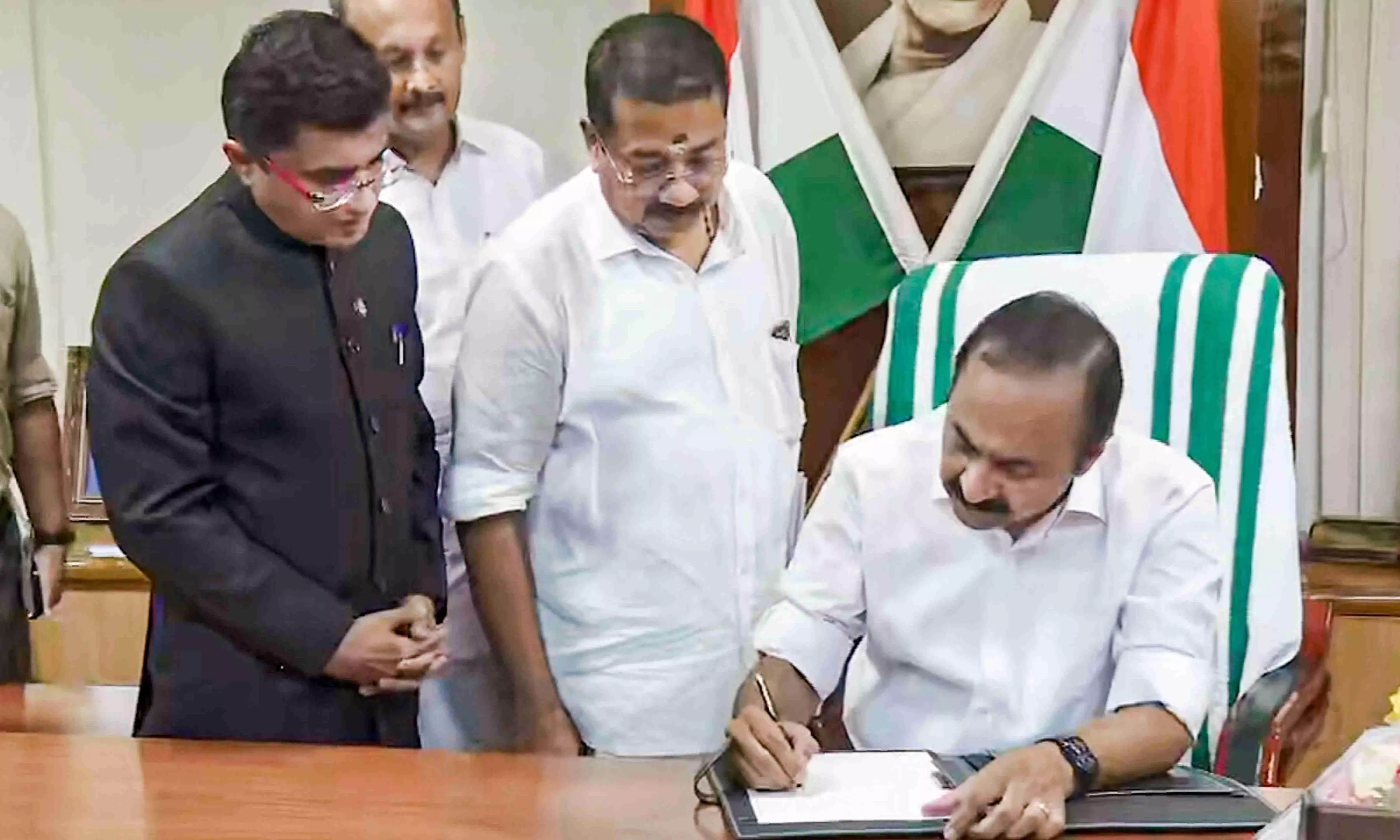
Newly sworn-in Kerala Chief Minister VD Satheesan takes charge at the Secretariat, in Thiruvananthapuram on Monday (May 18). Photo: PTI
On Day 1, Congress govt clears welfare measures under Indira Guarantees
The new VD Satheesan government moves swiftly on Congress guarantees, but repeatedly stresses financial constraints and calibrated implementation

The V D Satheesan government has begun its tenure by quickly rolling out the Congress manifesto’s “Indira Guarantees” and a set of welfare measures aimed at women, the elderly, and frontline workers.
At its very first cabinet meeting, held hours after the swearing-in, the United Democratic Front (UDF) government sought to establish both political credibility and administrative direction.
First cabinet decision
"Foremost among the decisions was the rollout of free bus travel for women in KSRTC services, a flagship promise of the Congress campaign. The scheme will come into effect from June 15, with modalities to be announced in the coming weeks," said Chief Minister V D Satheesan in his first cabinet media briefing.
Also read: Veterans to first-timers: Kerala’s new UDF Cabinet reflects broad alliance balance
The move is expected to have both economic and social implications, easing mobility costs for women while also positioning public transport as a more accessible and inclusive service.
Care for ageing population
Alongside this, the cabinet approved the creation of a dedicated geriatric department, another major commitment under the Indira Guarantees. The decision is being framed not merely as an administrative addition but as a structural shift in how the state engages with its ageing population.
Senior officials indicate that the department will draw from international best practices, with models such as Japan’s elderly care framework likely to be studied in detail. The government has acknowledged financial constraints but signalled that policy design and phased implementation will guide the initiative.
Welfare for frontline workers
ASHA workers, who had staged prolonged protests in the run-up to the elections, were among the first to see a tangible response. The cabinet approved a Rs 3,000 increase in their honorarium as an initial step, raising it from Rs 9,000 to Rs 12,000. While this falls short of some of the demands raised during the agitation, the government has indicated that this is only the first phase, with decisions on retirement benefits expected within a month.
Also read: Why and how VD Satheesan became the inevitable choice as Kerala CM
A similar approach was taken with anganwadi workers and helpers, who will receive a Rs 1,000 hike. Though modest in scale, the hike is being positioned as a signal of intent rather than a final settlement. The government has also extended a Rs 1,000 increase to cooking staff and pre-primary teachers and ayahs (caretakers), acknowledging long-standing concerns over low wages in these sectors.
Careful decisions
These decisions, taken together, suggest a calibrated balancing act. On one hand, the government is keen to demonstrate responsiveness to electoral commitments and labour concerns. On the other hand, it is cautious about the fiscal implications, repeatedly underlining that all measures have been cleared only after assessing the financial burden.
That caution is reflected in another key decision: the issuance of a white paper on the state’s finances. The move is likely to serve both administrative and political purposes. The white paper is expected to detail liabilities, revenue constraints, and expenditure commitments, setting the stage for future policy decisions.
Assembly roadmap
Procedurally, the cabinet also moved to set the legislative calendar in motion. A special session of the Assembly has been recommended, with MLAs to be sworn in on May 21 and the Speaker to be elected on May 22.
Also read: Two manifestoes, one destination: LDF and UDF battle for a 'New Kerala'
The Governor’s policy address is expected on May 29, subject to approval. Senior legislator and former minister G Sudhakaran has been identified as the pro-tem Speaker, marking a conventional but significant step in the transition process.
Vande Mataram row
Beyond policy and procedure, however, the swearing-in ceremony itself generated an unexpected layer of political discussion. The recitation of the six-stanza version of Vande Mataram at the event stood out, particularly in the Kerala context. This appears to be the first instance of the full version being rendered at a state government ceremony following a recent directive from the Union government.
Also read: Why the fury over Vande Mataram before Tamil Thaai Vaazhthu at Vijay's oath-taking
Sources suggest that the initiative originated from Lok Bhavan, with the new government agreeing to the arrangement. The decision has already triggered debate in political and cultural circles, with questions being raised about precedent, intent, and the evolving nature of official ceremonies in the state.
What adds to the intrigue is the contrast with other high-profile events elsewhere in the country.
Notably, Vande Mataram was not recited at the oath-taking ceremony of Suvendu Adhikari as West Bengal Chief Minister, despite the presence of the Prime Minister and the Union Home Minister. In Tamil Nadu, it was sung, when Vijay took over as Chief Minister.
Early governance signals
For the Satheesan government, the early days have thus combined substantive policy decisions with signals, both deliberate and incidental, about its approach to governance. The stress on fulfilling manifesto guarantees, addressing worker concerns, and foregrounding welfare measures suggests a government keen to establish momentum quickly.
Also read: Vijay's next frontier: TVK quietly begins Kerala expansion
At the same time, the repeated emphasis on financial constraints and the decision to release a white paper indicate an awareness of the limits within which it must operate.
The coming weeks, particularly the Assembly session and the policy address, are likely to offer a clearer sense of how these competing imperatives will be managed.