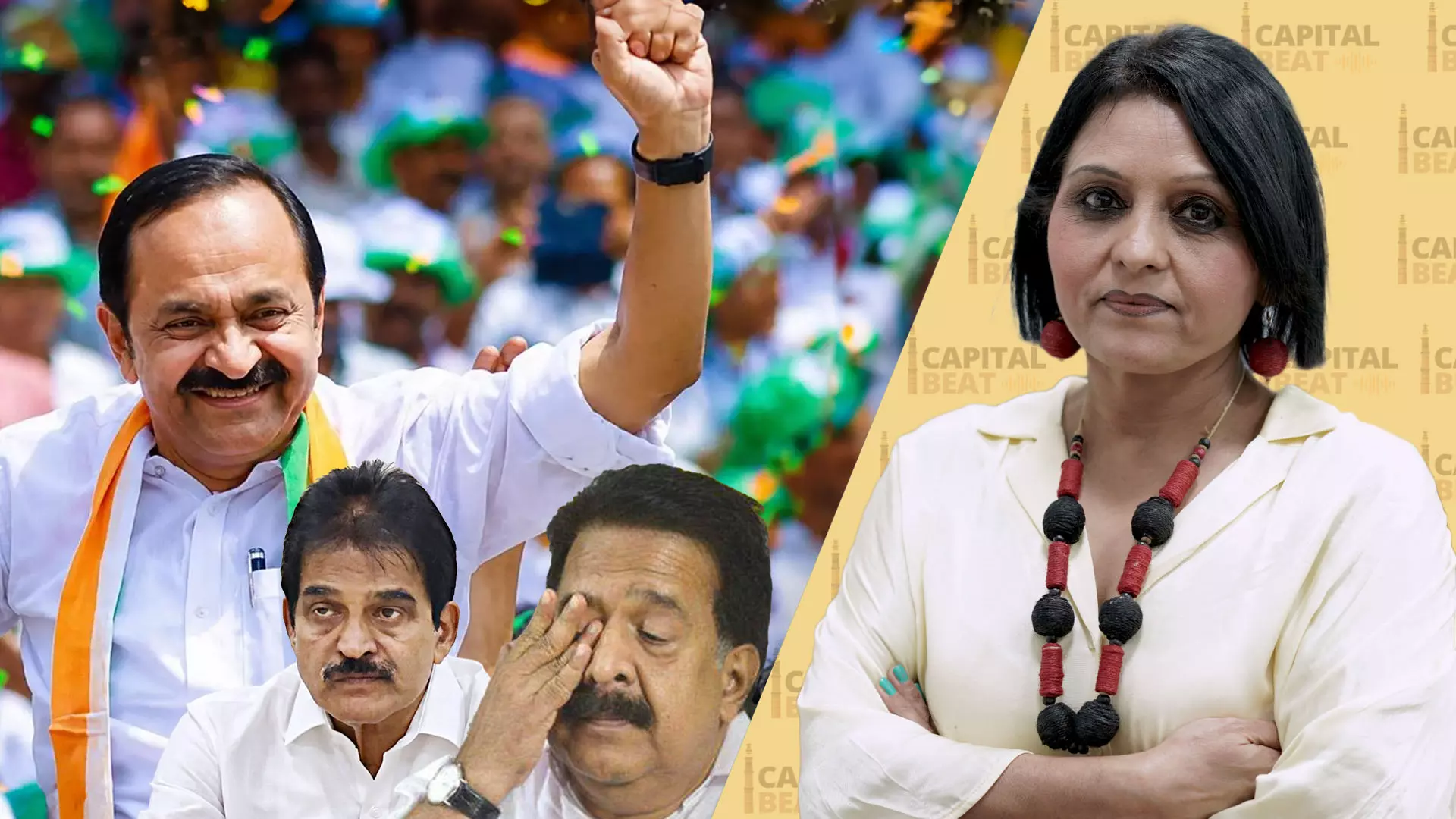
VD Satheesan has been picked as the next CM after 10 days of internal tussle.
Kerala fixed now, but does it reflect Congress' internal crisis?
Satheesan has been Kerala's CM, but the questions his selection raised won't go away as easily

The Congress may have finally settled on VD Satheesan as Kerala’s next chief minister, but the 10-day suspense over the decision has triggered fresh questions over the party’s leadership structure, internal factionalism, and organisational weakness ahead of crucial electoral battles.
“The Congress high command made a cardinal mistake in Karnataka by going in for this two-and-a-half-year formula. This does not work in politics,” senior journalist Javed Ansari said during a discussion on The Federal’s Capital Beat programme.
The prolonged uncertainty around Kerala’s CM choice came despite the Congress-led UDF securing a comfortable mandate. The Federal spoke to Ansari and TK Rajalakshmi, deputy editor of Frontline, about the Congress’s decision-making crisis, factionalism, weakening organisational structure, and the future of the INDIA bloc.
High command dilemma
Ansari argued that while the Congress could have handled the Kerala transition more efficiently, the delay reflected the complexities of balancing competing ambitions within the party.
According to him, the leadership had to reconcile the interests of Satheesan, K. C. Venugopal and Ramesh Chennithala before arriving at a consensus.
He also questioned why Congress alone faces intense scrutiny for delays in leadership announcements while other parties often take similar timeframes. Ansari pointed out that Venugopal still remains one of the most influential figures within the Congress organisation due to his proximity to Rahul Gandhi and his role as general secretary (organisation).
At the same time, he said the final decision in favour of Satheesan suggested that the leadership believed he had broader support among legislators and the public.
Optics problem
Rajalakshmi said the delay damaged the Congress’s public image because factionalism played out openly through posters, lobbying, and public mobilisation by supporters of different camps.
She noted that despite securing a smooth mandate in Kerala, the party still struggled to quickly settle leadership questions, exposing deeper organisational weaknesses.
According to her, the Congress now faces the difficult task of balancing experienced leaders with younger faces without alienating either faction.
She argued that this challenge becomes even harder in states where the Congress is weaker and must also manage alliances with regional parties.
The discussion repeatedly returned to the issue of accountability within the Congress organisation, particularly around repeated electoral defeats and the functioning of the central leadership.
Weakening authority
Ansari said the Congress leadership no longer commands the unquestioned authority it once enjoyed during the eras of Indira Gandhi or Rajiv Gandhi. “The Congress leadership’s hand has been weakened by the fact that they suffered a string of losses,” he said.
He argued that unlike the BJP, the Congress leadership lacks the ability to impose discipline because it is no longer in a position to dispense political rewards or punishments with the same effectiveness.
Also Read: Why and how VD Satheesan became the inevitable choice as Kerala CM
This, according to Ansari, forces the leadership into prolonged consultations and compromises rather than decisive action.
Responding to suggestions that multiple power centres exist within the Congress high command, Ansari maintained that final decisions still rest with Rahul Gandhi and Congress president Mallikarjun Kharge.
However, he acknowledged that the leadership’s authority has weakened significantly due to electoral setbacks.
Rotation formula
A major point of criticism during the discussion was the Congress’s use of rotational chief minister formulas in states such as Karnataka and Chhattisgarh.
Ansari called the arrangement a “mistake” and argued that once a leader becomes chief minister, they rarely relinquish power voluntarily.
He cited the continuing tensions in Karnataka involving D. K. Shivakumar as evidence that such compromises only postpone conflicts rather than resolve them.
Rajalakshmi agreed that repeated compromises reflect the Congress leadership’s inability to firmly settle disputes within state units.
She added that factionalism becomes even more visible when state leaders exploit the perceived weakness of the central leadership.
Both panelists suggested that Kerala’s leadership issue may be resolved for now, but similar tensions could re-emerge in other states as elections approach.
Rahul’s challenge
The discussion also focused on Rahul Gandhi’s role within the Congress and whether the party has become overly dependent on him to lead the fight against the BJP.
Ansari defended Rahul’s prominence, saying that as Leader of the Opposition and the party’s primary national face, he is naturally expected to lead the campaign against the BJP.
Also Read: KC Venugopal: Rahul's gatekeeper, who couldn't unlock Kerala CM office
However, he admitted that the Congress organisation has often failed to sustain the momentum generated by Rahul Gandhi’s campaigns and outreach programmes.
He said the party lacks the organisational machinery needed to convert public enthusiasm into long-term political gains, particularly in states such as Uttar Pradesh, Bihar, and West Bengal.
“Organisations are built brick by brick and it takes years,” Ansari said, while questioning why successive Congress leaderships have failed to rebuild the party structure despite repeatedly acknowledging the problem.
Rajalakshmi echoed similar concerns, arguing that the Congress has struggled to consistently build campaigns around key issues.
She said the Opposition often reacts sporadically to events while the BJP successfully dominates the political narrative with constantly shifting issues.
INDIA bloc future
The future of the INDIA alliance also emerged as a major point of discussion.
Ansari said the alliance currently exists “only in name” and suggested that Rahul Gandhi may have shifted focus away from it after difficulties with allies in Bihar and Tamil Nadu.
He argued that regional parties expect Congress to sacrifice seats and influence in their states while refusing to offer similar flexibility where Congress seeks a stronger role.
Ansari specifically mentioned the Congress’s frustration with the M. K. Stalin-led DMK over power-sharing arrangements in Tamil Nadu.
According to him, the Congress now increasingly believes it must rebuild independently rather than rely excessively on regional allies.
Rajalakshmi, however, cautioned that the Congress cannot realistically pursue an “Ekla Chalo” strategy without first rebuilding its grassroots organisation.
She said the party still needs coordinated efforts with opposition allies if it hopes to challenge the BJP effectively in 2029.
Organisational crisis
Both panelists agreed that rebuilding the Congress organisation remains the party’s biggest challenge.
Ansari said the Congress must recognise its reduced stature in several key states and avoid demanding seats disproportionate to its actual strength.
He argued that unless the party rebuilds its ground-level structure, alliances alone will not be enough to revive its national fortunes.
Rajalakshmi stressed that the Congress must consistently engage with public issues rather than launch occasional protests or campaigns.
According to her, the BJP’s ideological and organisational clarity gives it a major advantage over a Congress that still appears uncertain about its long-term political direction.
With Assembly elections approaching in several states and the 2029 Lok Sabha election cycle already looming, the Kerala leadership episode has once again highlighted the Congress’s continuing struggle to balance internal democracy, leadership authority, and organisational discipline.
The content above has been transcribed from video using a fine-tuned AI model. To ensure accuracy, quality, and editorial integrity, we employ a Human-In-The-Loop (HITL) process. While AI assists in creating the initial draft, our experienced editorial team carefully reviews, edits, and refines the content before publication. At The Federal, we combine the efficiency of AI with the expertise of human editors to deliver reliable and insightful journalism.