Cong-led UDF sweeps Kerala LSG polls; BJP captures Thiruvananthapuram
For the UDF, the verdict is a morale booster and a validation of its strategy to consolidate minority votes and capitalise on anti-incumbency

The writing is clearly on the wall for the Left Democratic Front (LDF) in Kerala. For the first time since 2010, the ruling front has suffered a significant electoral setback in the Local Self Government (LSG) elections, signalling a possible shift in the political mood of the state.
As counting concluded, the United Democratic Front (UDF) emerged as the clear winner across multiple tiers of local governance, denting the LDF’s long-held dominance and raising uncomfortable questions for a government that has been in power at the state level for a decade and in local bodies for nearly fifteen years.
Aura of invincibility cracks
At the time this report is being filed, the UDF has secured control of 501 out of 941 grama panchayats, 78 of 152 block panchayats, 7 of 14 district panchayats, 54 of 87 municipalities, and 4 of the 6 corporations. These numbers mark a decisive reversal from the 2020 LSG elections, when the LDF had swept the polls with commanding margins across almost every tier of local governance.
Also read | Kerala’s LSG polls today: A bellwether test for the 2026 Assembly polls
In 2020, riding high on the goodwill generated by welfare interventions, crisis management during floods and the early phase of the COVID-19 pandemic, the LDF had won 582 grama panchayats, 113 block panchayats, 11 district panchayats, 44 municipalities, and five corporations. That verdict had reinforced the Left’s image as an unbeatable force at the grassroots and laid the foundation for its unprecedented second consecutive Assembly victory in 2021.
Five years later, that aura has visibly cracked.
The Thiruvananthapuram shock
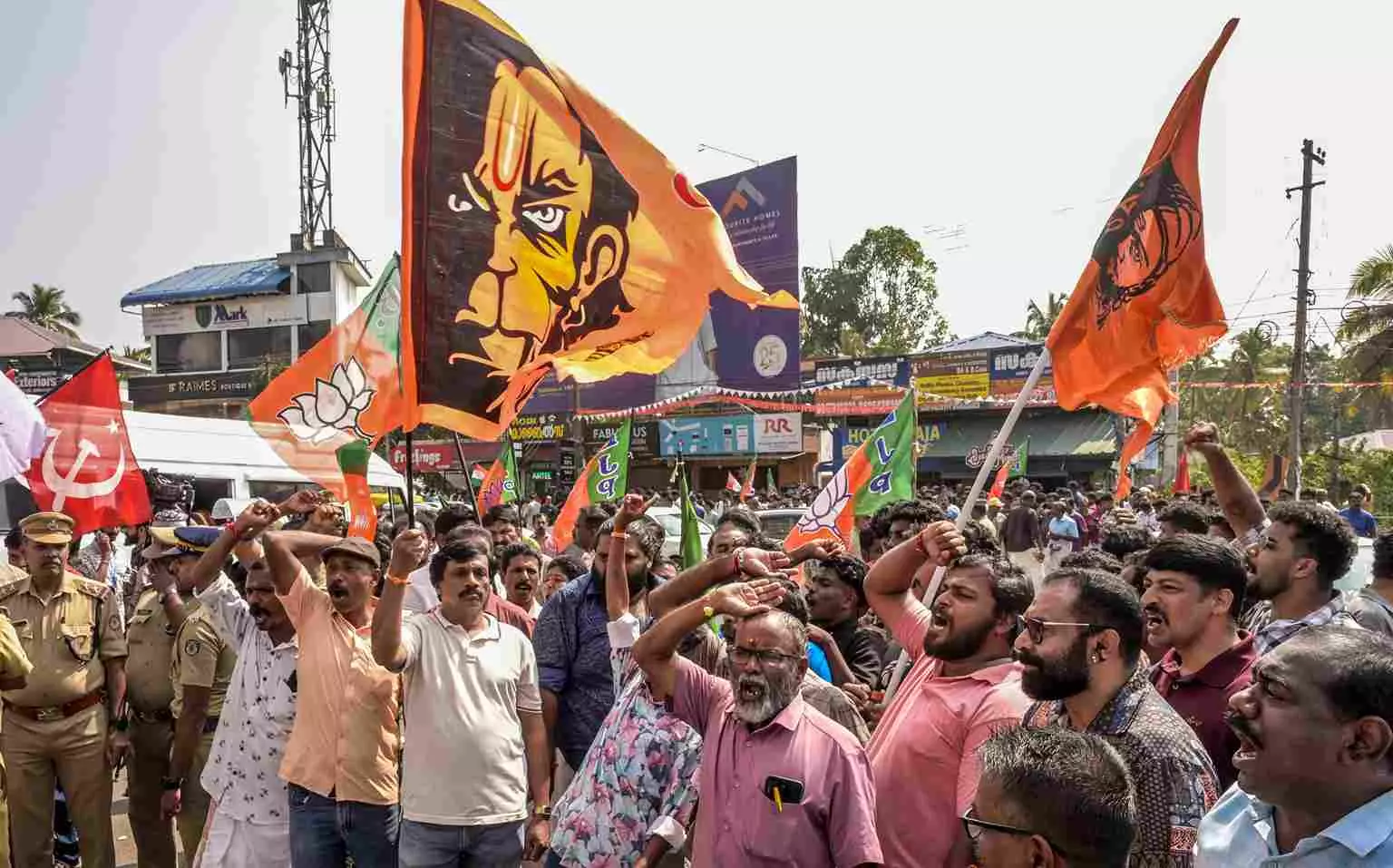
Perhaps the most alarming outcome for the LDF has been the loss of the Thiruvananthapuram Corporation, a Left bastion for over four decades. The BJP-led NDA wresting control of the capital city corporation, winning 50 seats, is not merely a numerical loss but a symbolic blow that cuts deep into the LDF’s political narrative. The corporation had long been showcased as a model of Left-led urban governance, and its loss underscores the scale of voter disaffection in urban Kerala.
The NDA’s overall footprint remains limited — its tally of grama panchayats has risen from 17 to 25, and it has retained control of two municipalities — but its breakthrough in Thiruvananthapuram sends a clear warning signal. It demonstrates that the BJP’s steady, issue-focused urban campaign, combined with LDF fatigue and UDF consolidation, can produce disruptive outcomes even in entrenched Left territories.
Anti-incumbency at multiple levels
At the heart of the LDF’s setback lies a layered anti-incumbency sentiment. The state government is completing 10 years in office, while many local bodies under the Left have been in power for 15 years. What once translated into administrative continuity has now begun to look like stagnation in the eyes of voters.
Local grievances, ranging from delays in service delivery and allegations of corruption to dissatisfaction over candidate selection, accumulated over successive terms. Welfare schemes and pension hikes, once the LDF’s strongest electoral currency, appear to have reached a point of diminishing returns, unable to fully offset voter fatigue and governance-related discontent.
The Thiruvananthapuram Corporation result, in particular, reflects this exhaustion. Urban voters, more exposed to daily administrative friction and infrastructure bottlenecks, appear to have voted decisively for change rather than continuity.
Minority consolidation and ideological alienation
Another decisive factor was the consolidation of minority votes in favour of the UDF, especially in central and northern Kerala. This shift was sharpened by the visible strain in relations between the CPI(M) and sections of Muslim organisations. The fallout with groups such as the Jamaat-e-Islami, which ran an aggressive campaign critical of the Left, eroded the LDF’s support base in several constituencies.
Also read | Jamaat, Hindutva are birds of same feather, says Kerala CM Pinarayi Vijayan
The CPI(M)’s ideological confrontation with political Islam, coupled with the Jamaat’s public messaging that equated the Left with the BJP on select issues, appears to have nudged minority voters towards the UDF as the most viable counterweight. In a tightly contested election, this consolidation proved decisive in tilting outcomes at the ward and panchayat levels.
Strongholds hold, but only just
Despite the setback, the LDF’s performance was not uniformly bleak. Traditional CPI(M) strongholds managed to hold their ground, especially in rural pockets. Districts like Thiruvananthapuram and Kollam continued to reflect the Left’s deep-rooted rural base, even as the front lost both corporations. Similarly, Thrissur, Kannur, Alappuzha and Palakkad saw the LDF weather the storm to an extent, preventing a complete sweep by the UDF.
These results underline a critical distinction: while the Left’s organisational machinery remains intact in rural Kerala, its appeal in urban and semi-urban centres has weakened significantly. The erosion of control in municipalities and corporations suggests a structural challenge that cannot be addressed merely through campaign recalibration.
A relative performance, not a collapse
Importantly, the LDF’s setback should not be mistaken for an electoral collapse. In absolute terms, the Left has still performed better than it did in earlier adverse cycles and even better than the UDF’s showing in the 2015 and 2020 LSG elections. This indicates that the CPI(M)-led front retains a resilient vote base, even amid growing dissatisfaction.
However, elections are as much about momentum as numbers. Losing the narrative of invincibility, particularly after a decade of uninterrupted rule, carries consequences beyond local bodies. The results have emboldened the Opposition and introduced uncertainty into what had appeared to be a stable political equation.
Implications beyond local bodies
Historically, LSG elections in Kerala have often served as indicators of the political direction ahead. While they do not mechanically translate into Assembly outcomes, they reflect shifts in voter mood with remarkable consistency. The LDF’s defeat, therefore, will be read as an early warning ahead of the next Assembly election cycle.
Also read | Kerala local body polls: Northern districts vote amid shifts in minority alignments
For the UDF, the verdict is a morale booster and a validation of its strategy to consolidate minority votes and capitalise on anti-incumbency. For the BJP, the Thiruvananthapuram breakthrough offers a foothold to expand its urban ambitions. For the LDF, the message is stark: welfare alone cannot substitute for political renewal, urban governance reform, and alliance management.
The LSG poll debacle does not spell the end of the Left’s dominance in Kerala, but it decisively punctures the sense of inevitability that had surrounded it since 2020. Whether the LDF treats this verdict as a course correction or a passing setback will determine not just its local body fortunes, but the trajectory of Kerala politics in the years ahead.