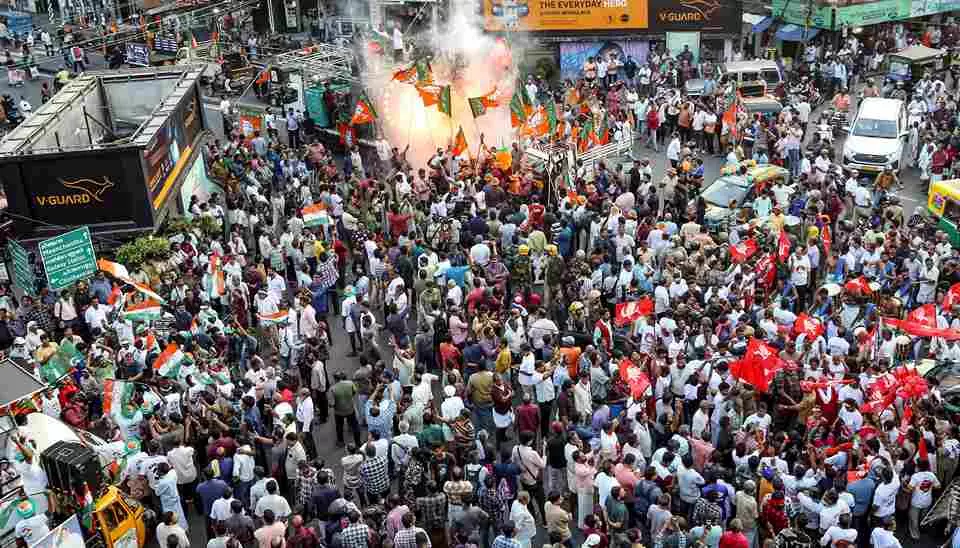
A campaigning scene from Kozhikode. Photo: PTI
Kerala local body polls: Northern districts vote amid shifts in minority alignments
Voting in seven northern districts involves 1.53 crore voters; results will indicate Muslim community's shifting support between the two major fronts in Malabar

The second phase of voting in the Kerala local body elections on Thursday (December 11) will take place across seven northern districts, where the political stakes for both the UDF and the LDF are closely linked to minority consolidation, Muslim community sentiment, and recent shifts in political advocacy groups, particularly in Malabar.
This phase covers Thrissur, Palakkad, Malappuram, Kozhikode, Wayanad, Kannur and Kasaragod, the regions where Muslim voters and minority-linked organisations have historically shaped local equations, but have also demonstrated a considerable degree of tactical voting depending on the political moment.
Polling will take place in 12,391 wards across 604 local bodies, including 470 grama panchayats, 77 block panchayats, 7 district panchayats, 47 municipalities and 3 corporations. A total of 15,337,176 voters are eligible in this phase, including 7,246,269 men, 8,090,746 women and 161 transgender voters. There are also 3,293 expatriate voters.
The election will see 38,994 candidates in the fray — 18,974 men and 20,020 women. Among them, 28,274 are contesting in grama panchayats, 3,742 in block panchayats, 681 in district panchayats, 5,546 in municipalities and 751 in corporations.
This phase covers Thrissur, Palakkad, Malappuram, Kozhikode, Wayanad, Kannur, and Kasaragod.
Critical and complex
For the UDF, this phase is particularly critical, given the significantly high proportion of Muslim voters in Malappuram, Kozhikode, Kannur and Kasaragod districts.
Since the beginning of the Pinarayi Vijayan government’s second term, sections of the Muslim community that had shifted closer to the LDF during the first term have gradually begun moving back towards the Congress-led UDF. This trend is linked to a mix of national political calculations, apprehensions over majoritarian policies, local factors driven by Congress leaders, and significantly, the sustained campaign by sections of Muslim organisations, led by the Jamaat-e-Islami, accusing the CPI(M) of taking positions that undermine minority interests.
Also read: Kerala’s LSG polls today: A bellwether test for the 2026 Assembly polls
What makes the current election strategically complex is the perception that the LDF’s social welfare networks, especially post-flood rebuilding and Covid management, had temporarily improved its goodwill among Muslim voters. But political analysts noted that the consolidation was never complete and has remained fluid. The UDF believes that it has regained at least a part of the earlier minority base, particularly after national political debates.
Local bodies, while not directly linked to these issues, have often acted as testing grounds for political signalling.
Polling will take place in 12,391 wards across 604 local bodies including 470 grama panchayats, 77 block panchayats, 7 district panchayats, 47 municipalities and 3 corporations.
Another dimension
Another dimension likely to reflect on the polling behaviour is the position of the Jamaat-e-Islami and its community connect in Malabar. While the organisation is not significant in membership, or formally aligned with any political front, its advocacy positions and electoral messaging tend to influence a measurable number of voters in the northern districts.
Recently, friction between the CPI(M) and the Jamaat-e-Islami has become more evident, particularly after senior CPI(M) leaders including Chief Minister Pinarayi Vijayan issued sharp public remarks warning against “religious organisations attempting to dictate political choices”, even suggesting that the Jamaat represents the other side of the same communal coin as the BJP in its attempt to influence voting behaviour.
While the Jamaat has been strategically backing the UDF, political observers pointed out that statements from the Chief Minister were clearly read as a direct attack on the Jamaat’s style of public advocacy. In several Muslim-dominated wards, especially in Kozhikode and Malappuram, even marginal shifts can alter municipal outcomes.
Gender justice issue
On the other hand, sections of the UDF campaign have found themselves dealing with a completely different controversy. That has to do with Congress MP and UDF convenor Adoor Prakash’s remarks, perceived as defending actor Dileep, who was recently acquitted in the Kerala actor assault case.
His statements sparked criticism within civil society groups and raised discomfort among women supporters, especially because the assault case has become symbolic of the broader conversation on gender justice in Kerala.
Also read: With LSG polls round the corner, Pinarayi gets ED notice in KIIFB Masala Bond case
Several local UDF leaders privately conceded that the remarks were avoidable and ill-timed, particularly during the campaign, when the party hoped to consolidate women voters. Though the Congress leadership later distanced itself from the MP’s position, the remarks offered the LDF ammunition to reassert its claim of being more consistent in backing survivors of gender-based violence.
Unique battlefield: Kannur
Kannur remains a unique battlefield in this phase. Traditionally a CPI(M) stronghold, the district has nevertheless shown pockets of tactical voting when minority-heavy wards are concerned. While the Left front retains organisational depth in Kannur, the UDF expects incremental gains in certain pockets where Muslim sentiment is expected to respond to the ongoing argument that national opposition to the BJP requires a clear political signalling through the UDF.
Polling details
Polling will be held from 7 am to 6 pm across a total of 18,274 polling stations. According to the State Election Commission, 2,055 booths have been classified as problematic or sensitive (Thrissur – 81, Palakkad – 180, Malappuram – 295, Kozhikode – 166, Wayanad – 189, Kannur – 1,025 and Kasaragod – 119).
In terms of equipment preparedness, 18,274 control units and 49,019 ballot units have been set up after candidate configuration. Another 2,631 control units and 6,943 ballot units are kept in reserve to replace faulty machines, if required.
Trend pointer
This phase will also indirectly test how much credibility the LDF still retains among Muslims despite the Chief Minister continuing to present himself as uncompromising on secular principles.
The Left argues that national political formations have appropriated religious identities, while Kerala’s specific secular history requires an alternative model. But critics within the community insist that allegations of police handling, campus politics and disputes with minority organisations have eroded the Left’s symbolic commitment.
The UDF, while hoping to harness these dissatisfactions, faces its own contradictions. Sections of the Muslim electorate view the UDF’s electoral performance outside Kerala, to counter majoritarian politics nationally as inadequate.
Some Muslim youth collectives and community organisations have argued that merely positioning the UDF as the “natural secular choice” is no longer enough. These debates are particularly visible in Kozhikode, where minority youth organisations have been more vocal in questioning established party lines.
Also Read: Crisis brews in Kerala BJP with cadre suicides in Thiruvananthapuram
Although local body elections do not directly predict Assembly outcomes, historical patterns show that the results often produce mood indicators.
In 2015, the LDF’s performance in local bodies was read as the earliest signal of its eventual Assembly victory. Since 1995, LSG election outcomes have frequently acted as trend pointers. With the next Assembly elections in 2026, both fronts are conscious that momentum needs to be built early.
The numerical spread of Phase Two, covering a demographic terrain where minorities play a decisive role, means that even marginal shifts may be exaggerated in political interpretation. For both fronts, municipal corporations in Kozhikode and district panchayats in northern Kerala carry symbolic significance far beyond administrative value.