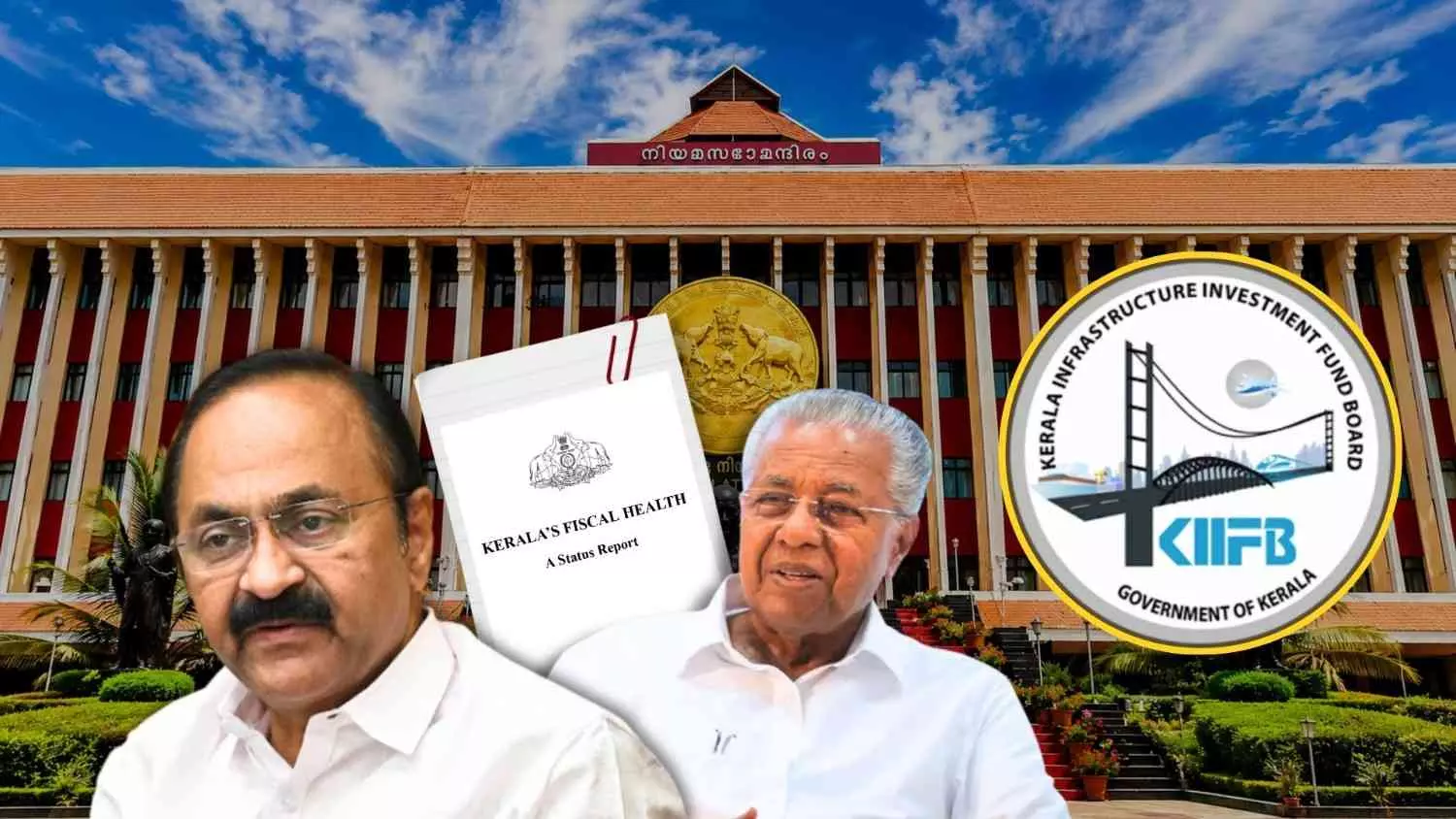
Welfare state to market reforms? Kerala white paper signals economic shift
Kerala’s financial status report flags rising debt, tight cash flow, and structural strain, sparking debate over KIFB, welfare model, and economic direction ahead of June 19 budget

Kerala’s financial position has come under sharp scrutiny after a new financial status report tabled in the state Assembly revealed rising debt levels, tight cash flows and mounting fiscal pressure on day-to-day governance. The report has sparked a political debate over the state’s economic model and the future of key investment vehicles such as the Kerala Infrastructure Investment Fund Board (KIFB).
According to the report, Kerala’s total debt has now crossed Rs 5 lakh crore, with nearly 77 per cent of revenue already committed to salaries, pensions, and interest payments.
Low capital expenditure
The report highlights that most of the state’s incoming revenue is already locked into fixed expenditure, leaving very limited fiscal flexibility. Capital expenditure, which drives infrastructure and asset creation, remains among the lowest in the country.
Also Read: Kerala fiscal White Paper sparks showdown in assembly over Rs 5.07-lakh-crore debt
Cash stress
The report also flags severe short-term cash constraints. It notes that Kerala depended heavily on RBI support for most of the financial year, including ways and means advances for over 250 days and overdrafts for nearly three months.
It also highlights nearly Rs 50,000 crore in arrears, including pending payments to employees, pensioners, and contractors.
KIFB debate
A major focus of the report is the Kerala Infrastructure Investment Fund Board (KIFB), created to fund large infrastructure projects outside the regular budget system. The report acknowledges that several visible infrastructure projects have been implemented through KIFB.
Also Read: Kerala CM V D Satheesan signals no immediate fuel tax relief despite price hikes
However, it notes that the Union government has begun counting KIFB borrowings as part of state debt, altering Kerala’s fiscal calculations. The report argues this “takes away KIFB’s very relevance", triggering a political and policy debate over its future.
A counter-position highlighted in the discussion argues that if KIFB is shut down, there is no viable alternative to fund large infrastructure projects, as the regular budget cannot support such scale.
Debate over Kerala model
The report itself has become part of a larger political narrative battle. While critics argue it paints an alarming picture, supporters of the model claim that earlier warnings of fiscal collapse during the COVID period were overstated.
It further stated that KIFB is described in the report as an “innovative institutional mechanism” that has enabled significant infrastructure spending across the state.
Reform push
The report moves beyond diagnosis to recommendations, suggesting possible restructuring of public sector units, disinvestment, and administrative consolidation. One proposal includes merging the civil supplies corporation with the state beverages corporation to balance losses and profits.
Also Read: UDF govt signals policy shift with welfare push, port hub vision, softer Centre stance
It also suggests tighter control over long-term expenditure, including revisiting retirement age policies for government employees.
Economic shift
Taken together, the recommendations indicate a potential shift in Kerala’s economic approach. The state, traditionally known for strong public sector presence and welfare-driven governance, appears to be moving towards a more market-oriented model.
The report has also sparked political objections over its preparation process, even as its policy implications continue to dominate discussion.
Budget test
The most immediate political focus now shifts to the upcoming budget to be presented by Chief Minister VD Satheesan on June 19. The report is expected to frame expectations for policy direction, fiscal discipline, and economic strategy.
Also Read: Silver Line out, Sreedharan’s high-speed rail plan in? What’s different this time?
As Kerala grapples with rising debt, constrained revenues, and competing economic visions, the upcoming budget is expected to be the first real test of how the state intends to respond to its fiscal reality. What direction will Kerala finally take — welfare continuity or structural overhaul?
(The content above has been transcribed from video using a fine-tuned AI model. To ensure accuracy, quality, and editorial integrity, we employ a Human-In-The-Loop (HITL) process. While AI assists in creating the initial draft, our experienced editorial team carefully reviews, edits, and refines the content before publication. At The Federal, we combine the efficiency of AI with the expertise of human editors to deliver reliable and insightful journalism.)