Silver Line out, Sreedharan’s high-speed rail plan in? What’s different this time?
After opposing Silver Line, the UDF government has backed E Sreedharan's high-speed rail proposal. What has changed, and are the concerns any different?

Kerala's long-running debate over rail development has entered a new phase, but many of the old questions remain. After the shelving of the Silver Line project, the UDF government has indicated support for a new high-speed rail corridor proposed by E Sreedharan. The proposal has reignited discussions about land acquisition, environmental impact, financial viability and political consistency.
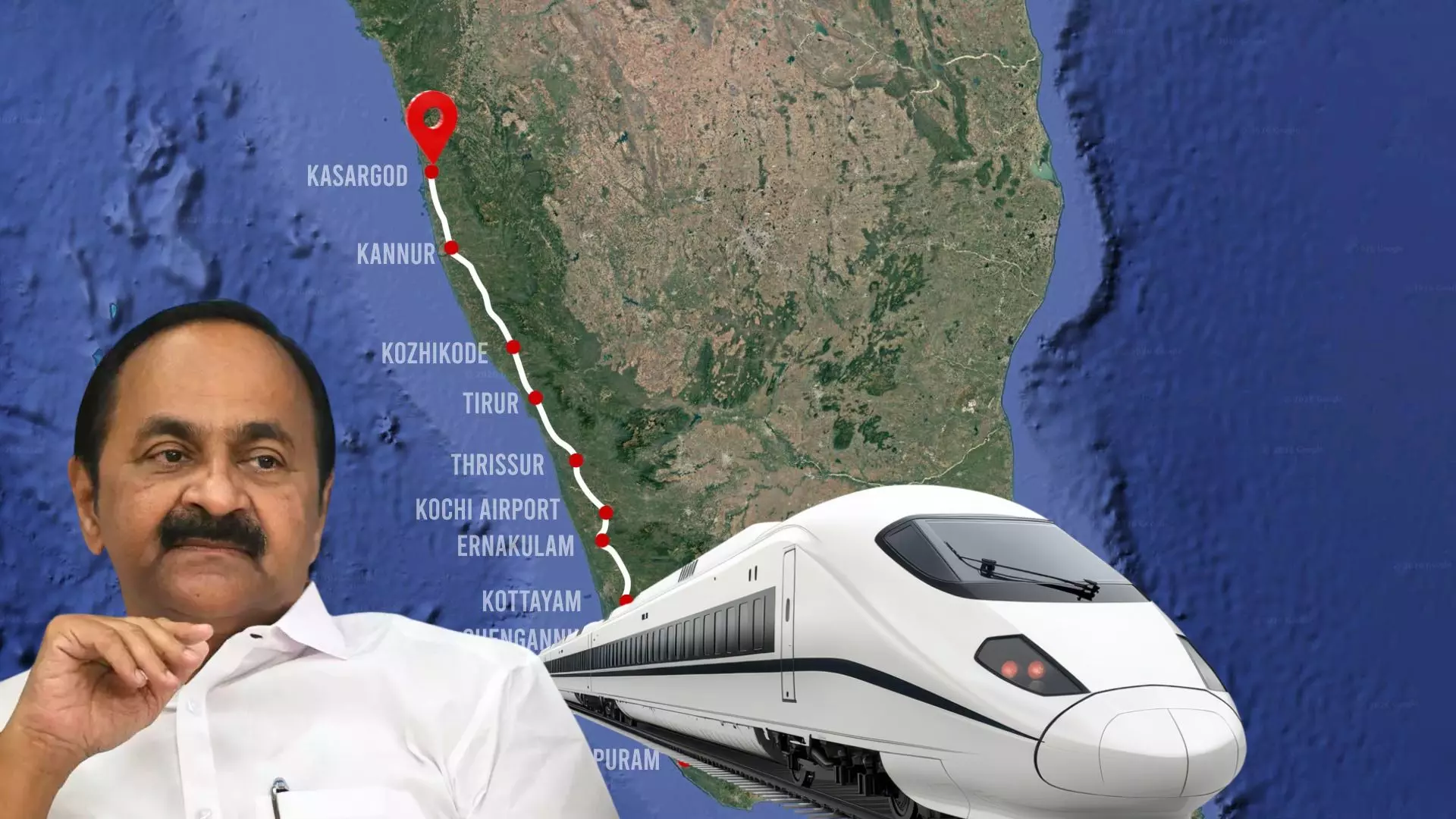
The interim report for the project has already been submitted by the Delhi Metro Rail Corporation (DMRC). The proposed corridor will run from Thiruvananthapuram to Kannur and aims to significantly reduce travel time across the state.
The development has drawn attention because several of the concerns raised against the Silver Line project are now being revisited in the context of the new proposal.
New proposal
The proposed Kerala High-Speed Railway (KHSR) will cover 473.2 kilometres between Thiruvananthapuram and Kannur, with 23 stations along the route.
According to the proposal, the journey between the two cities will take around three hours and 30 minutes. The project is designed as a double-line corridor, largely elevated, with approximately 6.5 kilometres of tunnelling in Thiruvananthapuram.
Also read: Why Congress govt dumped Kerala's SilverLine project
The railway will use standard gauge tracks and have a maximum design speed of 200 kmph, with trains operating at speeds of up to 180 kmph. Services are proposed at intervals of 20 to 40 minutes, with an estimated daily passenger capacity of 54,000.
Silver Line
The new proposal is being compared with the Silver Line project championed by the Left Democratic Front (LDF) government.
Silver Line was envisioned as a 530-km semi-high-speed rail corridor connecting Thiruvananthapuram and Kasaragod. The estimated project cost was Rs 63,940 crore, with trains capable of reaching speeds of up to 200 kmph and reducing travel time to under four hours.
The project proposed 11 stations across 11 districts and required the acquisition of an estimated 1,383 hectares of land.
However, the project faced sustained opposition from political parties, activists and civil society groups.
Key objections
Opponents of Silver Line raised concerns on three major fronts: land acquisition and displacement, environmental impact, and financial viability.
Also read: SilverLine out, central high-speed rail in: The contest over Kerala’s mobility control
Critics argued that the alignment would affect wetlands and paddy fields, leading to ecological concerns. Questions were also raised about the project's funding and long-term economic sustainability.
The UDF was among the most vocal opponents of the project. The Union Ministry of Railways also declined to grant approval, citing concerns regarding financial feasibility and compatibility with existing railway expansion plans.
Without clearance from the Union government, the project could not move forward.
Sreedharan model
During the debate over Silver Line, E Sreedharan had expressed reservations about the project's approach.
He later proposed an alternative model based on elevated tracks and standard railway systems. According to Sreedharan, such a model could reduce both land acquisition requirements and long-term project costs.
The current proposal reflects many of those recommendations.
However, there are important differences between the two projects. The new corridor ends at Kannur in its first phase, while an extension to Kasaragod is planned for a later stage.
Also read: Kerala wants high-speed rail corridor irrespective of who brings it: Pinarayi Vijayan
The funding structure also differs. Under the proposal, Rs 36,000 crore would be contributed as equity by the Union and state governments in a 51:49 ratio. The remaining Rs 24,000 crore is proposed to be raised through crowdfunding.
Political shift
The political response to the new proposal has drawn attention.
The LDF, which strongly backed Silver Line, has indicated that it will not oppose the high-speed rail proposal. Meanwhile, the UDF, which opposed Silver Line on environmental and financial grounds, has adopted a favourable position towards the new project.
This shift has led to questions about what exactly has changed.
The earlier objections to land acquisition, ecological impact and financial viability formed the basis of the UDF's criticism of Silver Line. Whether the new proposal sufficiently addresses those concerns remains a subject of debate.
Activists unconvinced
Anti-Silver Line activists remain sceptical of the new proposal.
They argue that Kerala should focus on upgrading and modernising its existing railway network rather than investing in a completely new high-speed corridor.
According to them, improvements to the current infrastructure could achieve better connectivity at a lower cost and with less disruption.
Also read: Why a high-speed rail network could lead to Kerala-Centre flashpoint
From their perspective, the central question is not whether one project is better than another, but whether a new rail corridor is necessary at all.
Debate continues
The comparison between the two projects ultimately revolves around several key factors — the extent of land acquisition, the degree of elevation, route alignment and funding structure.
At the same time, both projects share similarities in terms of overall scale, projected cost and intended travel speeds.
With the Union government yet to formally approve the Kerala High-Speed Railway proposal, the project remains at the stage of an interim report under consideration.
The debate surrounding rail development in Kerala is therefore far from settled. The political shift, E Sreedharan's alternative framework and the Union government's earlier rejection of Silver Line are all likely to remain central to discussions in the months ahead.
(The content above has been transcribed from video using a fine-tuned AI model. To ensure accuracy, quality, and editorial integrity, we employ a Human-In-The-Loop (HITL) process. While AI assists in creating the initial draft, our experienced editorial team carefully reviews, edits, and refines the content before publication. At The Federal, we combine the efficiency of AI with the expertise of human editors to deliver reliable and insightful journalism.)