



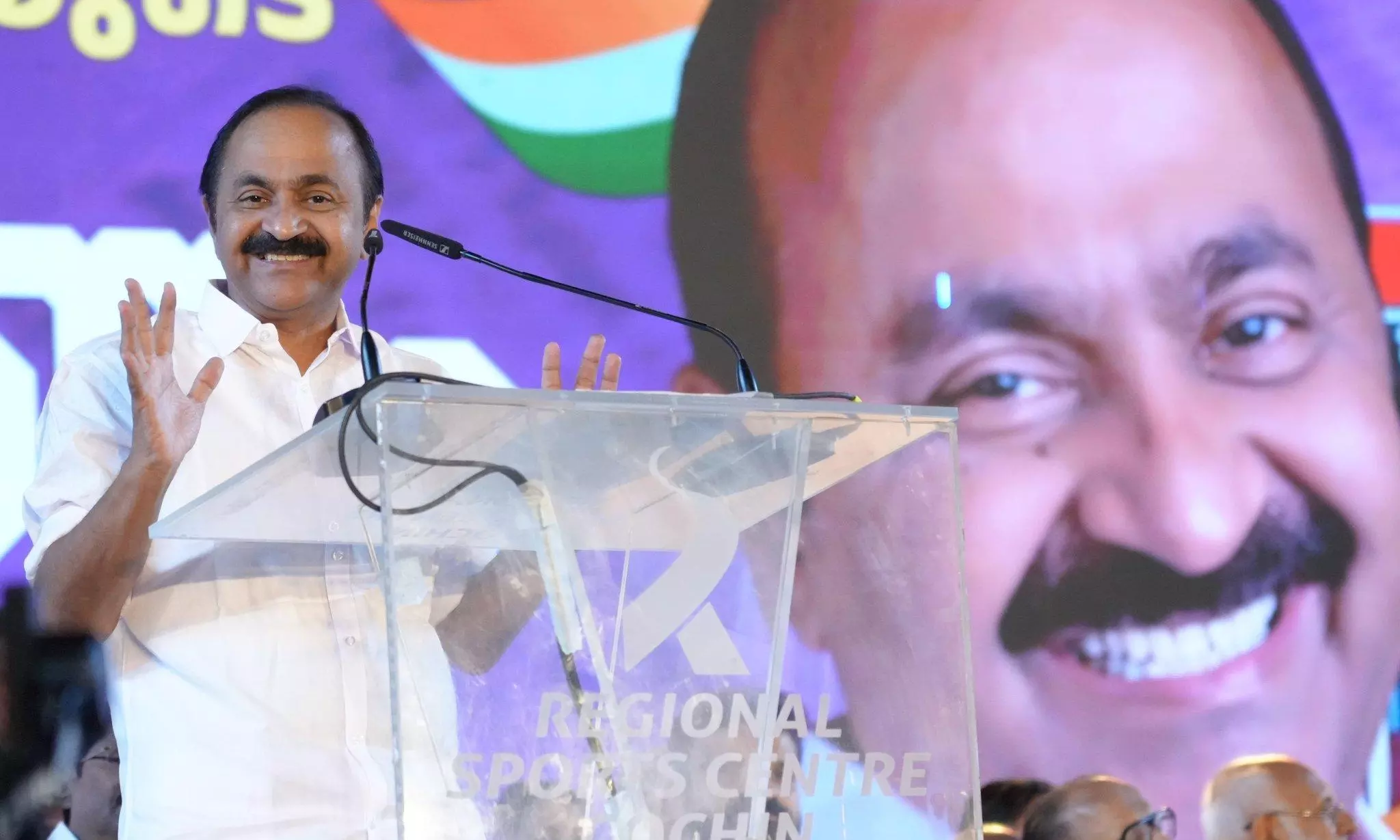
Can VD Satheesan's 'governance with empathy' survive Kerala’s fiscal reality?
As the honeymoon period fades, a look at the decisive hits, contentious U-turns, and the stark economic challenges defining the Kerala CM's first 30 days

When VD Satheesan took oath as Kerala’s 13th Chief Minister on May 18, he promised a transition from the previous administration’s "confrontational" style to "governance with empathy." One month in, that pledge has become a high-stakes balancing act.
Inheriting a state treasury reeling under a contested Rs 5 lakh crore debt, Satheesan has moved with surgical speed to dismantle legacy projects and address grassroots grievances. All while struggling to defend his maiden budget against charges of "political U-turns" and fiscal drift.
His first 30 days have been defined by a sharp dichotomy: a series of decisive "hits"—including the resolution of long-standing ASHA worker protests, the swift cancellation of the controversial SilverLine project, and a crackdown on narcotics—set against a backdrop of mounting friction.
While the Satheesan government positions these moves as a corrective to a decade of mismanagement, the Opposition is already sharpening its knives, branding the administration’s flagship policies as either performative or fiscally unsustainable. As the initial honeymoon period fades, the central question remains: can Satheesan’s "empathy" survive the cold, hard arithmetic of Kerala's precarious public finances?
Here's a dekko at his top 'hits' and 'misses', as widely perceived. We start with the hits.
ASHA workers' issue resolved
Among the earliest and most visible decisions was a Rs 3,000 hike in monthly honorarium for ASHA workers, bringing their pay to Rs 12,000. This ended a 266-day protest by the Kerala ASHA Workers' Welfare Association.
The government simultaneously raised honoraria for Anganwadi workers and pre-primary teachers by Rs 1,000 and gave Rs 500 more to cooks and helpers.
Also Read: Vijay govt 1-month report card: Coalition stability offset by fiscal strains
These were long-pending demands that the previous Pinarayi Vijayan government had left unresolved despite years of pressure. It was one of the most widely discussed issues in Kerala, and many believe it contributed to the Pinarayi government.
The Priyadarshini scheme, offering free bus travel for women and transgender individuals across seven categories of KSRTC ordinary buses, was another flagship announcement. Satheesan later confirmed in his budget speech that this was one of two "Indira Guarantees" his government had already delivered.
Junking SilverLine project
In one of its first cabinet meetings, the government officially interred the SilverLine semi-high-speed rail project — the Rs 63,940-crore, 530-km corridor that had been a political flashpoint for years. The Revenue Department cancelled all pending land acquisition proceedings and ordered the removal of concrete survey stones that had been driven onto private properties.
"This left ordinary landowners in limbo — unable to sell, buy, or mortgage their own property," Satheesan said, framing the scrapping as relief rather than politics.
In mid-June, the government launched 'Operation Toofan,' a multi-agency crackdown on drug networks led by Home Minister Ramesh Chennithala. Within 15 days, it registered 2,575 cases, arrested 2,778 people, and seized narcotics worth over Rs 10 crore, including MDMA, cannabis and hashish oil.
PSC aspirants see hope
The government also intervened to ensure the appointment of candidates from an expiring Kerala Public Service Commission (PSC) rank list for the post of Sub-Inspector (Trainee). With the rank list set to expire in June, the administration expedited the process and cleared the permanent appointment of 43 eligible candidates into the state police force.
The move was aimed at preventing administrative delays from affecting candidates who had already qualified for government service.
There were instances when the CM decided to act in response to media reports. Satheesan personally intervened to secure a livestock licence for local cattle farmer Vinod after bureaucratic hurdles stalled his permits. He contacted Vinod directly to assure him that his farm could operate immediately. These moves were seen in line with the motto of 'governance with empathy'
Land disputes resolved
Satheesan's first month was bookended by two volatile land disputes, both in Ernakulam, that forced direct intervention.
The Pariyathukavu case — involving seven Dalit families living on a disputed private estate — reached a head when a police eviction attempt on May 21 triggered a political storm. The Satheesan government intervened through Higher Education Minister Roji M John, and a settlement was reached on June 15, a day before a High Court deadline.
Private landowners agreed to provide a three-metre-wide access road; a boundary wall would be constructed; and the state would build 1,000-square-foot houses for each family through a sponsorship model. No eviction before rehabilitation.
Also Read | Kerala Budget: Pivot to port-led growth sparks row over land reforms and privitisation
The Munambam Waqf dispute proved more delicate. After the Kerala State Waqf Board uploaded 404 acres of Munambam land onto the Centre's UMEED portal, more than 600 families — predominantly Christian — feared for ownership rights they held through registered documents.
The government intervened to prevent revenue restrictions that blocked residents from paying taxes or securing loans. Following official assurances, the Waqf Board clarified that the portal listing was a technical exercise and would not determine ownership.
Budget and ambitious Mission Samudra
Satheesan's revised Budget for 2026-27, presented on June 19, was as much a political document as a financial one. Retaining the finance portfolio himself, he used the budget speech to catalogue what he called the LDF's "decade of mismanagement".
The picture he painted was grim: a total debt burden of Rs 5.07 lakh crore, with 77 per cent of all revenue being consumed by salaries, pensions and interest payments alone. Capital expenditure had collapsed to just 1.3 per cent of GSDP, among the lowest in India. The previous government, he alleged, had inflated its budget projections by Rs 20,500 crore — leaving the UDF to cover a revenue gap it did not create.
Against that backdrop, the budget outlined an ambitious vision: Mission Samudra, an initiative to transform Kerala into a global maritime powerhouse by integrating its 600-kilometre coastline, two international ports, the Vizhinjam transshipment terminal, 17 non-major ports and inland waterways into a single maritime economic ecosystem.
The government also announced a Rs 10 crore Malayalam AI Initiative to create an open language dataset and support indigenous AI models, and a Rs 50 crore Gen-Z Startup Fund aimed at youth entrepreneurs.
Opposition points out 'U-turns'
Satheesan has also attracted its share of criticism, particularly from the Opposition.
The Left dismissed the Budget as a "dream document" detached from fiscal realities, and accused the UDF of laying the groundwork for privatisation of Kerala's welfare infrastructure.
It further accused Satheesan of making multiple U-turns. Former minister MB Rajesh listed 12 such 'U-turns', from vehicle modification rules to the PM SHRI school scheme. On free bus travel for women, he accused the government of diluting its promise by limiting the scheme to ordinary KSRTC buses.
Rajesh questioned Satheesan's claim to have reduced state debt even as the budget proposed borrowing Rs 1,000 crore more than the previous one. On the promised Rs 15,000 crore in gold tax revenue — a major UDF campaign claim — he pointed out that the budget made no mention of it.
A month later, Satheesan has demonstrated a willingness to move fast — on welfare, on disputed legacy projects, on administrative bottlenecks. However, the transition from "governance with empathy" to sustainable fiscal health is proving to be a steeper climb. One worth waiting and watching for.