Kerala Budget: Pivot to port-led growth sparks row over land reforms and privitisation
Budget also fails to address how state plans to fund large-scale projects when it is grappling with GST-imposed structural limits and tight fiscal constraints

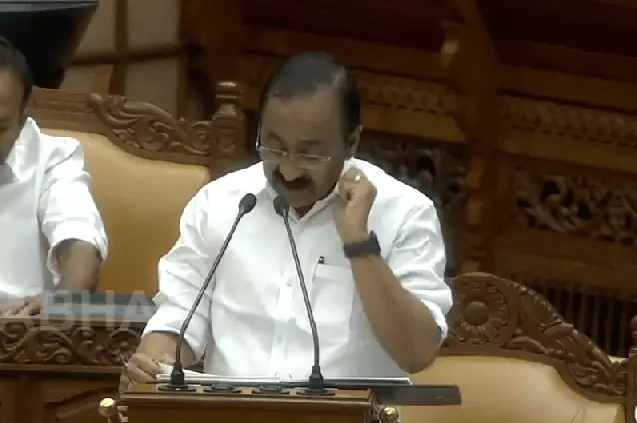
Kerala Chief Minister VD Satheesan on Friday (June 19) presented a revised Budget that positions the state as a “port city” economy, anchored in maritime growth, land policy changes, and a new investment framework. Even as the government outlined an ambitious shift, Leader of the Opposition Pinarayi Vijayan flagged concerns over land reforms, institutional restructuring, and what he called a growing tilt towards privatisation.
Push on investment
The Budget proposes ‘Mission Samudra’ to integrate the coastline, ports, logistics corridors, and industrial clusters into a single economic system. Vizhinjam is projected as a green bunkering hub, while a southern corridor across Thiruvananthapuram, Kollam, and Alappuzha is planned to link sectors such as rare earths, space technology, and the blue economy.
Also read: Tightrope walk for Satheesan: All eyes on Kerala Budget as UDF faces tough choices
The government’s pitch is a transition from a remittance-driven consumption model to an investment-led production economy. Investment zones, single-window clearances and infrastructure corridors form the backbone of this shift.
Concerns over land reforms
A central element in this plan is “Land Reforms 2.0”. The government argues that fragmented ownership, land scarcity, and procedural delays have slowed down investment. It proposes a land bank using public land, faster conversion processes, and land-pooling mechanisms.
However, Pinarayi warned that such changes could weaken a law that shaped Kerala’s social structure. He said the land reform framework, despite its limitations, remains the foundation of many of the state’s social gains. Any dilution, including indirect or incremental changes, could create serious tensions.
He also questioned the political intent behind the move, saying the changes appear designed to ease entry for large capital rather than address structural issues in land use. The concern is that protections built over decades could give way to a more market-driven approach without adequate safeguards.
Policy favours private players: Pinarayi
The criticism extends to the investment model outlined in the budget.
Projects such as the proposed Health and Life Sciences City have raised questions about the role of private capital in essential sectors. Vijayan pointed to a visible trend in Kerala’s healthcare space, where global investment firms such as KKR and Blackstone have expanded their presence. He said the Budget appears to encourage this trend while offering little clarity on strengthening government hospitals.
Also read: Kerala fiscal White Paper sparks showdown in assembly over Rs 5.07-lakh-crore debt
According to him, the policy direction signals an opening for private and multinational players in the pharma and healthcare sectors, without a parallel push to reinforce public systems.
Oppn questions Planning Board rejig
Another point of contention is the restructuring of the State Planning Board.
The budget proposes converting the planning board into a “think tank”. Vijayan said this reflects a shift similar to the Union government’s replacement of the Planning Commission with NITI Aayog. He questioned whether Kerala is moving towards a model where planning becomes advisory rather than directive.
He argued that such a change could reduce the state’s ability to intervene directly in development priorities. The move, based on recommendations in the fiscal white paper, suggests a broader shift in governance approach.
Budget mum on GST-related issues
While the budget does not explicitly confront GST design flaws, it implicitly reflects the constraints imposed by the system. Kerala’s reduced tax autonomy, dependence on Union transfers, and volatility in GST compensation have collectively weakened its revenue base. The shortfall of ₹20,500 crore due to overestimated central transfers underscores this vulnerability. The budget speaks of improving compliance and plugging leakages, but does not directly address structural limits imposed by GST on state finances. This raises questions about how the state plans to fund large-scale infrastructure and investment projects.
Also read: Welfare state to market reforms? Kerala white paper signals economic shift
Kerala continues to face a high debt burden, with a large share of revenue committed to salaries, pensions and interest payments. Its own tax revenue growth has weakened, and dependence on Union transfers within the GST framework has increased.
Arrears, welfare commitments add to fiscal load
Arrears remain another pressure point.
Pending liabilities, including DA and DR arrears and payments to contractors, run into tens of thousands of crores. The budget does not lay out a clear repayment plan. The approach appears to rely on deferment, which critics say shifts the burden onto employees and service providers.
The contradiction is evident. The budget lays out an ambitious growth strategy but operates within tight fiscal constraints.
At the same time, welfare commitments continue, including free bus travel for women and higher honoraria for frontline workers. These measures sustain social spending but add to the fiscal load.
Also read: As PM Modi inaugurates Vizhinjam port, a fierce 'credit' war rages in Kerala
The budget marks a clear policy shift. It pushes Kerala towards a model driven by ports, private capital and investment corridors. The Opposition argues that this shift raises fundamental questions about land rights, the role of the state in planning and the balance between public and private sectors.
The debate is likely to centre on whether the state can pursue growth without weakening the principles that shaped its development path.