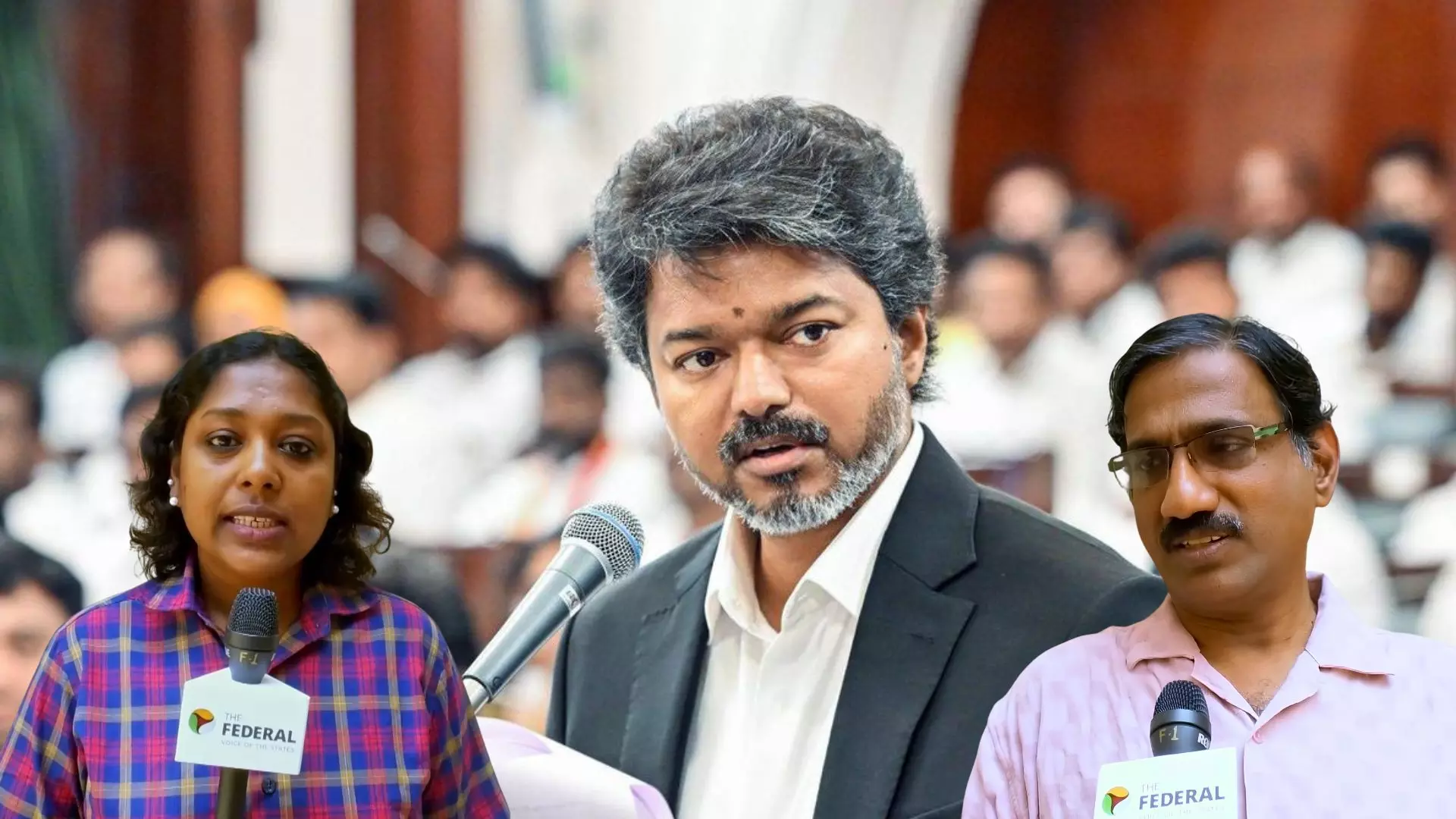
Vijay govt 1-month report card: Coalition stability offset by fiscal strains | Interview
Political analyst T Ramakrishnan says TVK's coalition has started smoothly, but delivering costly poll promises remains a major challenge

The first month of the Tamilaga Vettri Kazhagam (TVK) government under Chief Minister Joseph Vijay has drawn both praise and criticism. While supporters point to a smooth coalition transition and a fresh style of governance, Opposition parties have questioned the government's functioning and ability to deliver on ambitious election promises.
To assess the government's performance after a month, The Federal spoke to senior journalist and political analyst T Ramakrishnan about the political challenges before the new government, the functioning of the coalition, the viability of TVK's welfare promises, and the performance of ministers and MLAs.
What were the major political challenges faced by TVK in stabilising its government during the first month?
The first challenge Vijay faced was securing a majority. The Congress was the first to join him, followed by the two Left parties, the Indian Union Muslim League (IUML), and the Viduthalai Chiruthaigal Katchi (VCK).
However, the real twist came with a split in the AIADMK. Around 25 MLAs broke ranks, and Vijay visited them at their office in Raja Annamalaipuram and greeted them. I would not call that a desirable development, but in politics, when one needs to secure a majority, several things have to be done. He would have been advised to do that, and he did it on the eve of the trust vote in the Assembly.
Also read: Vijay meets Sonia and Rahul in Delhi, said to have discussed 2029 election
That was the first major political challenge.
The second challenge, which will continue throughout his tenure, is the criticism that he does not have a majority of his own. TVK secured only 107 seats. This criticism will remain a talking point against his government and party.
He did refer to this issue in his Tiruchirappalli speech, saying voters could have given him a majority. But that criticism will continue, and it is up to him to address it.
How do you assess the functioning of the coalition government and the role of alliance partners?
The transition has been seamless so far.
We do not know much yet about how individual ministers are functioning, and it is too early to judge. However, there has been very little bickering among coalition partners so far.
Take Karnataka as an example. The Congress has a majority there, but within days of government formation, a minister resigned and others travelled to Delhi to complain about portfolio allocations. We have not seen that kind of confusion here.
The constituents of the TVK-led alliance are behaving responsibly, and that deserves appreciation. Vijay also deserves credit for the way he is taking the government forward.
Also read: EPS slams Vijay: 'Must people die while you learn how to govern TN?'
In fact, one hardly feels that Tamil Nadu is being governed by a coalition. It appears almost like a single-party government. That smooth transition is surprising and pleasantly so.
Tamil Nadu has never really experienced a coalition government in the way states like Kerala have. From that perspective, the style of functioning has been impressive.
What about TVK's election promises, especially welfare schemes and direct cash transfers?
Implementing TVK's poll promises will be a huge challenge because of their financial implications.
Vijay has formed the government at a time when India is experiencing the combined effects of two major global conflicts — the Russia-Ukraine war and the US-Israel-Iran conflict.
The economy is facing uncertainty not only in India but globally. Tamil Nadu's economy is highly integrated with the global economy through exports and industry, making it more vulnerable to international volatility than many other states.
Under these circumstances, implementing large-scale direct cash transfer schemes will be extremely difficult.
Also read: Vijay govt halts Rs 3,600-crore ‘Tasmac corruption’, vows transparency
The government must first meet mandatory expenditures such as salaries, pensions and debt servicing. Any default on these commitments would affect the state's credibility and ability to raise funds.
Successive governments in Tamil Nadu have handled this responsibly. Even during the pandemic, Tamil Nadu did not reduce employee salaries, unlike some other states.
Once these mandatory expenditures are accounted for, the fiscal space available for new welfare schemes becomes limited.
If the monthly women's assistance scheme is increased from Rs 1,000 to Rs 2,500, assuming around 1.3 crore beneficiaries, the annual expenditure could approach Rs 40,000 crore. That would mean an additional burden of roughly Rs 24,000-25,000 crore.
Then, there are other promises such as six free LPG cylinders annually, marriage assistance schemes and educational support grants.
According to estimates, the additional expenditure required to implement all the promises could range between Rs 1.5 lakh crore and Rs 2 lakh crore.
Tamil Nadu's total revenue receipts for 2025-26, according to provisional figures released by the Comptroller and Auditor General (CAG), are around Rs 2.91 lakh crore.
Given the economic environment, the government cannot realistically implement every promise immediately.
Also read: Little on governance, plenty on politics: Decoding Vijay’s first speech as CM
Vijay needs to explain this honestly to the people. He has already hinted at this, saying he requires time.
People may have to wait several years before some of these promises can be implemented.
There are, however, some schemes that can be executed more easily. Assistance for fishermen during the fishing ban period, for instance, would cost only around Rs 500 crore.
How do you view some of the government's early policy decisions?
Two decisions stand out.
One was increasing free electricity from 100 units to 200 units for households consuming up to 500 units every two months. The condition regarding the 500-unit ceiling was not mentioned in the manifesto or campaign promises.
Personally, I feel this need not have been treated as a top priority. I do not think free electricity was the issue most people were concerned about.
The second issue relates to crop loan waivers. What was announced turned out to be a diluted version of what had been promised, and many farmers are unhappy.
Also read: Allowed allies to back TVK only to avoid President's Rule in TN, says Stalin
The DMK had avoided promising crop loan waivers due to Reserve Bank of India guidelines and financial concerns. However, both the AIADMK and TVK promised such waivers.
Instead of a blanket waiver across the state, the government should have targeted farmers in regions that genuinely suffered losses, especially rain-fed farming areas in southern Tamil Nadu.
In the Cauvery delta region, many farmers enjoyed a bumper harvest last year and earned good returns through procurement centres and private traders. They do not necessarily require loan waivers.
Universal waivers often provide benefits to those who do not need them while failing to adequately support those in genuine distress.
Taxpayer money should be used more effectively through targeted interventions.
How do you assess the performance of TVK ministers and MLAs, particularly their active use of social media?
For optics, social media activity is fine.
It is good if younger generations are becoming more aware of governance and public administration. No one would object to that.
However, governance cannot be reduced to optics.
Some ministers and MLAs appear to be adopting an adversarial approach when interacting with government officials during inspections and field visits.
Government employees may not always perform perfectly, but creating hostile public confrontations is unlikely to benefit the people whom elected representatives are supposed to serve.
TVK legislators first need to understand how the Tamil Nadu bureaucracy functions. They have nearly five years before the next election. There is enough time to identify shortcomings and improve governance.
Also read: MK Stalin has a question: Will Vijay's TVK govt last three months?
A confrontational relationship with government staff will not help.
They should exercise restraint and understand how administrative systems work before responding.
At present, I do not see senior TVK leadership publicly advising them against such behaviour. As a result, they may feel encouraged to continue.
They need to tone down their approach, understand the functioning of the system and engage more constructively.
(The content above has been transcribed using a fine-tuned AI model. To ensure accuracy, quality, and editorial integrity, we employ a Human-In-The-Loop (HITL) process. While AI assists in creating the initial draft, our experienced editorial team carefully reviews, edits, and refines the content before publication. At The Federal, we combine the efficiency of AI with the expertise of human editors to deliver reliable and insightful journalism.)