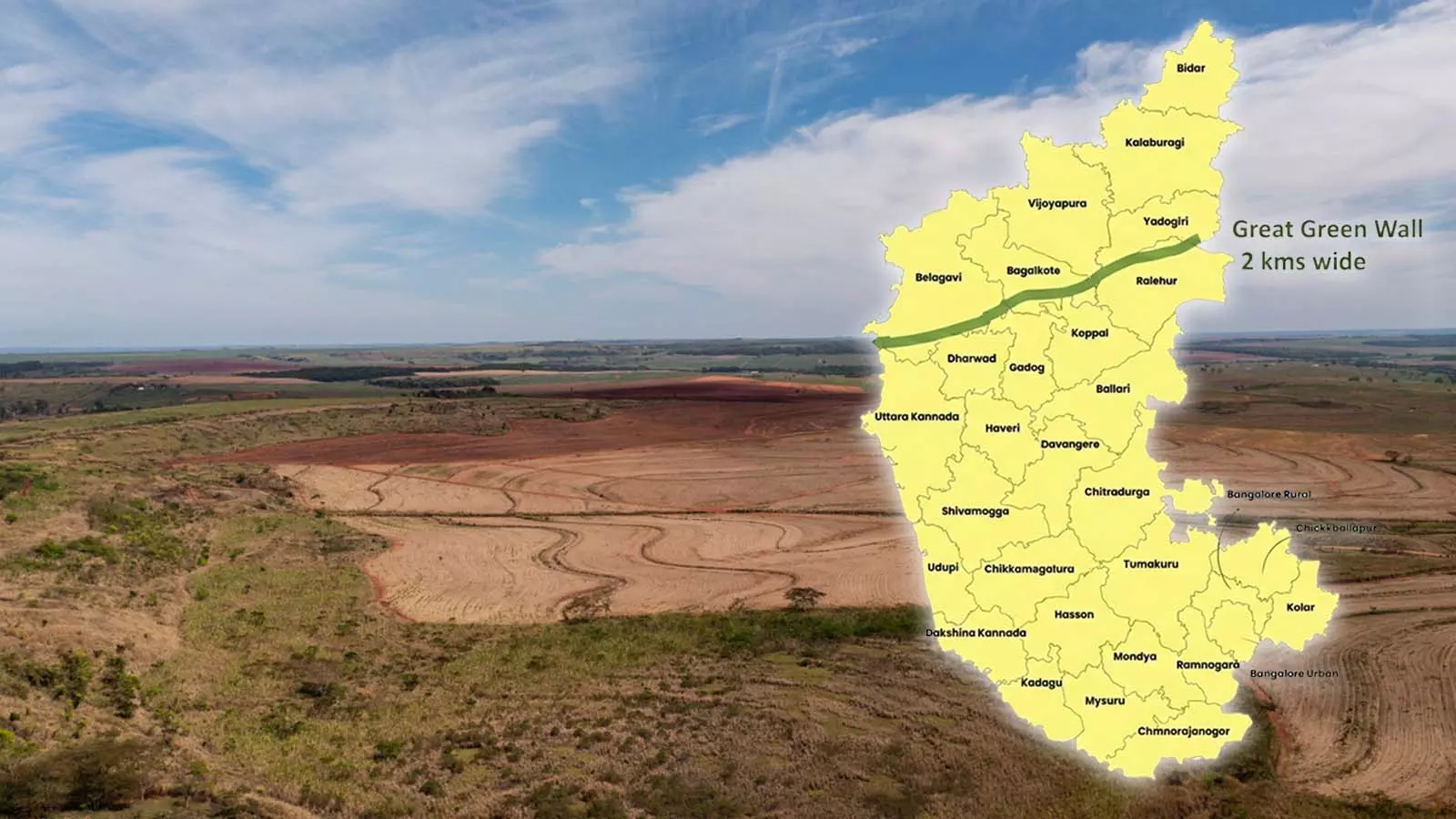
As scientists warn of imminent desertification, can a green wall shield North Karnataka?
State planning commission recommends three-km-wide forest shield to protect five vulnerable districts from becoming India’s next desert

For environmentalists, desertification is a dreadful term. And even more, if it happens over a large chunk of land in the world’s most populous country. Yes, if the current trend is not bucked, a vast area of North Karnataka could be home to a large desert in a matter of two decades, scientists have warned.
According to them, five major districts located in the northern part of the country’s sixth-largest state — Belgaum, Bagalkote, Vijayapura, Raichur and Yadgir — will remain vulnerable to desertification if urgent and adequate development doesn’t take place in those places. Relentless deforestation, mining activities, extraction of underground water and rising temperatures have endangered the zone, which now needs a timely intervention.
Building a green wall
While development could be a long-term procedure to reverse the situation on the ground, environmental scientists have a quick solution to offer, and it is building a green wall to rectify the desert-like landscape.
Desertification is a global problem today. From Africa to China, the problem is threatening, and to counter it, green walls are being erected. They are large-scale ecological engineering projects that are designed to prevent desertification, stabilise soil and resist wind-blown sand by increasing vegetation.
Also read: What Dharwad protests tell us about Karnataka’s huge hiring crisis
Authorities in Karnataka are also looking for a similar solution. What has left them worried is that the desert-like situation could also threaten the state’s southern parts, which house the economic engines, and that makes it even more urgent to build the green wall. The Karnataka State Policy and Planning Commission (KSPPC) has recommended that the government immediately start building the life-saving wall.
Green wall models in India and abroad
One of the major models of the green wall is the ‘Great Green Wall’ of Africa. Started in 2007 by the African Union and backed by the United Nations, the initiative seeks to restore the continent’s impaired landscapes and change millions of lives for the better. The project is being executed across 22 nations (with 11 core ones) and will reinvigorate several communities across Africa. The green belt that Africa is building is nearly 8,000 kilometres long and 15 kilometres wide.
The Great Green Wall of Africa to prevent the expansion of the Sahara Desert. (Photo: AI generated)
In India, green wall initiatives are not unprecedented. In the north, the Aravalli Green Wall Project runs from Porbandar in Gujarat to Panipat in Haryana, is aimed at arresting the eastward expansion of the Thar desert in Rajasthan. The project, going on for some years now, is seeing an estimated 64,000 hectares of greenery being cultivated in 29 districts in five states.
In Andhra Pradesh, too, authorities have taken an initiative to build a green wall, not to tackle desertification but threats to livelihood and property by sea-borne natural disasters such as cyclones.
Also read: Karnataka seeks to take on TN with revised Mekedatu dam plan
In China, a green wall measuring nearly 5,000 kilometres is being constructed to prevent the expansion of the Gobi and Taklamakan deserts. In some places, the width of the belt has gone on to reach almost 1,500 kilometres. The country is also building many other smaller green walls.
Taking a leaf out of those projects to ensure that Karnataka’s desertification is stopped, the KSPPC science committee has submitted a proposal to the state government to build a two-kilometre-wide green forest in those five vulnerable districts.
Nagesh Hegde, an eminent writer on science and environment who hails from North Karnataka, cited the global examples of green wall initiatives, saying a ‘think globally, act locally’ approach should be taken and executed in the region’s districts.
“If there are fewer trees and no moisture in the soil, the amount of sand and hot air will increase. Groundwater will decrease, and cold and heat waves will also increase. These are the characteristics that create deserts. Scientists observed this 20 years ago,” he said, warning that in the next 15-20 years, most parts of Karnataka will also display these and become desert-like.
'Conservation of nature is key'
But he is also worried about the conservation of the environment. Speaking to The Federal, Hegde said while green walls can help in preventing the expansion of desert-like situations, it is more important to create a favourable environment where such threats do not exist.
While suggesting how environment-friendly measures taken in the desert state of Rajasthan, like the Indira Gandhi Canal, the country’s longest, which turned arid desert into agricultural land, could be replicated in North Karnataka, Hegde said the desert-like situation is still expanding in the region despite using water of local rivers such as Krishna, Bhima and Tungabhadra.
How green wall will help?
Explaining how a green wall would help in mitigating the effects of desertification, Hegde said it will reduce the heatwave originating from Maharashtra and other parts of North India. “If we make a little greenery grow in the barren land, nature itself will take over the entire area and make it green,” he said.
Also read: Why a Karnataka farmer’s campaign for road access to his land has made him a local ‘Gandhian’ hero
“The ground will cool down. Rainwater will accumulate and evaporate. Then it will become a place for biodiversity. This can prevent sand particles. We should cooperate in greening as an alternative to the forests that we have destroyed in the past.
“Earlier, the land of Hampi Kannada University was barren. Now it is green because a wall was built around it. The shadow of drought is also covering Kolar. It is coming rapidly from the north to the south. The desert is already expanding in Uttar Pradesh and Chennai. Therefore, only if we identify clear boundaries and green it can prevent drought,” he said.
'Govt, organisations, individuals should join hands'
Stressing on an all-round effort towards building the green wall, Hegde said, besides the government, organisations, and even common people should also come forward to contribute so that the entire project becomes socially accountable and viable.
“The government, organisations and people should also participate in the construction of the green wall. If this is a government project, satellite images can be obtained from ISRO (Indian Space Research Organisation). Technical assistance can be sought from IISc (Indian Institute of Science). Organisations should provide financial assistance. However, the project should be initiated and directed by the government itself. An authority should be appointed for this. Then the assistance will flow in on its own,” he told this website.
On individuals owning responsibility, Hegde said, under the Great Green Wall in Africa project, there is a provision to give the same land to those who have cultivated greenery as part of the project. He said that although such a possibility is difficult in India, a similar plan can still be made. He said some well-off engineers are eager to buy barren land and cultivate greenery.
Also read: Unscientific capture, release of tigers: Expert Dr Ullas Karanth slams Karnataka govt
The environmentalist also lauded the forest department for coming up with plans to expand the green cover.
Hegde said one should not feel handicapped thinking about the financial aspects while handling such projects. He said international organisations such as the UN and the Asian Development Bank extend support. He also added that the farmers can be taken into confidence to take the work forward and urged against encouraging factors such as caste, religion and politics with it.
Hegde, however, regretted that while it is often said that development and environmental protection should go hand in hand, in reality, it is seen that only grand development projects come one after another, while the environmental aspect remains largely underemphasised.
“If the Karnataka government announces such a great wall, it will be India's first such ‘state-level’ project and become a new national landmark,” he told The Federal. He also said that the work on such green projects also increases the scope for employment, something that the African model has shown by eyeing the generation of a crore of green jobs.
Also read: Why Karnataka’s Lakkundi village has become the state’s latest history hotspot
Yellappa Reddy, another environmental expert, also expressed concern over the threat of desertification. The land is becoming barren due to mining, deforestation, floods, forest fires and other reasons, he told The Federal.
“Land is being exploited in many ways. The greenery is disappearing due to the use of pesticides on crops. Rivers are drying up. The temperature is rising daily in parts of North and South Karnataka, which are signs of turning into deserts,” he said.
Backing the proposal to build a green wall, he said governments should come together and implement the plan urgently. He asked, while governments come up with several plans in their annual budgets, do they care about something on protecting the land?
(The article was originally published in The Federal Karnataka.)