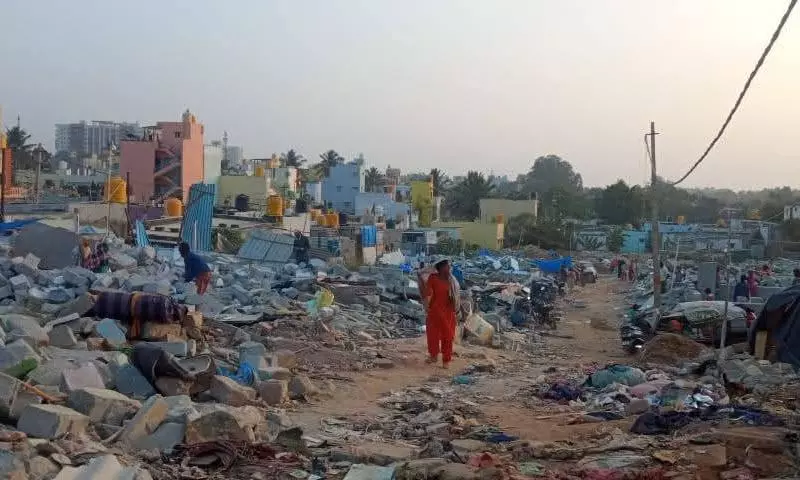
How Yelahanka slum razing snowballed into an inter-state political storm
As Karnataka defends administrative action and Kerala debates its fallout, Congress faces challenge of reconciling governance realities with political messaging

The demolition of slum settlements in Bengaluru’s Yelahanka area has spilled far beyond Karnataka, rapidly transforming into a charged political issue in Kerala and injecting fresh tension into an already polarised electoral landscape.
What the Karnataka government described as the removal of unauthorised constructions has been framed by Kerala’s ruling Left as an instance of “bulldozer justice”, triggering a sharp inter-state war of words and leaving the Congress on the defensive in Kerala.
The demolition drive targeted structures in Kogilu village, including areas popularly known as Fakir Colony and Waseem Layout, where families, many of them Muslims, had reportedly lived for years. Visuals of bulldozers tearing through rows of modest homes and residents scrambling to retrieve belongings circulated widely on social media and television channels, fuelling outrage well beyond Karnataka.
Pinarayi Vijayan’s strong reaction
Kerala Chief Minister Pinarayi Vijayan reacted with an unusually strong and emotive statement, casting the demolition as part of a wider ideological project rather than a routine administrative action.
Also read: Yelahanka eviction unavoidable, displaced families to be rehabilitated: Siddaramaiah
In a sharply worded response, Pinarayi said the bulldozing of Fakir Colony and Waseem Layout, where Muslim families had been living for years, was “extremely shocking and painful”. He alleged that what unfolded in Bengaluru was another version of the minority-targeting, aggressive politics associated with the Sangh Parivar in north India.
“When an entire community is forced onto the streets and compelled to flee in the biting cold, it is impossible to see this as mere administration,” Pinarayi said. He warned that the “north Indian model of bulldozer justice” was now advancing into southern India and said it was “astonishing” that in Karnataka, its execution was taking place under a Congress-led government.
Reaction from Karnataka
The Kerala chief minister further questioned how the Congress could justify mass evictions carried out through force, arguing that governments were duty-bound to ensure housing for the poor and prevent displacement rather than facilitate it.
Pinarayi’s intervention ensured the issue assumed political proportions in Kerala, where minority protection and secular governance are central to electoral discourse. The strong language from Thiruvananthapuram drew swift rebuttals from Karnataka’s top leadership.
Also read: Bengaluru demolitions: DKS asks Pinarayi not to interfere in Karnataka’s affairs
Deputy Chief Minister DK Shivakumar accused Pinarayi of interfering in Karnataka’s internal matters, asserting that the demolition was carried out strictly in accordance with the law. He maintained that the structures removed were unauthorised and located on encroached land, and that the administration could not selectively ignore court orders or statutory obligations.
Shivakumar argued that branding the action as “bulldozer justice” was misleading and politically motivated, and said comparisons with demolitions in BJP-ruled states were unwarranted.
Siddaramaiah’s justification
Chief Minister Siddaramaiah echoed that line, hitting out at Pinarayi for what he called an attempt to import “north Indian political narratives” into a Karnataka-specific administrative issue. He described the Kerala chief minister’s remarks as politically driven and insisted that the Congress government in Karnataka had a long-standing commitment to minority welfare and social justice.
Also read: Kerala CM slams demolition of Muslim homes in Bengaluru, calls it ‘bulldozer justice’
Siddaramaiah said the eviction was not punitive but legal, stressing that no government could permit unauthorised constructions indefinitely. However, he also sought to distance the Karnataka Congress from the BJP’s bulldozer symbolism, underlining that there was no celebratory or retaliatory intent behind the action.
Despite these clarifications, the optics of the demolition and the speed with which it was executed continued to draw criticism.
Congress damage control
As the controversy escalated, senior Congress leader and AICC general secretary K C Venugopal sought to contain the political fallout, particularly in Kerala, where the Congress-led United Democratic Front faces a tough contest against the ruling Left.
In a post on social media, Venugopal said: “Spoke to Karnataka Chief Minister and Deputy Chief Minister regarding the demolition of unauthorised constructions in Kogilu village, Bengaluru. Conveyed the AICC’s serious concern that such actions should have been undertaken with far greater caution, sensitivity, and compassion, keeping the human impact at the centre.
Also read: ‘Disturbed by visuals’: SC cites viral video of girl with books outside razed house
“They have assured that they will personally engage with the affected families, put in place an appropriate mechanism for addressing grievances, and ensure rehabilitation and relief for those impacted.”
A subtle admission
While the tweet emphasised rehabilitation and compassion, it also implicitly acknowledged that the manner of the demolition had caused discomfort within the party. In Kerala, however, critics pointed out that the intervention came after the damage, both humanitarian and political, had already been done.
The episode has placed the Congress in Kerala in a distinctly uncomfortable position. With the party ruling Karnataka and opposing the Left government in Kerala, it has been forced to respond to accusations of ideological inconsistency.
The Left Democratic Front seized on the issue to question the Congress’s credibility on minority protection, arguing that the party condemns bulldozer politics in opposition while presiding over similar actions when in power.
Minority apprehensions
Within minority communities in Kerala, apprehensions grew sharper. Community leaders and civil society groups expressed concern that the Yelahanka demolition blurred the distinction between Congress and BJP governance when it came to the treatment of vulnerable populations. Many questioned whether assurances of rehabilitation could compensate for the trauma of sudden displacement.
Also read: 'Shocks our conscience': SC slams UP govt over demolitions in Prayagraj
For minorities in Kerala, the controversy reinforced anxieties shaped by developments elsewhere in the country. The fear was not merely about one demolition, but about the normalisation of forceful evictions without prior rehabilitation.
Political observers note that while the Yelahanka issue alone may not determine electoral outcomes in Kerala, it feeds into broader narratives about trust, secularism, and governance models. In a state where margins can be narrow, such perceptions carry weight.
Left’s campaign rhetoric
The Left has already begun weaving the episode into its campaign rhetoric, portraying itself as the only consistent bulwark against both BJP majoritarianism and what it calls Congress ambivalence.
The Left views the controversy as a strategic opening to reclaim minority confidence, which it believes has gradually shifted towards the Congress and the UDF over the past few electoral cycles. Party leaders argue that the episode reinforces their claim of ideological consistency on minority protection and social justice, contrasting it with what they describe as the Congress’s wavering positions when in power elsewhere.
Also read: SC verdict should be turning point in hate campaigns against Muslims: Amnesty
The rapid politicisation of the Yelahanka demolition underscores how governance decisions in one state can reverberate across state borders, shaped by visual imagery, social media amplification, and national ideological battles.
As Karnataka defends its administrative action and Kerala debates its implications, the Congress faces the challenge of reconciling governance realities with political messaging. For now, the bulldozers that rolled through a Bengaluru settlement have left behind not just rubble, but a fresh fault line in Kerala’s already charged political terrain.