Sarat Uday row: Are politicians too thin-skinned for comedy? | AI With Sanket
Bengaluru incident raises questions about political outrage, the limits of satire, and the growing pressure on comedians in India's polarized environment

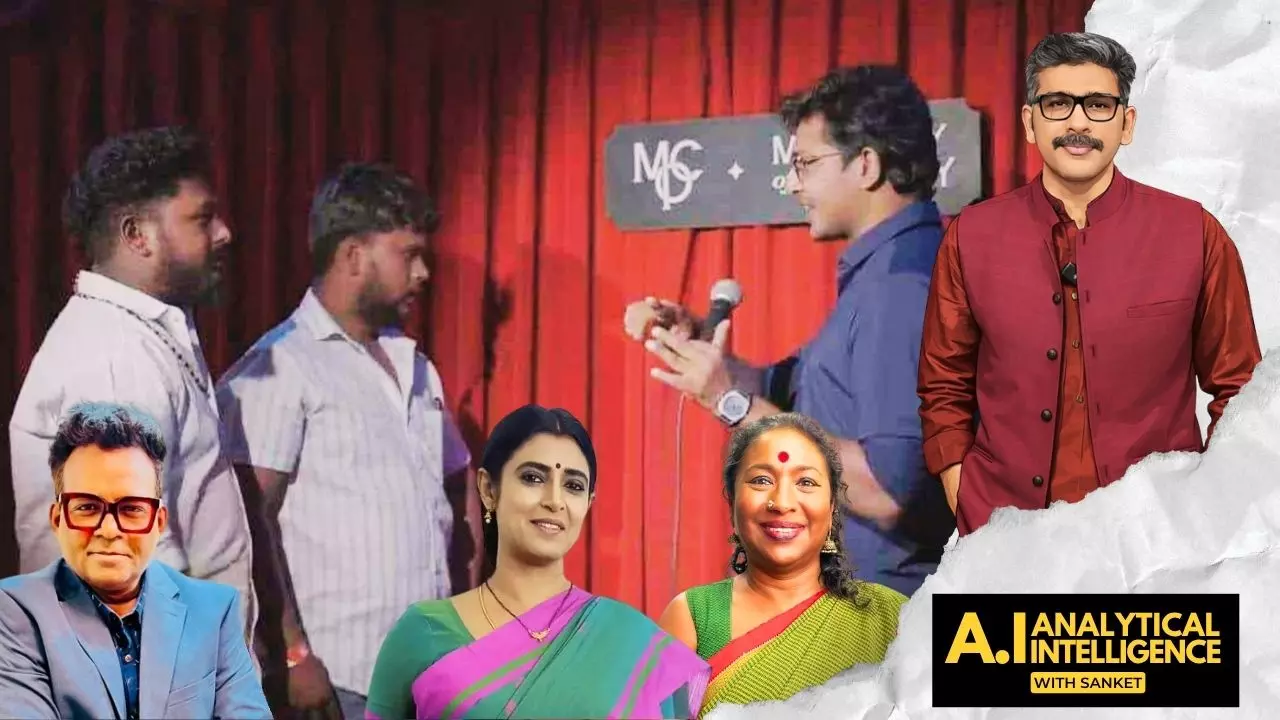
Is political satire in India facing increasing backlash? In a heated discussion anchored by Sanket Upadhyay for The Federal, activist Brinda Adige, actor-activist Kasturi Shankar, and trade analyst Girish Wankhede argued that “politicians are so thin-skinned that even a joke leads to intimidation, disruption, and threats to livelihoods”.
The conversation centred around an incident in Bengaluru where a stand-up comedy show allegedly turned chaotic after individuals linked to political affiliations objected to jokes made by comedian Sarat Uday.
Show disruption claims
A group allegedly associated with the Telugu Desam Party (TDP) disrupted the show over jokes made by the comedian on Chandrababu Naidu.
The panel noted how Uday had already apologised for earlier material in 2024, yet tensions resurfaced during the event, leading to demands that he publicly chant political slogans on stage.
Also Read: Iran mocks Trump with Lego-style video after White House dinner shooting
The panellists also recounted that the disruption escalated into collective pressure on the performer, ultimately forcing the show into disorder.
Political reactions
Actor-activist Kasturi Shankar said the incident reflected a “culture of outrage” where comedy is increasingly policed by political sensitivities rather than accepted as satire.
She argued that India once had a strong tradition of political humour through cartoonists and comedians like Jaspal Bhatti, but that space is shrinking due to rising intolerance.
Shankar added that while some jokes may offend, reacting with intimidation or collective pressure crosses into “hooliganism,” undermining artistic freedom.
Satire under pressure
The discussion repeatedly returned to the idea that satire is under growing pressure across India, with examples cited from multiple incidents involving comedians.
The panel referenced past controversies involving performers such as Kunal Kamra and Samay Raina, as well as cases involving public backlash against stand-up comedy shows in different cities.
Also Read: 'TN 2026' teaser sparks row over Vijay parody; 'DMK-BJP ploy', says Aadhav Arjuna
Kasturi Shankar stressed that in global democracies, political satire is widely accepted, pointing to shows like Saturday Night Live in the United States as examples of unrestricted political humour.
Accountability debate
A key part of the debate focused on whether political leaders should be held responsible when supporters allegedly act in their name.
Some panellists argued that leaders like Andhra Pradesh Chief Minister Chandrababu Naidu and his son Nara Lokesh should publicly condemn such disruptions if they occur in their party’s name.
Others countered that it is difficult to attribute responsibility without verified identification of individuals involved, especially when incidents occur outside the state’s jurisdiction.
Mob or messaging?
Activist Brinda Adige strongly criticised what she called a “mob narrative,” arguing that buying a ticket to a comedy show implies acceptance of differing opinions, even if one disagrees.
She said demanding apologies or slogans during a performance distorts the nature of entertainment and undermines freedom of expression.
Also read: Kunal Kamra refuses to apologise for ‘traitor’ remark on Eknath Shinde
Adige further argued that selective outrage reflects a deeper issue of entitlement, where some believe their sentiments override others’ rights.
Freedom at risk
Trade analyst Girish Wangade said the incident reflected a broader pattern where creative professionals face increasing pressure from politically motivated groups.
He warned that repeated disruptions and lack of accountability could create a chilling effect on comedians, filmmakers, and satirists.
Wangade also pointed to similar incidents in Mumbai’s comedy circuit, arguing that intolerance is not region-specific but part of a wider national trend.
Satire and politics
The panel debated whether Indian political culture itself contributes to the problem, noting that politicians often use harsh or derogatory language in speeches while criticising comedians for similar expressions.
Also read: Commercial vs free speech: 5 key points made by SC in comedians’ case
Wangade argued that this contradiction creates an imbalance where political speech is unrestricted, but artistic expression is increasingly scrutinised.
He said comedians today are often more restrained than politicians themselves, despite being accused of crossing boundaries.
Call for change
Towards the end of the discussion, Brinda Adige called for citizens to demand accountability from elected representatives, stressing that they are not “feudal lords” but public servants.
She said leaders must ensure that supporters do not engage in intimidation or harassment in response to satire or criticism.
The panel collectively agreed that while offensive content may be debated, resorting to disruption or threats represents a deeper democratic concern.
(The content above has been transcribed from video using a fine-tuned AI model. To ensure accuracy, quality, and editorial integrity, we employ a Human-In-The-Loop (HITL) process. While AI assists in creating the initial draft, our experienced editorial team carefully reviews, edits, and refines the content before publication. At The Federal, we combine the efficiency of AI with the expertise of human editors to deliver reliable and insightful journalism.)