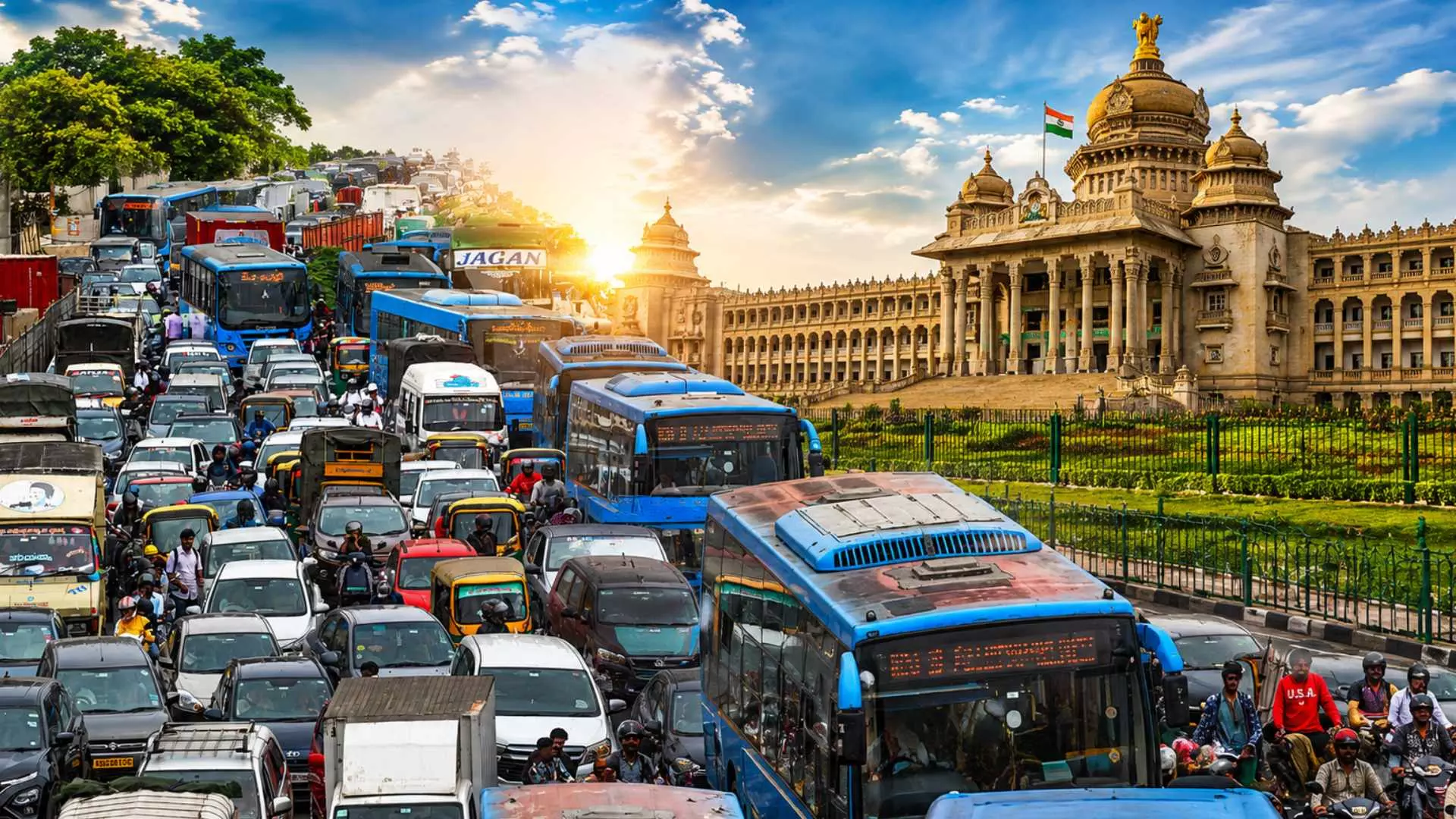
Home to over 1.3 crore people and nearly one crore registered vehicles of all categories, Bengaluru continues to rank among the world's most congested cities
Bengaluru's traffic nightmare isn't just about cars. Here's why
The data suggests Bengaluru's gridlock is as much about transport infrastructure as it is about rising car ownership

Bengaluru has become the first Indian city to cross 25 lakh registered private cars, overtaking both Delhi and Mumbai. The milestone has once again drawn attention to the city's worsening congestion. But while the rising number of cars is striking, it raises a larger question: Are vehicle numbers alone responsible for Bengaluru's traffic woes, or is the city's public transport system struggling to keep pace with its rapid growth?
Home to over 1.3 crore people and nearly one crore registered vehicles of all categories, Bengaluru continues to rank among the world's most congested cities.
Also read: Bengaluru traffic worsens, 2nd most-congested city in world; here are top 10
A comparison with Delhi and Mumbai suggests that the real difference lies not just in the number of private vehicles but in the scale, capacity, and reach of public transport.
Private car ownership
Bengaluru now has 25 lakh registered private cars, ahead of Delhi's 22 lakh and Mumbai's 15 lakh.
The city also witnessed one of its biggest monthly jumps in vehicle registrations, with over 78,000 new private vehicles added in June, following recent tax reductions on new vehicles.
While the figures point to growing dependence on private transport, they tell only part of the story.
Rail connectivity
The biggest gap becomes evident when comparing rail-based public transport.
Mumbai's century-old suburban railway network carries around 93 lakh passenger journeys every day, making it one of the busiest commuter rail systems in the world.
Delhi Metro records approximately 64.6 lakh daily passenger journeys, accounting for more than half of India's total metro ridership.
Also read: Bengaluru's big plan to ease traffic: 35 flyovers, 25 underpasses, 101 skywalks
In comparison, Bengaluru's Namma Metro, despite the recent Yellow Line extension to Electronic City, records around 9.1 lakh daily passengers, barely one-tenth of Mumbai's suburban rail ridership.
The numbers underline how Bengaluru's rail infrastructure is still playing catch-up with the city's expanding population and employment hubs.
Buses carry the burden
While Bengaluru lags in rail connectivity, its bus network tells a different story.
The Bengaluru Metropolitan Transport Corporation (BMTC) carries nearly 48 lakh passengers every day, outperforming the Delhi Transport Corporation's 42 lakh daily riders. Mumbai's bus network records around 30-35 lakh daily passengers.
BMTC operates approximately 6,500 buses, compared with about 7,000 buses in Delhi and 2,700-3,300 buses in Mumbai.
This means every BMTC bus carries significantly more passengers on average than buses in the other two metros. While this reflects strong public transport usage, it also indicates that the city's bus network is operating under heavy pressure, with overcrowding becoming a routine experience.
Why do Bengalureans still prefer private vehicles?
Despite expanding Metro lines and one of India's busiest city bus networks, many residents continue to rely on private vehicles.
One of the biggest reasons is poor last-mile connectivity. For commuters travelling to employment hubs such as Outer Ring Road and Whitefield, public transport often involves multiple transfers between buses, Metro services and autorickshaws. Driving frequently remains the quicker and more convenient option.
Also read: Bengaluru flyover plan sparks uproar over greenery loss and opacity
Metro coverage is another limitation. Although Namma Metro serves the corridors it covers efficiently, several major residential neighbourhoods and commercial districts still remain outside the network.
The bus system, despite carrying nearly 48 lakh passengers daily, is stretched. Around 6,500 buses serve a population exceeding 1.3 crore, resulting in overcrowded buses and longer waiting times during peak hours.
Walkability also remains a challenge. Broken or missing footpaths, inadequate pedestrian infrastructure and Bengaluru's frequent rainfall make walking to bus stops and Metro stations inconvenient for many commuters.
The bigger challenge
The comparison reveals a key difference in how India's three largest metropolitan regions evolved.
Delhi and Mumbai built extensive public transport networks before private vehicle ownership exploded.
Bengaluru, by contrast, is trying to expand its transport infrastructure after more than 25 lakh private cars have already become part of everyday commuting.
The city's challenge, therefore, is not simply reducing the number of cars on its roads. It is ensuring that Metro services, buses, suburban rail and pedestrian infrastructure grow quickly enough to provide a reliable and convenient alternative to driving. Until then, Bengaluru's rising car numbers may be less a cause of congestion than a symptom of a public transport network still struggling to catch up.