



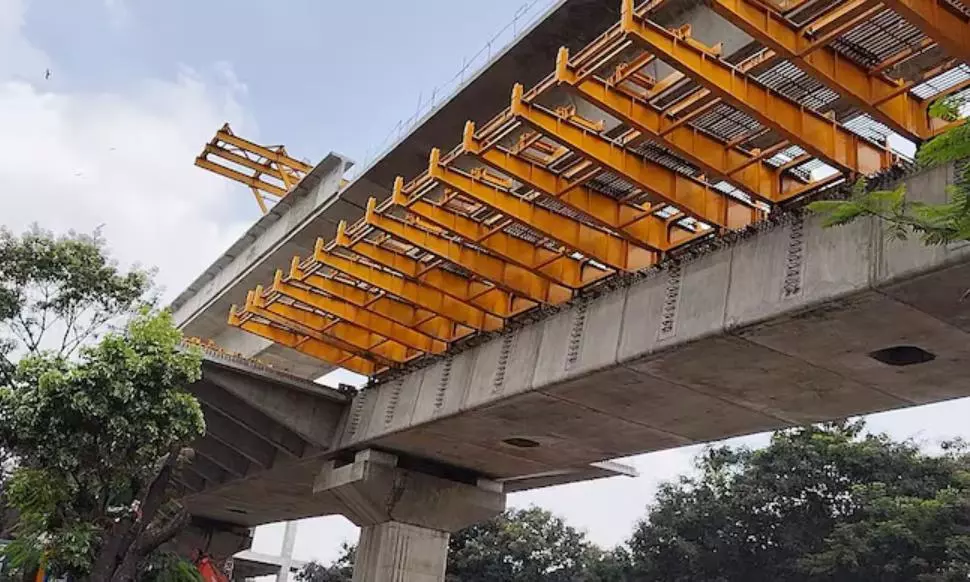
Bengaluru's Silk Board double-decker flyover opens fully
South India’s first road-cum-rail structure with five flyovers now runs along Outer Ring Road and Silk Board, easing congestion in a busy corridor

The double-decker flyover at Silk Board Junction in Bengaluru is now fully operational, offering much-needed relief to commuters. The project, developed by Bangalore Metro Rail Corporation Limited (BMRCL) and constructed by Afcons Infrastructure Ltd, marks a significant milestone in the city’s urban transport network.
South India’s first road-cum-rail structure comprises five flyovers. With flyovers D and E now opened to traffic, the Silk Board flyover network is fully functional, running along the Outer Ring Road and the Central Silk Board junction, easing congestion in one of the city’s busiest corridors.
Five-level structure
“Building a five-level structure amid Bengaluru's second busiest junctions required precision, perseverance and innovation,” said Krishnamurthy Subramanian, Executive Chairman of Afcons Infrastructure Ltd.
Also read: Bengaluru to undergo tunnel road bypass ‘surgery’, prognosis is scary
The flyover, which integrates both metro and road traffic, runs between Ragigudda and Silk Board, serving as a vital link for commuters travelling from the southern parts of the city. It connects with the Namma Metro Yellow Line on the upper deck, while vehicular traffic flows on the lower level.
As part of the Namma Metro Blue Line, Afcons constructed a 9.8-km elevated stretch of the Silk Board–KR Puram corridor, aimed at easing congestion at the Central Silk Board junction.
‘Project completed despite challenges’
D. Murugadasan, Executive Vice-President (Divisional Head) at Afcons, said that due to heavy traffic and limited working space, construction had to be carried out in phases. Work was restricted to a five-hour window each day, between midnight and 5 am.
Also read: Bengaluru's big plan to ease traffic: 35 flyovers, 25 underpasses, 101 skywalks
“All five flyovers are now operational and commuters can save at least 30 minutes of travel time. Of the five, Flyover D is the tallest at 28 metres, positioned at the fifth level, crossing the existing Hosur flyover, the Yellow Line metro, and the double-decker structure,” he said.
Despite constraints such as heavy traffic, limited space due to an existing Rajakaluve, three operational flyovers, and the under-construction Central Silk Board metro station, the project was completed with precision, said Ambareesh.
Flyover at busiest junction
The Central Silk Board junction is the city’s second-most congested traffic point after Hebbal Junction. The construction of flyovers A, B, C, D, and E, spanning a total of 3.2 km, is expected to ease traffic flow in the area significantly.
Three flyovers—A, B, and C—were opened in mid-2024, improving connectivity from Ragigudda and BTM Layout towards HSR Layout and Electronic City by allowing vehicles to bypass the Silk Board signal.
Also read: Bengaluru traffic worsens, 2nd most-congested city in world; here are top 10
With the addition of flyovers D and E, commuters travelling from HSR Layout to BTM can now completely avoid the junction. The signal will primarily serve traffic between HSR–Madivala and Electronic City–HSR, significantly reducing congestion.
The flyover system includes: Flyover A (Ragigudda Metro Station to Hosur Road), Flyover B (BTM Layout to Hosur Road and HSR Layout via Flyover A), Flyover C (branch from Flyover A towards HSR Layout), and Flyovers D and E, which connect HSR Layout to Ragigudda, along with a down ramp towards BTM Layout.