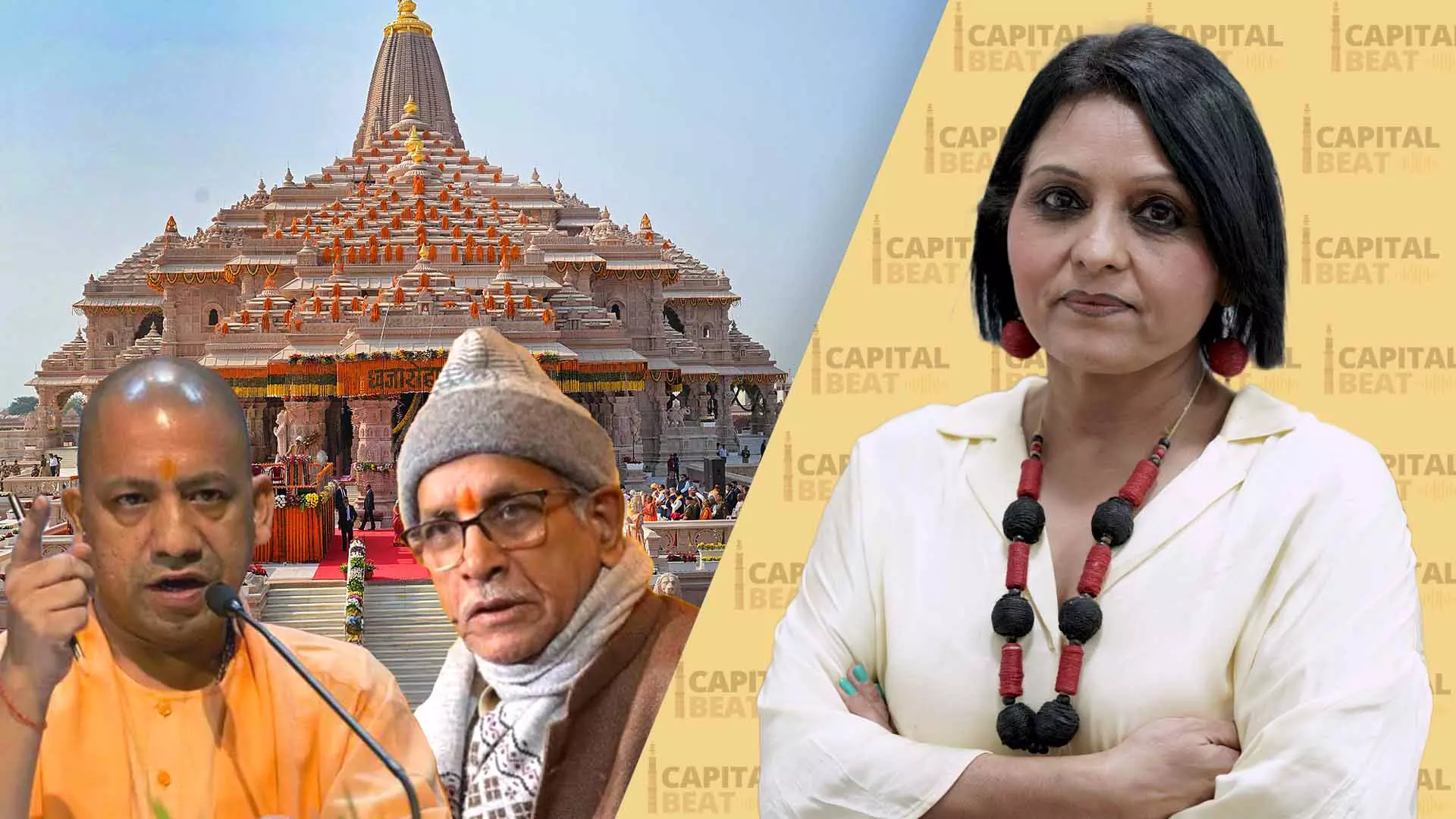
The resignation of Champat Rai is viewed as an attempt at damage control rather than a resolution of the controversy.
Ram Mandir row: Why Champat Rai’s exit may trigger a big political battle
As donation controversy deepens, Champat Rai’s resignation sparks debate over damage control, political strategy and wider implications for BJP, RSS and UP govt

The Federal spoke to Anand Vardhan Singh, author, veteran journalist and Editor-in-Chief of Public India; Sharad Pradhan, author and senior journalist; Shahira Naim, senior journalist and political commentator; and Vivek Deshpande, senior journalist and political commentator, on what Champat Rai's exit could mean for the investigation, the BJP-RSS relationship and Uttar Pradesh politics ahead of the Assembly election in 2027.
Damage control
Opening the discussion, Anand Vardhan Singh argued that the resignation should primarily be viewed as an attempt at damage control rather than a resolution of the controversy.
Also read: Shri Ram Janmabhoomi Trust chief reigns amid donations embezzlement probe
According to him, the controversy has already caused reputational damage because senior functionaries associated with the Trust have long been linked with the RSS. He said Champat Rai occupied one of the most influential positions within the Trust, while Anil Mishra was among the key figures overseeing its functioning.
Singh also suggested that the resignations reflected political compulsions. In his view, the episode marked the first time the Narendra Modi-led establishment had effectively acknowledged wrongdoing within an institution closely associated with it, although he noted that no personal allegations had been made against Champat Rai in the FIR.
Delhi vs Lucknow
Singh further argued that the developments should also be viewed through the prism of internal political dynamics between the Uttar Pradesh government and the Centre.
He said the Special Investigation Team's report was routed through senior officials before being forwarded to the Prime Minister's Office, suggesting that political responsibility had effectively shifted to New Delhi. According to him, Uttar Pradesh Chief Minister Yogi Adityanath had strategically positioned himself by ensuring that the report reached the Centre.
Also read: How Ayodhya Ram temple donation row put faith and transparency to test
Singh also speculated that further legal action against senior Trust functionaries could not be ruled out if investigators deemed it necessary.
Political balancing
Sharad Pradhan described the resignations as politically beneficial for both New Delhi and Lucknow, albeit for different reasons.
According to him, the central leadership could project the resignations as proof that it acted impartially against those facing scrutiny, while the Uttar Pradesh government could claim that its actions forced accountability within the Trust.
However, Pradhan argued that resignations alone were insufficient. He maintained that the controversy warranted a deeper criminal investigation into alleged financial irregularities and questioned whether senior figures associated with the Trust had adequately explained their roles.
Also read: Temple towns, land ‘scams’: Are BJP govts fostering corruption in name of religion?
He also expressed disappointment over the response of former bureaucrat Nripendra Mishra, saying his initial remarks distancing himself from the Trust's financial affairs raised further questions about accountability.
Investigation concerns
Pradhan questioned whether the Special Investigation Team had been constituted primarily to identify those responsible or simply to limit political damage.
He argued that allegations involving financial irregularities and disproportionate assets required more extensive investigation and suggested that agencies dealing with financial crimes could eventually have a role if evidence warranted such action.
According to Pradhan, limiting action to a few arrests without examining the wider allegations would leave important questions unanswered.
Bigger political risk
Shahira Naim argued that the resignations represented only the minimum response to a controversy of this scale.
She pointed out that resigning from a position was not equivalent to facing criminal proceedings, observing that no FIR had been registered against the two senior Trust functionaries and that no arrests had been made.
Also read: Nripendra Mishra's shifting defences on Ram temple row: Genuine or managed?
Naim maintained that the real significance of the controversy lay not merely in the resignations but in the political consequences that could follow. She argued that because the Ram Temple movement had played a central role in the BJP's political rise, any controversy surrounding the Trust carried potentially significant political implications.
According to her, public discussion surrounding the issue had already intensified, making it difficult to treat the matter as closed.
BJP-RSS equation
Vivek Deshpande focused on the relationship between the BJP and the RSS, describing it as one of mutual dependence despite internal differences.
He argued that both organisations would initially attempt to protect senior figures associated with the Trust while simultaneously trying to reassure their core supporters that accountability was being maintained.
However, he suggested that if public opinion continued to turn against them, political considerations could eventually outweigh personal loyalties.
Deshpande argued that the controversy was especially sensitive because the Ram Temple has remained central to the BJP's political narrative for decades. Any perception that donations made by devotees had been misused, he said, would create discomfort even among committed supporters.
Electoral implications
The panel repeatedly returned to the possible electoral consequences of the controversy.
Also read: Ayodhya Ram temple multi-crore donation scam: What we know so far
Deshpande observed that the BJP had already suffered a setback in Ayodhya during the 2024 Lok Sabha elections and argued that a prolonged controversy surrounding the Trust could further complicate the party's political prospects in Uttar Pradesh.
Naim agreed that the political ramifications remained difficult to predict because the full extent of the controversy was still emerging.
Pradhan similarly argued that the central leadership likely recognised the potential electoral cost of allowing the controversy to continue without visible action, making the resignations politically necessary.
Questions remain
In the concluding phase of the discussion, the panellists agreed that Champat Rai's resignation alone was unlikely to bring closure to the controversy.
Several participants argued that the investigation would ultimately determine whether responsibility extended beyond those already arrested and whether further action would follow.
The panel also discussed fresh evidence reportedly submitted regarding alleged land transactions connected with the broader controversy, suggesting that the political and legal dimensions of the case could continue to evolve.
The discussion concluded with the observation that the controversy has entered a new phase, with both its political impact and the outcome of the investigation likely to remain under scrutiny in the weeks ahead.The content above has been transcribed from video using a fine-tuned AI model. To ensure accuracy, quality, and editorial integrity, we employ a Human-In-The-Loop (HITL) process. While AI assists in creating the initial draft, our experienced editorial team carefully reviews, edits, and refines the content before publication. At The Federal, we combine the efficiency of AI with the expertise of human editors to deliver reliable and insightful journalism.