In 2027, can Mayawati revive BSP’s 2007 formula in Uttar Pradesh?
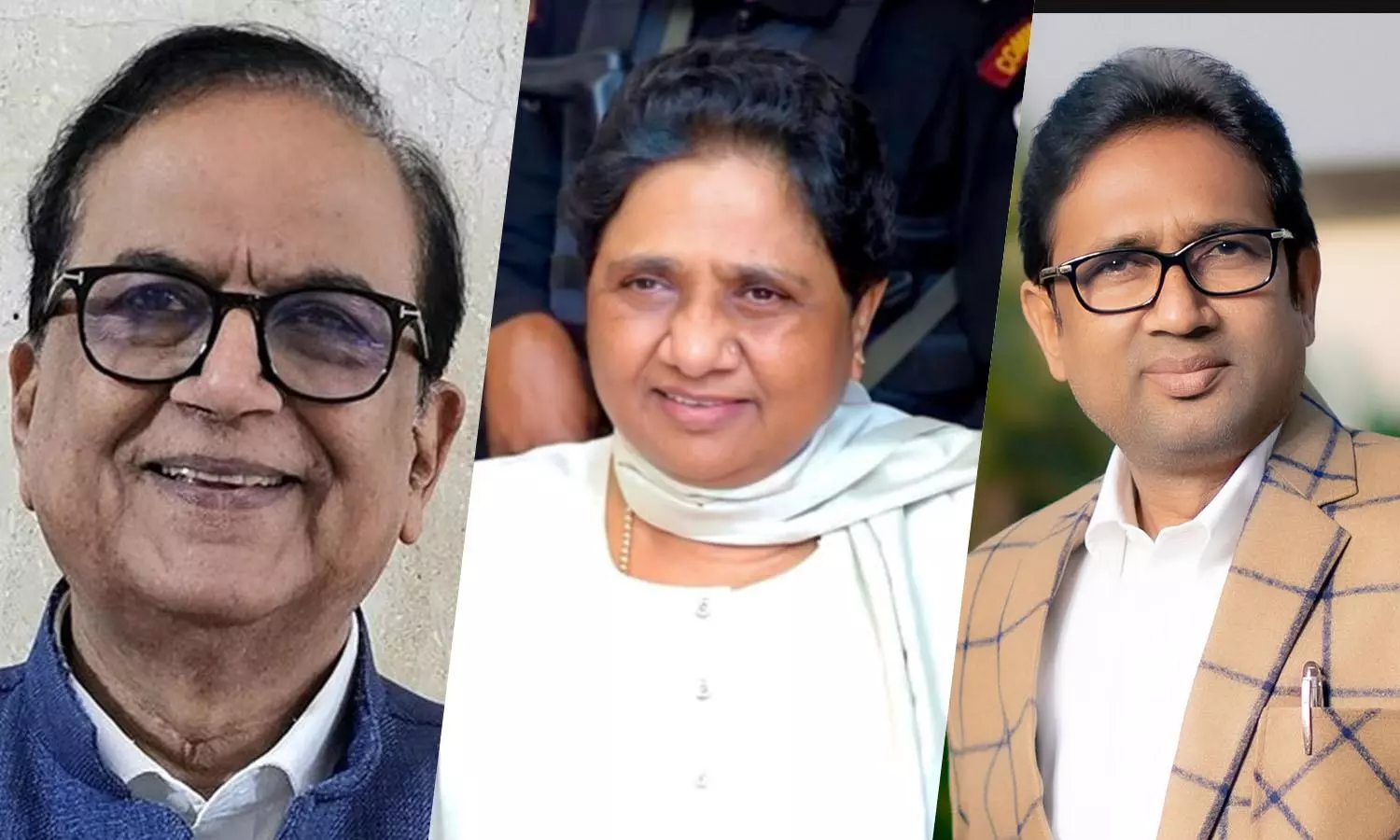
By banking on Satish Chandra Mishra and Umashankar Singh, Mayawati aims to revive a Dalit-Brahmin-Thakur coalition to challenge BJP and SP in Assembly election

Uttar Pradesh, one of India’s politically most decisive states, is set to vote in a new Assembly next year. Although the election is still nearly a year away, political parties have already begun sharpening their strategies.
While the Akhilesh Yadav-led Samajwadi Party (SP) continues to attack the Yogi Adityanath government, which has had two successive runs, the Mayawati-led Bahujan Samaj Party (BSP) is attempting a comeback. And, this is no easy task.
Since 2012, the BSP’s electoral graph in the state has steadily declined. The 2019 Lok Sabha election was a rare exception, as the BSP's alliance with the SP bagged 10 seats, briefly reviving the former's relevance at the national level.
Steep decline
After 2019, however, the slide has been sharp. Today, the BSP has no representation in the Lok Sabha and just one MLA — Umashankar Singh — in the Uttar Pradesh Assembly. On the face of it, expectations from the party in the 2027 Assembly election remain modest.
Also read: Why Nitin Nabin’s leadership will be tested in Uttar Pradesh
Yet politics often defies straight-line projections. What seems improbable can suddenly become possible. Well aware of this, the BSP has begun tightening its organisational structure and handed key responsibilities to Mayawati’s nephew Akash Anand, senior leader Satish Chandra Mishra and the lone MLA Umashankar Singh.
Reading the signal
The decision to foreground Satish Chandra Mishra and Umashankar Singh is politically loaded. Satish Chandra Mishra, a lawyer by training, is widely regarded as the chief architect of the BSP’s sarvajan (inclusive) experiment.
Between 1984 and 2007, the party had largely pursued bahujan politics, focusing on Dalit assertion. While this helped Mayawati emerge as a powerful leader and become chief minister, the BSP could not form a government on its own before 2007. That changed when the party consciously broadened its appeal beyond its core base.
Also read: Budget 2026 showers Uttar Pradesh with a bagful of goodies
In 2007, the BSP shifted from bahujan to sarvajan, and the gamble paid off. The party secured a clear majority and formed the government independently for the first time. Much of the credit went to Satish Chandra Mishra.
Mishra spearheaded a series of Brahmin-Dalit brotherhood conferences, which significantly expanded the BSP’s social base. The consolidation of around 21 per cent Dalit voters with nearly 10 per cent Brahmins created a formidable 31 per cent core vote bank. The result was a decisive victory that allowed the BSP to dominate Uttar Pradesh politics.
Context matters
In recent years, the Yogi Adityanath government has often been labelled as anti-Brahmin. The BSP believes this perception offers an opportunity. Critics, however, question Mishra’s political clout, asking why the party failed the elections in 2012, 2014, 2017, 2019, 2022 and 2024 if he was such a decisive strategist.
Also read: UP political battle intensifies over 4 crore 'missing' voters
Political analysts counter this by pointing out that electoral outcomes are shaped not just by arithmetic but also by chemistry. In 2007, public resentment against the Mulayam Singh Yadav government, favourable social equations and a weakened BJP all worked in the BSP’s favour.
The present political climate is different but not without possibilities. The SP faces its own organisational and narrative challenges, while signs of anti-incumbency against the BJP are visible in parts of the state. Mayawati appears to believe that elements of the 2007 formula can be revived under these conditions, with Mishra once again playing a key role.
The Umashankar factor
Alongside Mishra, Umashankar Singh has emerged as an important face. Hailing from eastern Uttar Pradesh, Singh represents Rasra in Ballia and belongs to the Thakur community. Notably, he retained his seat at a time when the BSP failed to get any other MLA elected.
Also read: BSP to contest 2027 UP polls alone, form majority govt: Mayawati
While observers note that Singh is not a dominant Thakur leader state-wide, his elevation may be symbolic. It signals the BSP’s intent to reach out to Thakurs and reinforce its commitment to sarvajan politics.
By the numbers, Dalits constitute about 21 per cent of Uttar Pradesh’s population, Brahmins around 10 per cent and Thakurs close to 7 per cent, together forming nearly 38 per cent. If the BSP manages to consolidate even a large part of this social coalition, it could also influence Muslim voters, who often engage in tactical voting, to rally against the BJP.
Also read: Praising BJP, attacking SP: What’s Mayawati’s game plan?
Whether this strategy can translate into electoral success remains uncertain. But the BSP’s renewed emphasis on social engineering suggests Mayawati is once again willing to bet on the formula that once reshaped Uttar Pradesh politics.
This article was originally published in The Federal Desh.