



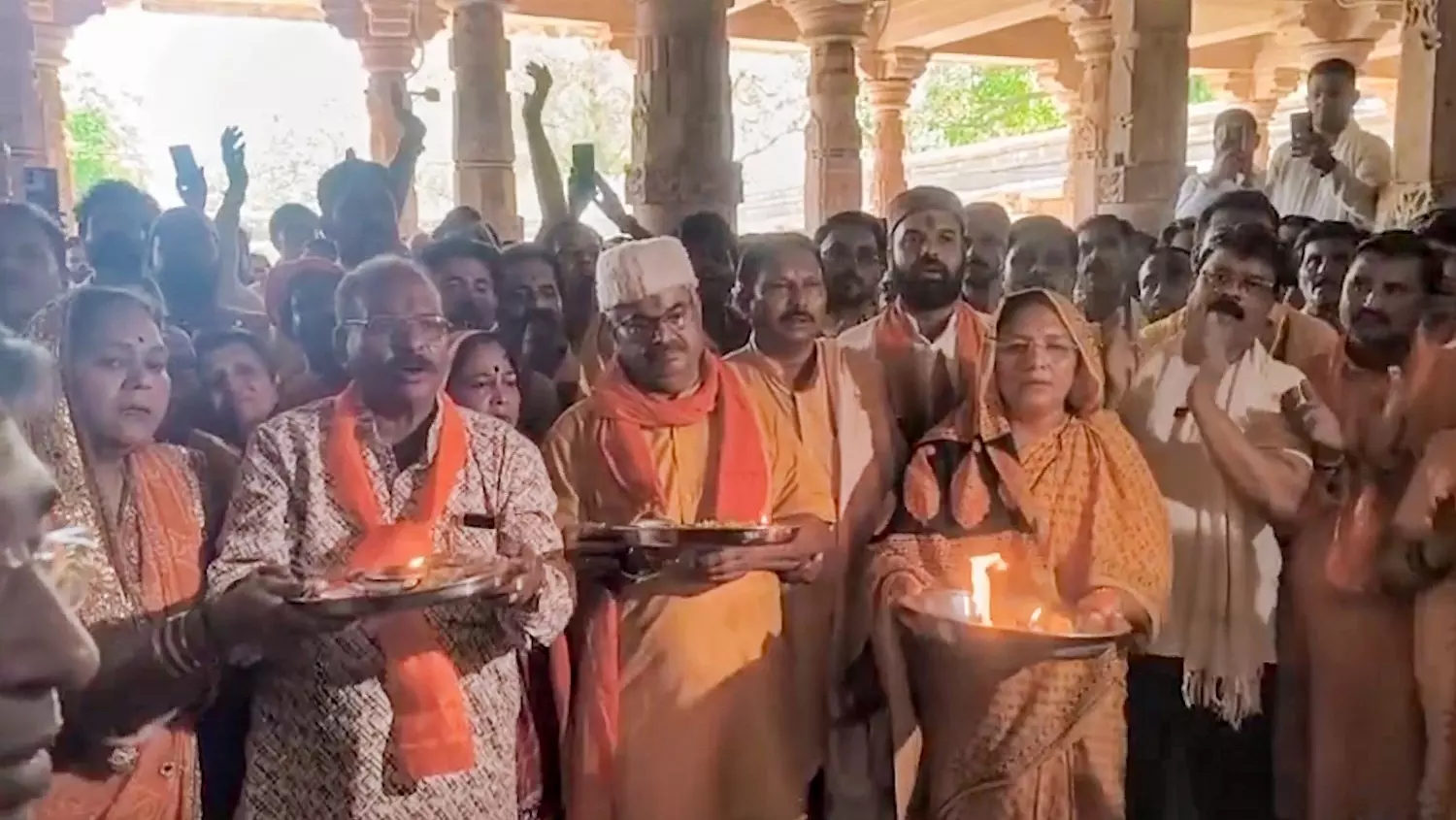
Hindu groups take Saraswati idol into Bhojshala complex, conduct prayers
After decades of Hindu-Muslim legal row, Madhya Pradesh High Court last week ruled the site hosts a Hindu temple, basing its decision on archaeological evidence

A formal worship ceremony was conducted on Sunday (May 17) at the Bhojshala complex in Madhya Pradesh's Dhar district, marking the first-ever installation of Goddess Saraswati in the complex. This came after a ruling from the Madhya Pradesh High Court on May 15, saying the archaelogical evidence indicates the existence of a Hindu temple on the disputed site.
Outside the premises, posters were put up by some Hindu organisations calling for a ban on entry into the complex for non-Hindus. These organisation had been holding prayers at the premises since 2003.
“Entry for non-Hindus is prohibited at the Bhojshala due to security purposes. Only those who arrive wearing a tilak and draped in a saffron scarf will be granted entry,” said Gopal Sharma, a member of the Bhojshala Utsav Samity, as quoted by media sources. Led by Union minister Savitri Thakur, a saffron flag was also hoisted on Sunday in accordance with newly implemented guidelines.
Based on findings presented by the Archaeological Survey of India (ASI), the High Court held last week that the contested complex is a temple dedicated to Goddess Saraswati, and that the Centre and the ASI are authorised to determine its administration and management.
Bhojshala’s conflict-filled history
The Bhojshala complex is believed to have been constructed during the time of the 11th-century king Raja Bhoja of the Paramara Dynasty. Hindus consider it a temple devoted to Goddess Saraswati and where Sanskrit was taught, before it was invaded by Alauddin Khilji. The complex became a centre of religious controversy as Hindus, over time, increasingly demanded rights for Saraswati worship, while the Muslims also sought their rights for Friday prayer uninterrupted.
Also Read: HC says Bhojshala complex is Hindu temple; what's the row all about?
The year 2003 marked a major turning point when more than a lakh Hindu devotees assembled at the Bhojshala site seeking unrestricted worship rights. However, as protesters tried to advance towards the complex in February 2003, the police opened fire, resulting in several deaths and arrests.
After the 2003 incident, the ASI brought in an arrangement that governed Bhojshala for many years. The Hindus could worship on Tuesdays and the Muslims on Fridays, between 1 pm and 3 pm. However, every time Basant Panchami clashed with Friday prayers, tensions prevailed. This arrangement was quashed by the High Court ruling.
Rebuilding and unrestricted access
Chief Minister Mohan Yadav said the BJP government in the state was committed to restoring Bhojshala to its “former glory”. “It will be developed to enable devotees from across the state and nation to seek the blessings of Goddess Vagdevi,” he said. Meanwhile, former CM Digvijaya Singh reacted to the court’s order, saying, “The High Court’s order was ambiguous. The monument is protected under the ASI and there is legally no provision for conducting worship.”
Also Read: Bhojshala verdict: How a narrow 1958 law was opened for a temple claim
Following the court order, the ASI released an order on Saturday, stating, “The high court quashed restrictions previously imposed by the director general of ASI that limited Hindu worship rights within the complex while permitting Muslim prayers. The Hindu community shall have unrestricted access to the Bhojshala Complex.”