



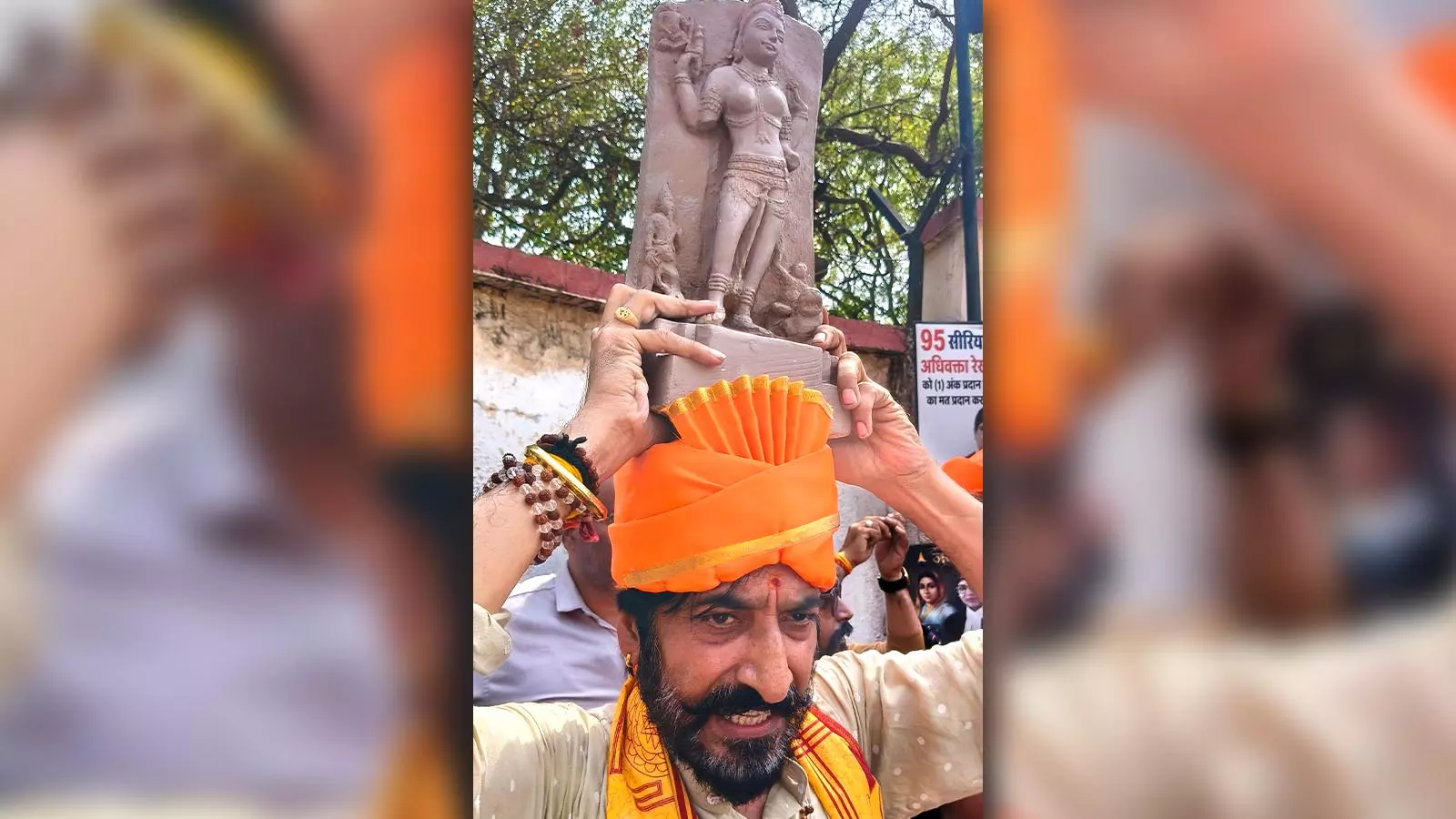
A member of a Hindu organisation carries an idol of a deity in Indore after the Madhya Pradesh High Court declared that the disputed Bhojshala complex in Dhar is a temple dedicated to Goddess Saraswati. Photo: PTI
HC says Bhojshala complex is Hindu temple; what's the row all about?
What’s the history of Bhojshala complex? What's the archaeological evidence on the disputed site? Did ASI try to intervene and resolve the issue? Let's find out

The Madhya Pradesh High Court on Friday (May 15) ruled that the contested Bhojshala complex in the state’s Dhar district is a temple dedicated to Goddess Saraswati. It also said the Centre and the Archaeological Survey of India (ASI) are authorised to determine its administration and management.
The Indore bench of the High Court, which was reviewing the case, also stated that the Muslim community, which refers to the 11th-century structure as the Kamal Maula Mosque, may seek the state government's assistance for the allocation of a separate parcel of land in the district for the purpose of building a mosque.
Also read: Supreme Court allows Hindu and Muslim prayers at Bhojshala complex
The court also scrapped a 2003 order by the Archaeological Survey of India, which allowed Muslims to offer Friday prayers on Bhojshala premises. What's the issue all about? Why did the 11th century structure trigger a legal row? Here are the details.
What’s the history of the Bhojshala complex?
The Bhojshala complex is believed to have been constructed during the time of the 11th-century king Raja Bhoja of the Paramara Dynasty. Hindus consider it a temple devoted to Goddess Saraswati and where Sanskrit was taught. In its verdict on Thursday, too, the High Court observed there were indications of a Sanskrit learning centre and a Saraswati temple existing in Bhojshala.
Hindu petitioners cited that the original temple structure suffered considerable damage when Alauddin Khilji invaded it.
The British administration announced the site to be protected, while after independence, the ASI took it over under the Ancient Monuments Act.
What problems escalated over the Bhojshala complex?
The complex became a centre of religious controversy as Hindus, over time, increasingly demanded rights for Saraswati worship, while the Muslims also sought their rights for Friday prayer uninterrupted.
The problem escalated after the demolition of the Babri Masjid in December 1992. Fresh petitions were filed seeking a declaration of the Bhojshala complex as a Hindu temple and unrestricted worship rights for the majority community.
Also read: Hinduism not bound by rituals: SC on women’s entry in places of worship
The year 2003 marked a major turning point when more than a lakh Hindu devotees assembled at the Bhojshala site seeking unrestricted worship rights. Various right-wing organisations, including the Vishwa Hindu Parishad (VHP), backed the mobilisation.
However, an untoward incident happened as protesters tried to advance towards the complex in February 2003, and the police opened fire, resulting in several deaths and arrests.
Did the ASI try to intervene and resolve the issue?
After the 2003 incident, the ASI brought in an arrangement that governed Bhojshala for many years. The Hindus could worship on Tuesdays and the Muslims on Fridays, between 1 pm and 3 pm. However, every time Basant Panchami clashed with Friday prayers, tensions prevailed.
This arrangement was quashed on Friday (May 15).
The Dhar district, which is home to more than 21 lakh people, has around 5.3 per cent Muslims (2011 census). But the density of Muslim households around the Bhojshala complex is higher than in other parts of town.
What's the archaeological evidence on the disputed site?
In March 2024, the Madhya Pradesh High Court asked the ASI to carry out a detailed scientific investigation. The survey lasted nearly 100 days. In July, the body submitted a long report of more than 2,000 pages to the court.
According to a report by Live Law, the ASI said the existing mosque structure at the site was built using parts from earlier temples. Archaeological remains found during the agency’s scientific survey stated that the pre-existing structure could be dated to the Paramara dynasty.
The report also said that human and animal figures had been “chiselled out or defaced”.
The report added that the inscriptions in Sanskrit and Prakrit emphasise the historical, literary, and educational importance of the site. The agency reported that it had discovered an inscription referencing King Naravarman of the Paramara dynasty, who reigned from 1094 AD to 1133 AD.
What did the Muslims claim?
The Muslim community asserted that salah/namaz has been conducted at Kamal Maula Mosque for the past seven centuries. They contend that the site underwent a survey in 1902 and 1903, leading to its designation as a mosque.
Also read: Three states, one Constitution, two irreconcilable visions of religious freedom
The Muslim community maintains that Maula Kamaluddin Chisti, a 14th-century Sufi saint and disciple of Nizamuddin Auliya, after whom the mosque is named, did not demolish any existing place of worship.
It is believed that Chisti arrived in Dhar in 1291. For approximately 40 years, he preached in the region. His tomb was built next to the mosque within the complex.
Furthermore, the Muslims assert that the ASI referenced the Kamal Maula Mosque in its records from 1902.
The Hindus claim that coins, sculptures, and inscriptions found by the ASI during its scientific survey prove the complex was originally a temple. The Muslims, on the other hand, argue that the ASI's survey report was "biased" and prepared to support the claims of the Hindu petitioners.
What happened in 2026?
In January, the Supreme Court asked the Indore Bench of the Madhya Pradesh High Court to unseal the ASI’s survey report submitted in 2024 to ensure transparency. It also allowed both Hindus and Muslims to offer prayers at the disputed site.
In February, the High Court unpacked the report and shared copies with both the religious communities for their respective objections and submissions.
Also read: Christians vs indigenous groups: Arunachal sees rare religious cracks
In April, A division bench of Justices Vijay Kumar Shukla and Alok Awasthi of the HC's Indore bench began regular hearings on five petitions and one writ appeal related to the case.
After hearing all the parties against the backdrop of differing religious beliefs, historical claims, complex legal provisions, and thousands of documents related to the disputed monument, the bench reserved its decision on May 12.