Bhojshala verdict: How a narrow 1958 law was opened for a temple claim
By turning a narrow antiquity loophole into a wide route for faith claims, the MP High Court's verdict upends nine decades of relatively peaceful worship

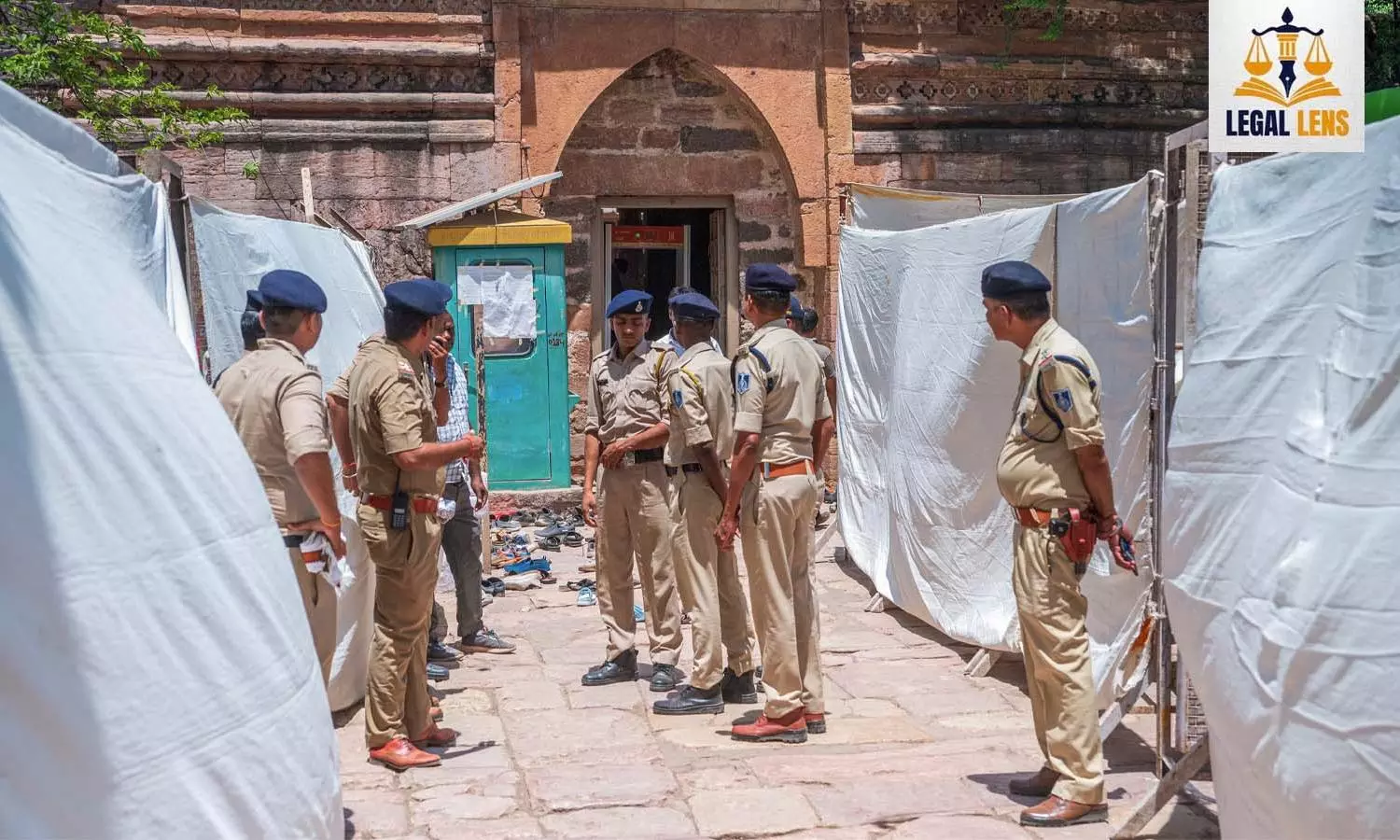
The disputed Bhojshala-Kamal Maula Mosque complex at Madhya Pradesh's Dhar district has hosted Friday namaz, under one State arrangement or another, for the better part of nine decades. It was also on a Friday (May 15) that two judges of the Madhya Pradesh High Court at Indore held the practice impermissible.
The Bench has invited the Muslims of Dhar to apply to the state government for land elsewhere in the district to build a mosque. The structure stays. The custody stays. What changes is who can pray inside it.
The verdict, delivered by Justices Vijay Kumar Shukla and Alok Awasthi, declares the Bhojshala-Kamal Maula Mosque complex at Dhar to be a temple of Goddess Vagdevi, or Saraswati. It quashes an Archaeological Survey of India order of April 7, 2003, which had set Friday namaz for Muslims and Tuesday puja for Hindus. That order built on a Collector’s order of 1997 and an ASI direction of 1998. The arrangement it crowned is now gone.
1991 law failed to end dispute
The Places of Worship (Special Provisions) Act, 1991 was passed to settle exactly this kind of question. It froze the religious character of every place of worship in the country as it stood on August 15, 1947. It forbade conversion. It extinguished all pending suits seeking to change a site’s character. It made breach a jailable offence.
The Supreme Court in its Ayodhya judgment called the Act a basic feature of the secular Constitution, beyond ordinary amendment.
Also read: HC says Bhojshala complex is Hindu temple; what's the row all about?
The Act, however, carved out two exceptions. Ayodhya was one. The other was sites already protected as ancient monuments under a 1958 statute, the Ancient Monuments and Archaeological Sites and Remains Act. Bhojshala has been a centrally protected monument since 1904. It falls within that second exception.
The reading converts a narrow exemption into a broad route. Any monument more than a century old could be made the subject of a fresh religious-character claim.
The exception was meant to be narrow. Antiquities law had to keep working on protected monuments without being trumped by the 1991 freeze. It was a housekeeping carve-out, not a separate jurisdiction in which the religious character of sites could be re-determined.
The Indore Bench has read it as a separate jurisdiction. Once Bhojshala was held to be outside the 1991 Act, the Court turned to Section 16 of the 1958 Act. That section says a protected place of worship cannot be used for any purpose inconsistent with its character. The Bench declared the site’s character to be that of a temple. The 2003 ASI order permitting namaz was held inconsistent with that character. It was quashed.
The reading converts a narrow exemption into a broad route. By that route, any monument more than a century old can be made the subject of a fresh religious-character claim. Most contested sites in India are more than a century old.
Where the reasoning is weakest
The finding that the building was originally a temple rests on the ASI’s 2024 survey. That survey reported that the existing structure was assembled from parts of earlier buildings. Decorated pillars and pilasters had been reused while building the colonnades. That much is uncontested. The same finding has been on the record since the late 19th century.
Also read: Bhojshala dispute: CPI(M) says MP High Court ruling could deepen religious divisions
But how a building was constructed is not the same as how it has been used. The pillars do not match in style. They show no consistent pattern. The structure does not look like a coherent temple any more than it does a coherent mosque.
A reading under which a pre-2024 filing escapes the restraint hollows it out. Every Mathura, Gyanvapi, and Sambhal proceeding is, in some form, pending.
It is, like much medieval Indian construction, an assembly of reused fabric. To call its present religious character a temple on that basis is to let the provenance of stone overrule the practice of worship at the site.
Fact vs displacement
The Court also treats Hindu worship at the site as a fact never extinguished, and Muslim worship as a displacement to be remedied with land elsewhere. The record makes that asymmetry difficult.
The Bench’s own tabulation of pre- and post-Independence notifications includes an order issued by the Dhar State on August 24, 1935. That order dedicated Bhojshala as a mosque for offering namaz.
The Court invalidates it on three grounds. First, it says, the Government of India Act, 1935 was not yet in force on that date. Second, Bhojshala had already been a protected monument from 1904. Third, the order was an executive arrangement of a princely state, not a piece of legislation, and so cannot survive the Constitution.
None of those grounds disturbs the underlying fact. The Dhar State, then the competent authority over the site, formally recognised Muslim worship there in 1935. To hold that recognition without legal force does not erase the fact. It only refuses to attach consequences to it.
The ruling has not protected the monument’s history. It has chosen one chapter of it, and asked the rest of the country to forget the others.
The Tuesday-Friday split itself traces to a Collector’s order of 1997. The ASI codified it in 1998. In 2003 the ASI extended it to permit Hindu Tuesday worship in addition to Basant Panchami. The Bench also records the 1985 gazette of the site as Jama Masjid, Dhar. It rejects that gazette on the ground that no material shows the property was waqf.
To call one community’s worship continuous and the other’s displacement is to choose, on a record that includes more inheritance than the framing allows.
Way around SC’s Dec 2024 restraint
In December 2024, after the Sambhal violence and the Gyanvapi proceedings, the Supreme Court issued a corrective. It restrained all lower courts from passing effective or final orders in disputes touching the religious character of existing structures. It also barred fresh suits. The order was meant to buy time while the apex court itself heard the question.
Also read: Supreme Court allows Hindu and Muslim prayers at Bhojshala complex
That order has not held at Bhojshala. The Indore Bench held it inapplicable on two grounds. First, the Hindu Front for Justice writ was filed in 2022, before the December restraint. The restraint, the Bench said, does not operate retrospectively. Second, on January 22, the Supreme Court had itself remanded the matter to the High Court. The bench that did so had its own earlier order on the record.
Both grounds are fragile. The December order did not exempt pending cases. It directed that in pending suits, no effective or final orders should be passed. The whole point of that wording was to cover pending cases.
A reading under which a pre-2024 filing escapes the restraint hollows it out. Every Mathura, Gyanvapi, and Sambhal proceeding is, in some form, pending. The January remand was procedural and addressed Basant Panchami arrangements. It did not, on its face, override the substantive embargo. The Supreme Court will now have to decide whether it did.
Prior plan worth preserving?
There was a defensible reading of this site under which no community wins, and none loses. The arrangement that ran from 1998 through 2003 was an attempt at that reading. Muslims on Fridays, between 1 and 3 in the afternoon. Hindus on Basant Panchami, and since 2003, also on Tuesdays.
The arrangement was clumsy, often contested, occasionally inflamed. But it was workable. It honoured both communities’ attachment to the structure without asking the State to elect between them. Its imperfections were remediable: Clearer access protocols, codified hours, sensitive-day policing.
Also watch: ASI's findings on the Bhojshala-Kamal Maula mosque complex
The 1958 Act itself imagines this kind of co-existence. It allows places of worship to continue as places of worship within protected complexes. Section 16 does not require a single denomination. Where two communities have prayed at the same site, the character to be preserved is the composite character that has actually existed there. To narrow that character to one denomination is a reading choice, not something the text compels.
What happens next?
The judgment will go up. The Supreme Court will have to decide whether the 1958 Act’s exemption can carry the weight the Indore Bench has put on it. Whether the December 2024 restraint applies to writ petitions filed before that date. Whether the Ayodhya verdict, which the Ayodhya Bench itself warned was specific to that one dispute, can serve as a template elsewhere.
Until those answers come, the loss is one of inherited civility. Bhojshala has stood at Dhar for nearly a thousand years. It has been a centre of Sanskrit learning. It has been a mosque. It has been both.
The order before us now fixes its character as one of these, and offers the other community a plot elsewhere. That has not protected the monument’s history. It has chosen one chapter of it, and asked the rest of the country to forget the others.