



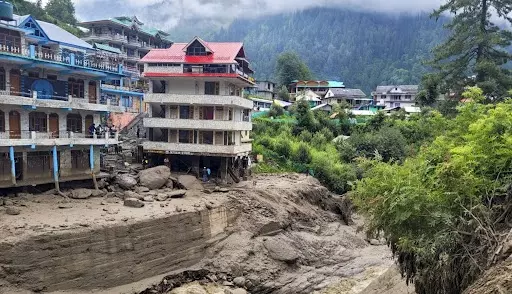
As climate disasters increase in Himalayas, Himachal proposes scientific study
After repeated cloudbursts, floods and landslides, state government moves to assess glacier melt, evaporation losses and growing climate risks in the Himalayan region

The Himalayas, India’s most significant mountain range, support climate, biodiversity, glaciers, livelihoods, and geodiversity. Home to some of the world’s highest peaks, they also play a critical role across South Asia, influencing monsoon floods, rains, and river systems.
For the past few years, the Himalayas have become the epicentre of major disasters and extreme weather events like cloudbursts, torrential rains, floods, droughts, erratic snowfall, avalanches, and rising winter temperatures, all notable signs of climate change and human-induced factors.
Also read: Massive portion of Himachal hill swept away after landslide
Over the past two and a half years, Himachal Pradesh has witnessed a series of monsoon disasters, a trail of deaths, destruction, population displacements, and loss of livelihood.
Effects of climate change
As per data released by the Himachal Pradesh State Disaster Management Authority (SDMA) and State Emergency Operation Centre (SEOC), the state experienced unprecedented destruction, with cloudbursts, flash floods, and landslides causing severe damage.
The state recorded 46 separate cloudburst incidents during the monsoon season in 2025. The worst-affected areas were Mandi, hard hit by 19 cloudbursts, followed by Kullu (12) and Chamba (6). Shockingly, as many as 10 cloudbursts happened in a single day in Mandi’s Seraj area, one of the remotest belts, causing severe damage to the local population.
Also read: Himachal Pradesh floods: 617 roads closed, over 400 rescued
The government assessed economic loss between Rs 4,000 crore and Rs 4,800 crore. The 2025 monsoon alone claimed around 448 lives, erasing several villages, fields, orchards, and houses, apart from public infrastructure, including roads, bridges, drinking water supply schemes, and electricity supply lines.
The scale of destruction, according to Chief Minister Sukhwinder Singh Sukhu, was significantly larger than the 2023 floods, even though the number of fatalities was lower due to improved pre-emptive measures.
Study on glacier-melting rate
The growing vulnerability of the state to disasters and extreme weather events has indeed compelled the government to prepare for future weather-related tragedies and to find scientific solutions to reduce the risks of climate change for hill communities.
Also read: Himalayas in high quake-risk zone as India unveils new seismic zonation map
Alarmed over the situation, the Himachal Pradesh government has decided to conduct a comprehensive scientific study to analyse the rate of glacier melting and its implications for flood management. It is believed that glacier melt will adversely affect the ecosystem and disrupt the natural environmental balance in Himachal Pradesh.
“It’s scientifically proven that the glaciers are melting at an accelerated rate due to rising temperatures and large-scale infrastructure projects, including the construction of roads, highways, and vehicular mobility to places close to the snowline and glaciers. There is an urgent need to have a scientific idea of how long the glaciers will sustain our rivers and hydropower projects,” said Ramsubhag Singh, Chief Minister’s Principal Advisor.
Data-driven study
A retired chief secretary said the government will appoint a team of scientists from different national and international institutions, reputed organisations and engaged young scientists to undertake the study.
“Overall, this initiative is aimed at generating data-driven insights that will help the government optimise water resources, safeguard energy production from hydroelectric projects, protect glaciers, and enhance long-term resilience against climate-related challenges,” he said.
Impact of evaporation rate
Equally significant will be the study on water evaporation from various dams and reservoirs in the state, especially during the summer season. Lately, the state has started noticing an increased level of haze in different cities of the state, which is also a matter of concern.
For example, the town of Bilaspur, a mid-Himalayan region next to Govind Sagar reservoir, a man-made lake created by the construction of Bhakra Dam in 1963, experiences persistent haze after morning hours as a consequence of the 1963 Bhakra Dam construction, even when other parts of the state are clear.
Also read: Char Dham project pushing Himalayas to catastrophe, warns its ex-chairman
The proposed study will examine whether there is any correlation between water evaporation from reservoirs and the rising incidence of cloudbursts.
By analysing meteorological data such as temperature, solar radiation, wind speed, and humidity, this study will assess evaporation rates in major dams. Special attention will be given to seasonal fluctuations, with an emphasis on the high-evaporation summer season and its impact on water availability.
“Quantifying actual water losses will help authorities understand how much stored water is being lost before it can be used for drinking, irrigation, power generation, or ecological needs,” said Ramsubhag.
The data available with the HP Department of Environment and Climate Change reveals that the Indian Himalayan Region (IHR) has around 17 per cent of its region under permanent snow cover and glaciers. About 30-40 per cent under seasonal snow cover, forming a unique water reservoir.
Need for urgent attention
The Chief Minister said he will soon initiate a technical and scientific assessment of Himachal Pradesh’s ecological contribution to the nation’s environment. Some studies suggest it could well be around Rs 90,000 crore annually.
Dr Suresh Attri, Joint Member Secretary, Department of Environment, Science, Technology, and Environment, Himachal Pradesh, endorses this view, emphasising the urgent need for a comprehensive study to quantify the state's environmental services.
Also read: Himalayas to lose 75 per cent of snow by 2100 leading to eco disaster
“The state is increasingly under stress due to climate change, unplanned exploitation of natural resources, and other related pressures. Rising temperature, altered precipitation, episodes of drought, extreme weather events, landslides, cloudbursts, and hazards should alarm planners,” he explained.
This is threatening the very survival of indigenous upland communities. There are also fears about its impact on the lives and livelihoods of downstream populations within the Himalayan region and beyond. The Himalayan ecosystem requires urgent and focused attention to ensure its long-term sustainability. A holistic, science-based approach to conservation, sustainable resource management, ecological planning, and adaptation is the only way out.